Simple Italy

Celebrating Your Inner Italian

  • Home
  • Contact us
  • Links

Enchanted Wisteria

Posted April 19, 2010 by Sharon 2 Comments

All my gardenista friends assured me that wisteria cannot, actually will not, die.

“Sharon,” they warned, “it will take over your pergola. . . your roof. . .then your entire house. Eventually you will be trapped in a maximum security wisteria prison.”

Boy, were they wrong! The newly constructed pergola behind our sub-division home was sitting on a slab of soil as hard as concrete. Several wisteria plantings succumbed. After I had the brilliant idea to construct planter boxes for new attempts, the voles moved in to pig-out on the all-you-can-eat roots buffet.

Now, 10 years later, I am triumphant. I have not one, but two, wisteria that bloom. How I appreciate them.

Every spring when I gaze at these impossibly gorgeous pendulous blooms, I’m reminded of the film Enchanted April. It starts as Lottie the frumpy post WW I English housewife reads a newspaper advert for vacations in Italy:  “To Those Who Appreciate Wisteria and Sunshine.”

This flick is quintessential posh Brit production.  Lush settings and costumes showcase a tale of British hot house flowers—Lottie and three new acquaintances who  share the villa rental—blossoming under the Mediterranean sun.

Italy works its fatal magic on the quartet, of course.  We’d expect nothing less for those who appreciate wisteria and sunshine.

Directed by Mike Newell, this 1992 film features a stellar ensemble cast including Jim Broadbent, Miranda Richardson, Josie Lawrence, Polly Walker, Joan Plowright, Alfred Molina, and Michael Kitchen. Set in London and the Ligurian coast of Italy in 1922, this gentle comedy is love-and-life affirming.  Rent the film on Netflix or purchase a copy at amazon.
Filed Under: Culture, Film, Gardening, Lifestyle, Travel Tagged With: Enchanted April, Gardening, Italy, wisteria

Cacciucco

Posted March 22, 2010 by Sharon 8 Comments

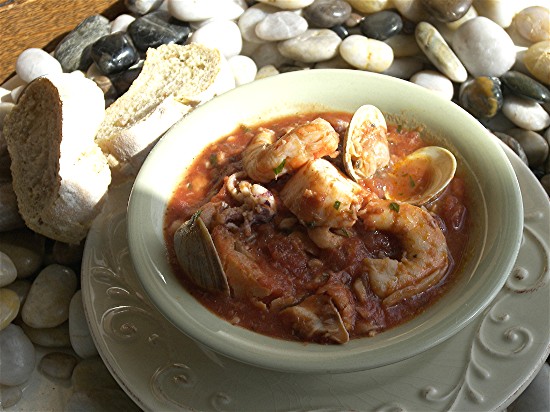
cacciucco

Every coastal region of Italy has a seafood stew. Tuscany— or more specifically the port town of Livorno—has cacciucco (ka-CHOO-ko). While the word is fun to pronounce, the dish is even more pleasurable to eat.

I yearn for cacciucco in the spring. It was in primavera that I first tasted cacciucco at Trattoria Benvenuto in Florence and I haven’t been the same since.

Some say the dish must have at least five types of seafood to correspond to the five Cs in the word. The more fish and shellfish, the better the flavor. And select good quality red wine and artisanal quality bread with good texture to soak up the amazing broth.

Choose the freshest fish available. Use one type or as many as three or four, to comprise 2 pounds. Sea bass, monkfish, cod, halibut, swordfish, shark, tilapia, turbot, catfish, or red snapper are all good choices.

As for the shellfish, in this recipe, I’m using littleneck clams and shrimp but baby calamari, octopus, mussels, or scallops may be substituted.

Cacciucco

Serves 6 to 8

3/4       cup olive oil
1          large red onion, coarsely chopped
4          large cloves garlic, minced
1 1/2    teaspoons dried crushed red-pepper flakes
1           cup dry red wine
1        can (28 ounces) crushed plum tomatoes
1/2       cup minced fresh flat-leaf parsley, divided
1 1/2 teaspoons salt
24       littleneck clams
24                medium or large unpeeled shrimp
2 to 2 1/2         pounds mild white-fleshed fish fillets, cut in 2-inch chunks
3          cups cold water
6 to 8 thick slices Rustic Bread, toasted

Heat the oil in a 6-quart Dutch oven over medium heat. Add the onion, garlic, and pepper flakes. Cook, stirring occasionally, for 10 minutes or until soft. Add the wine. Increase the heat to medium-high. Cook at a brisk simmer for 5 minutes or until the wine no longer smells of alcohol. Add the tomatoes, all but 2 tablespoons of the parsley, and salt. Bring to a boil then reduce the heat until sauce simmers gently. Cover and cook for 10 minutes, stirring occasionally, for the flavors to blend.

Add the clams and shrimp; stir. Add the fish and stir gently. Increase the heat to high. Cook for 2 minutes or until liquid starts to bubble. Add the water. Cover and reduce the heat so the mixture simmers but does not boil. Cook for 10 minutes or until the clams open and the other seafood is opaque in the center. Discard any clams that will not open. Spoon over bread set in pasta plates or large shallow bowls. Sprinkle with the remaining parsley.

What Italian seafood stews have you savored and where? Tell us!

Filed Under: Florence, Food, Italian seafood, Language, Mediterranean diet, Recipes, Tuscan cooking Tagged With: cacciucco, Italian seafood recipe, Italian seafood stew, Livorno

Giotto Anew

Posted March 8, 2010 by Sharon Leave a Comment

A statue of the artist and architect Giotto stands outside the Uffizzi Gallery in Florence.

A statue of the artist and architect Giotto stands outside the Uffizzi Gallery in Florence.

Art restorers using ultra-violet rays are seeing rich original details of Giotto’s paintings in the Peruzzi Chapel in the Basilica di Santa Croce in Florence that have been hidden for centuries, according to an exclusive just-released story from Reuters news service.

The dry painted frescoes, said to have influenced Michelangelo, had been whitewashed and then badly repainted over the course of centuries.

Reporter Philip Pullella describes one panel of the Giotto viewed under ultra-violet light, “In the scene where God is accepting John the Evangelist into heaven, the wrinkles in John’s forehead, the threads of his beard, the whites of his eyes and God’s welcoming gaze appear like fleeting but powerful visions.”

Giotto di Bondone, known simply as Giotto, painted in the late 1200s and early 1300s throughout central Italy. His work was seminal in moving artists away from the stiff portrayls in Byzantine paintings to the more humanistic renderings of the Renaissance.

Filed Under: Culture Tagged With: art history, Basilica di Santa Croce, Giotto, Italian art, Peruzzi Chapel, Phillip Pullella, Reuters

Ragú

Posted February 16, 2010 by Sharon 1 Comment

raguRagú is the Italian term for long-simmered, mellow meat sauce that dresses pasta or polenta. It varies from region to region, sometimes prepared with large chunks of meat, sometimes with ground, or more properly, finely minced meat.

I’ve sampled ragú of duck, rabbit, mixed meats, and sausages and have never encountered one that failed to satisfy my appetite. Arguably the most renowned of Italian meat sauces is ragú alla bolognese from the storied food city of Bologna. It is classically prepared with a combination of chopped beef, veal, or pork, and, in the good old days, was finished with heavy cream. Milk is now more often used.

Finely chopping onion, celery, and carrot into a mxiture called a battuto is the first step in making a ragu.

Finely chopping onion, celery, and carrot into a mxiture called a battuto is the first step in making a ragu.

Ragú alla bolognese is not as tomatoey as the meat sauces of the south that influenced Italian American sauces. The tomato acidity in a bolognese is balanced by the sweetness of the sautéed aromatic vegetables—the soffrito, or flavor base.

The soffrito should be lightly caramelized but not browned. This sauteed vegetable mixture is the flavor base of ragu.

A properly cooked soffrito is one of the secrets to a divine ragu.

It’s essential to cook the soffrito slowly to lightly caramelize the vegetables without browning them. I like to remove the soffrito from the pot so the meats can brown without the steam created by the veggies.

[Read more…]

Filed Under: Bologna, Food, Recipes Tagged With: Bologna, italian food, Italian meat sauce, italian recipes, ragu, ragu alla bolognese

Why Italians Love To Talk About Food

Posted January 20, 2010 by Sharon 3 Comments

Photograph of Elena Kostioukovitch by Massimo Pasquale

Photograph of Elena Kostioukovitch by Massimo Pasquale

Elena Kostioukovitch is not Italian. She was born in Kiev, Ukraine. But Kostioukovitch is deeply in touch with her Inner Italian. How do I know? I’ve been reading Why Italians Love to Talk About Food, the Farrar, Straus and Giroux publication of her book.

Kostioukovitch’s day job is to translate the literary works of Umberto Eco and other authors into the Russian language. Also an essayist and literary agent, she has lived in Milan for more than two decades. She explains in the preface to her 400-plus page tome, “This book was born specifically to assemble in a single volume stories about the symbolic foods of each Italian region and their ‘ideological’ meanings.”

She creates an intellectual journey from the north of the peninsula to the south, exploring culinary history, characteristic dishes, and cultural eccentricities of each region. Her research is rigorous — footnotes and bibliography cover more than 30 pages.

We learn, for instance, that the aperitivo Campari was created by Gaspare Campari at the Caffè Zucca in Milan in 1867.

We practically taste the brine on our lips as we discover that the remaining wilderness of Puglia fosters in the locals a preference for unadulterated foods. “The tendency to eat unprocessed food is especially evident in the consumption of raw fish. In fish markets, for example, it is customary to set out plates of raw shrimp, cuttlefish, and mussels for customers who are waiting, to be eaten on the spot with a squirt of lemon.”

And who knew that Nutella, the jarred gianduia paste created by the Ferrero brothers in Piedmont, makes a political statement? Kostioukovitch explains, “Nutella, loved by children (naturally) and adults, was also prized by nonconformists and leftists. As Italy’s answer to [American peanut butter], it is winning, uplifting, and youthful, a sign of democracy and leftist ideals.”

Essays interspersed between the regional food chapters are quirky and informative, covering topics as diverse as the “Jews,” “Early Gifts from the Americas,” “Totalitarianism,” and “Joy.” I particularly appreciated “Preparation Methods,” a roster of dozens of cooking techniques written in sort of a shorthand code. Not much is spelled out for the Italian home cook in printed recipes—presumably the cook learned these methods at an older cook’s elbow.

“Soak prickly pears.”

“Extract the ink from cuttlefish.”

“Shape polenta in a cloth.”

“Crogiolare (bask or laze comfortably): cook a food over a slow fire, with a little liquid, for a long time.”

One word of warning: Perusing this volume can be hazardous on an empty stomach. Hunger ensues. References to Roman coda all vaccinara (oxtail stew), Neopolitan sartù, (a rice mold with giblets, mushrooms, peas and mozzarella), Ferrara’s pumpkin filled tortelli, Calabrian jujume (sea anemone fritters), Sicilian granita with brioche, and more dishes too numerous to recount will surely make you long to be dining at an Italian table.

Kostioukovitch bottom line is this: “Examining the culture of food, we also come to understand its unique ability to inspire joy and create harmony. Whether at table with family, in a restaurant with friends, or at a scientific conference—food is talked about in a language that is accessible to all, exciting to everyone, democratic and positive.”

What conversations have you enjoyed around an Italian table?

Comment below.

Filed Under: Culture, Food, Italian seafood, Language, Lifestyle, Mediterranean diet, Travel Tagged With: Elena Kostioukovitch, Italian cooking, italian food, Italian regional cooking, Umberto Eco

Bollito Misto

Posted January 17, 2010 by Sharon 3 Comments

bollitoIn northern Italy’s sub-Alpine areas, particularly Piedmont and Lombardy, Bollito Misto (mixed boil) is the culinary cure for chilly damp winters. Not so much an exact recipe as it is a ritual, the dish can include beef, veal, cotechino sausage, chicken or capon and aromatic vegetables. Tougher cuts of meat are simmered slowly in water—not actually boiled at all—for hours until they are fork tender and the resulting broth is liquid heaven. I actually crave hot broth in the cold months. I believe my body is saying, “I need to be hydrated. I need some savory steam to open my dry air passages.”

In Italy, bollito misto is typically prepared for a crowd because it takes so many different ingredients to achieve the desired flavor complexity. The broth is often ladled into bowls as a first course, sometimes embellished with tortellini and Parmesan cheese. The meats are then served separately as a secondo, or second plate, garnished with mostarda di frutta, salsa rosa, or salsa verde.

In my kitchen, I opt for a simpler version made with beef and chicken. I also cook carrots, onion, celery, and potatoes in the broth to serve with the meats. This makes a wonderful one-dish meal with plenty of leftovers for lunches.

The salsa verde may be prepared several days in advance and refrigerated in a tightly closed container. Thanks to Michele Scicolone in her cookbook 1,000 Italian Recipes for the tip on adding fresh bread crumbs to bind the salsa verde.

Bollito Misto Semplice

Makes about 8 servings

10 cups filtered water

6 cups reduced-sodium chicken broth

1 cup drained canned plum tomatoes

4 bay leaves

2 cloves garlic, peeled

1/2 teaspoon dried thyme

2 1/2 to 3 pounds beef top round or chuck

1 broiler-fryer chicken (3 1/2 to 4 pounds), quartered

4 carrots, cut into 3-inch lengths

4 ribs celery, cut into 3-inch lengths

1 1/2 pound red potatoes, quartered if large

1 large onion, cut into wedges

Salt and pepper

Minced parsley (optional)

Salsa verde (recipe follows)

Mostarda di frutta

In a 10 to 12-quart pot, bring the water, broth, tomatoes, bay leaves, thyme and garlic to a boil. Add the beef. Reduce the heat so the mixture simmers. Cover partially and simmer for 2 hours.

Add the carrots, celery, and onion to the pot. Cover partially and simmer for 1 hour. Add the chicken and press to submerge until the broth. Simmer, partially covered, for about 1 1/2 hours or until the chicken is very tender. Season to taste with salt and pepper. If desired, serve a bowl of the broth for a first course. Remove and discard the bay leaves.

Remove the beef and chicken to a cutting board that has a well to catch the broth. Break into small pieces. The meat will be very tender. Transfer to plates. Surround with vegetables. Garnish with parsley if desired. Ladle on just a bit of the broth to moisten. Serve with salsa verde or mostarda di frutta on the side.

Salsa Verde

Makes 1 cup

2 cups packed parsley leaves

1/2 cup packed soft Italian bread crumbs without crust

1/4 cup drained capers in brine or soaked and rinsed salted capers

1 salted or canned-in-olive oil anchovy, filleted (note)

2 small cloves garlic

1 teaspoon Dijon mustard

1 teaspoon wine vinegar

1/2 cup extra-virgin olive oil

Salt

In the bowl of a food processor fitted with a metal blade, combine the parsley, bread crumbs, capers, anchovies, garlic, mustard and vinegar. Process until finely chopped. With the machine running, drizzle in the oil through the feed tube until smooth. Season with salt to taste. Refrigerate in a covered container.

Note

For salted anchovy, rinse well under cold running water. Place in a small dish and cover with milk. Refrigerate for at least 1 hour or up to 4 hours. Remove from the milk, rinse and pat dry before using.

For anchovy in oil, pat dry before using.

Filed Under: Food, Lombardy cooking, Piedmont cooking, Recipes, Travel Tagged With: bollito misto, Italian boiled dinner, italian recipes, Italian soups, mostarda di frutta, salsa verde

  • « Previous Page
  • 1
  • …
  • 29
  • 30
  • 31
  • 32
  • 33
  • …
  • 41
  • Next Page »
Follow Simple Italy on FacebookFollow Simple Italy on RSS
Lasagne_19 Simple Italy's Greatest Hits at a click!
Lasagne alla Bolognese and more

Recent posts

  • The Hill Towns of Molise
  • Fior di Latte Cheese
  • In the Mood for Molise, Italy
  • Silk from the Sea in Sardinia
  • Driving a Ferrari Spider

Posts by Category

  • Abruzzo (12)
  • AirBnB (1)
  • Amalfi (8)
  • Archeology (3)
  • Architecture (21)
  • Art (19)
  • Artisans (4)
  • Automobiles (1)
  • Bakery (1)
  • Basilicata (3)
  • Bologna (4)
  • Books (21)
  • Calabria (4)
  • Campania (17)
  • Cooking Classes (5)
  • Cremona (2)
  • Culture (174)
  • dreamofitaly (1)
  • Driving in Italy (2)
  • Emilia Romagna (2)
  • Ferrari (1)
  • Ferrari Museum (1)
  • Film (22)
  • Florence (30)
  • Food (134)
  • Fred Plotkin (1)
  • Friuli-Venezia Giulia (2)
  • Gardening (25)
  • Genoa (2)
  • Golf in Italy (1)
  • Guides (1)
  • History (8)
  • Hotels (14)
  • Inner Italian Q & A (11)
  • Italian seafood (7)
  • Italy Artisans (3)
  • Italy restaurants (17)
  • Language (86)
  • Le Marche (4)
  • Lifestyle (113)
  • Liguria (2)
  • Lombardy cooking (5)
  • Lucca (3)
  • Mantua (1)
  • Markets (26)
  • Mediterranean diet (55)
  • Milan (1)
  • Miscellany (86)
  • Modena (1)
  • Molise (3)
  • Mt. Etna (1)
  • Music (9)
  • Naples (2)
  • New Orleans (2)
  • Opera (1)
  • Palermo (3)
  • People (3)
  • Photography (4)
  • Piedmont cooking (1)
  • Puglia (9)
  • Quotes (4)
  • Recipes (64)
  • Rome (8)
  • Salerno (3)
  • Sardinia (4)
  • Sicily (15)
  • Test Drive (1)
  • Testimonials (2)
  • Travel (110)
  • Trentino Alto-Adige (1)
  • Tuscan cooking (17)
  • Tuscany (30)
  • Venice (2)
  • Videos (2)
  • Wine (23)

Inside SimpleItaly

  • American Couple Marries Italian-Style
  • Appearances
  • Contact us
  • Cooking Up an Italian Life
  • Le Marche Tour with Luisa
  • Links
  • Palazzo Donati Sample Itinerary
  • Palazzo Donati Tours
  • Privacy and Site Policies
  • Publications and TV
  • Sharon’s Inner Italian
  • SimpleItaly Adventure in Tuscany Tour
  • Thank You
  • Walter’s Inner Italian

Tags

Abruzzo bucket list Florence Gardening gelato Genoa Inner Italian Italian cooking italian culture italian food Italian food stores italian language italian lifestyle italian markets Italian music Italian pasta recipe italian recipes Italian tourism italian travel italian wine Italy Italy travel Lago di Como Lake Como Malika Ayane Mediterranean diet mozzarella di bufala Naples tourism Paestum Paolo Conte porcini Puglia Rome Santa Croce Sardegna Sardinia Sicily Southern Italy Stile Mediterraneo Sulmona Tuscan cooking Tuscany Uffizi Gallery Villa Pipistrelli women and travel