Simple Italy

Celebrating Your Inner Italian

  • Home
  • Contact us
  • Links

Sara Jenkins Respects Italian Food

Posted September 9, 2011 by Sharon 3 Comments

Regional Italian dishes rely on specialized ingredients like superfino rice to make a characteristically creamy risotto.

Chef Sara Jenkins, of NYC’s Porchetta and Porsena, writes in Atlantic magazine that Italian cooking has too often been shoved in the back seat behind haute French cuisine and even nouvelle Spanish.

She works to change that perception and hits upon two essential points.

First, there is no such thing as Italian cuisine. There are many Italian regional cuisines.

Second, the reverence for fine food in Italy is democratic. The plumber and the professor both appreciate and know good cooking.

Grazie, Sara.

Here’s her article.

Filed Under: Culture, Food, Italy restaurants, Mediterranean diet Tagged With: Italian cuisine, Italian regional cooking, Porchetta restaurant, Porsena restaurant, Sara Jenkins

Sizzling Melon Salad

Posted August 19, 2011 by Sharon 5 Comments

Sweet garden cantaloupes ready for the picking.

Lovely Lisa, the neighborhood queen of zucchini and tomato cultivation, has diversified this season. She’s growing cantaloupes and I think she’s on to something. One plant is bearing enough sweet, juicy orbs to supply an entire block of freeloading friends.

I picked two cantaloupes and let them to ripen for several days in a cardboard box filled with tomatoes, peaches, and other fruit sitting on the kitchen counter. The rind beneath the webbing actually turned a lovely yellow, something I’ve never seen with store-bought melons. I could actually detect the scent of cantaloupe!

Lovely Lisa and her husband Dr. Bill host an annual pool party so the time seemed ripe to showcase her home-grown cantaloupe in my pot-luck dish. I wanted something more exciting than the classic prosciutto and melon (not that there’s anything wrong with that.)

I remembered a Southeast Asian mixed melon salad recipe from Susan Feniger and Mary Sue Milliken of Border Grill fame. It’s a vivid mélange of lime juice, sugar, hot chiles, and mint.

Hmmm, how to Italianize it? [Read more…]

Filed Under: Calabria, Food, Gardening, Mediterranean diet, Recipes Tagged With: cantaloupe recipe, cantaloupe salad, Italian cantaloupe, sweet and hot cantaloupe salad

Bellezza Gelato Caffe

Posted August 11, 2011 by Sharon 4 Comments

News of great gelato spreads faster than a melting cone.

I heeded the journalistic “rule of three.” My instincts said, “If you’ve heard about Chicago’s Bellezza Gelato Caffe from three sources, you should check it out.”

• As I devoured a recent Wall Street Journal article on the finest gelati in Sicily, I noticed a “Local Scoops” sidebar that cited Bellezza Gelato Caffe  as one of the four best in the U.S.

• A few days later, on my Facebook news feed, my Chi-town buddy Bill “fun is my middle name” Linden announced he was taking his nieces and nephews to Bellezza.

• My husband’s baby brother Michael, no slouch on the insider foodie circuit, mentioned that Bellezza was the real deal.

Fate played a winning hand in my research because a visit to Windy City relatives was already on the calendar.

Walter, Tess, and I snuck out on a searing Friday afternoon to Harlem Avenue on the city’s far west side. Bellezza, tucked into a tiny shopping strip, looked modest as we pulled into the parking lot.

Once inside,  the voices of Italian crooners filled the air as we were drawn like magnets to the sleek display cases.

Italian-style case--sleek as a Ferrari.

One silken spoonful is all it takes to feel as if you're in Florence, Rome, or Palermo.

We were greeted by Maria Di Nunzio and Tim Ashorian, corporate dropouts turned gelateria proprietors. They glow with the joy of sharing one of life’s simple pleasures.

They explained that their gelato is prepared from all natural ingredients with no artificial colors, emulsifiers, or additives. The pistachio, for instance is pale compared to the typical dyed neon green version, but the flavor is pistachioissimo.

Gelato tastes so vibrant for several reasons. The fat content is lower than ice cream. Because fat coats the palate and dulls the perception of flavor, gelato tastes more intense. It also has less air whipped into it (the technical term is “over run”) and is stored and eaten at a slightly warmer temperature which also lets the flavors pop.

“Would you like to sample any flavors?” Maria asked. Si, si, si. Lemon sorbetto, classic cannoli, Capri coconut . . . all delightful.

The adorable Tess ordered a combo shake of flavors Dutch Chocolate Delight and Strawberry. Walter asked for a bowl with half vanilla and half coffee. As a coffee fiend, I had no choice but to select the Affogato, touted on a countertop chalkboard.

Tim and Maria, aka l'angeli del gelato!

Affogato means “drowned” in Italian and in this specialty, a scoop of gelato (I chose vanilla) sits on a squirt of syrup (I chose caramel) and then gets “drowned” with a shot of freshly-brewed espresso followed by whipped cream and some chocolate shavings.

Maria told us that she and Tim researched specialty gelato dishes and Affogato appealed to them. Their clients have agreed. She believes it’s from Tuscany. I couldn’t find any background information on gelato l’affogato al caffè in any of my Italian culinary reference books, yet a search on Google.it produced 110,000 hits. I’m thinking the Affogato may be a recent–and brilliant–invention.

This recipe on the illy site is classic and would be easy to do at home (although I cannot guarantee it will be as divine as Bellezza’s). It calls for 2 small scoops of vanilla gelato (chocolate or fiordilatte are mentioned as acceptable alternates) drowned with an espresso lungo (brewed with slightly more water than a regular espresso) topped with whipped cream and chocolate shavings.

If you should find yourself in Chicago, or more likely stuck at O’Hare Airport which is a mere 8-mile taxi ride from Bellezza Gelato Café, please have an Affogato for me.

Is Affogato a gelato dish or a drink. . .or both?


Have you savored gelato l’affogato al caffè?

Do you know where it originated?


Filed Under: Food, Lifestyle, Travel Tagged With: affogato, Chicago gelato, coffee gelato, gelato, gelato specialties, Italian gelato, O'Hare International Airport

Peaches in Wine

Posted August 2, 2011 by Sharon 9 Comments

Pesche in vino are an essential accessory for an Italian summer.

As sweet as a child’s hug and as cool as a spray from the sea, peaches in chilled wine is the Italian cure-all for a sweltering summer.

Choose fruit–yellow or white–that’s locally grown and lusciously ripe. Peel the peaches by submerging them in boiling water for 30 seconds before soaking in ice water for one or two minutes. The skin will practically shed itself.

Slice the peaches into a bowl and pour on enough dry white wine, sparkling wine, or fruity red wine to cover. Sprinkle on a little sugar if you like. Refrigerate for several hours—long enough so you can’t tell where the peaches end and the wine begins.

If you can wait for evening dessert, spoon the pesche in vino into a frosted wine glass. On heat advisory days, you may have to spear a slice or two every time you pass the frig.


Filed Under: Food, Language, Lifestyle, Recipes, Wine Tagged With: Italian peaches in wine, Italian summer dessert, pesche in vino

Spaghetti Al Farouk

Posted June 20, 2011 by Sharon 4 Comments


As I meandered through the recipes of The Glorious Pasta of Italy by Domenica Marchetti, with France Ruffenach’s sensual photographs, my appetite revved from 0 to 60 in no time.

What to savor first?

Mafalde with Roasted Tomatoes, Robiola, and Crushed Fennel Seeds?

Maccheroni alla Chitarra with Ragù all’Abruzzese and Palottine?

The Candy-Wrapped Tortelli with Rainbow Chard and Ricotta (whimsically named because the pasta is twisted to resemble hard candy wrappers)?

Bigoli with Spicy Sardine Sauce?

Or… BLT Bucatini?

Turns out—none of the above.

The answer presented itself definitively on page 127: Spaghetti al Farouk. It wasn’t only the spaghetti, cream, seafood, and saffron that got to me. It was the charming anecdote that seasoned the dish. The story behind the pasta reminded me of the scene in Fellini’s Amacord where the Middle Eastern potentate arrives at the Grand Hotel with his harem.

Domenica describes is like this. . .

“This is a unique dish, and one that is near and dear to my heart. When I was a girl, my family owned a beach house on Abruzzo’s Adriatic coast. I have many wonderful memories of whiling away summer days on the beach with friends and enjoying late-night marathon meals that featured freshly caught local seafood. One of our favorite restaurants was right on the beach. My memory says it was on the outskirts of the port city of Pescara, but my mother swears it was in nearby Francavilla. Since she is originally from the region, I will defer to her on that detail. Neither of us remembers the name of the restaurant, but we do remember that it was a casual place with a reputation for impeccable fish and seafood. One of its signature dishes was Spaghetti al Farouk, a fanciful curried pasta dish that brimmed with fresh mussels, shrimp/prawns, and pannocchie (something like crayfish or tiny lobsters.) The dish was named for the deposed Egyptian king who fled to Italy in 1952, and the sauce was spicy, silky, and a deep gold. My mother re-created the recipe in her own kitchen in the 1970s, and I still have a typed copy that she gave me. I’ve tinkered with the sauce over the years, lightening it a bit and trying different quantities of the various spices. In all honesty, I can’t tell you whether it is anything like the original—it’s been some thirty years—but I can tell you that it is a sauce like no other.

Spaghetti al Farouk

Makes 4 to 6 servings

2 tablespoons extra-virgin olive oil

1 tablespoon unsalted butter

1 large yellow onion, chopped

Large pinch of saffron threads, pounded to a powder (see cook’s note)

1 tablespoon curry powder (preferably spicy)

1/2 teaspoon ground ginger

1/4 teaspoon minced fresh thyme

1 fresh bay leaf

1/2 teaspoon kosher or fine sea salt

Freshly ground black pepper

Juice of 1/2 lemon

3/4 cup/180 ml dry white wine

1 cup/240 ml heavy/double cream

1 pound/455 g dried spaghetti

12 mussels, well scrubbed and debearded if necessary (see cook’s note)

16 large shrimp/prawns, peeled and deveined

6 ounces/170 g frozen shelled cooked langoustine tails (see cook’s note)

Bring a large pot of water to a rolling boil and salt generously.

In a frying pan large enough to hold all of the seafood, warm the olive oil and butter over medium heat. When the butter is melted and begins to sizzle, add the onion and stir to coat with the oil and butter. Sauté, stirring frequently, for about 7 minutes, or until the onion is softened but not browned. Stir in the saffron, curry powder, ginger, thyme, bay leaf, salt, and a generous grind of pepper, taking care to incorporate all of the herbs and spices. Stir in the lemon juice, raise the heat to medium-high, and pour in the wine. Let the sauce simmer briskly for about 3 minutes, or until slightly thickened. Reduce the heat to medium and stir in the cream. Bring the sauce back to a very gentle simmer. If the pasta water is not yet boiling, reduce the heat under the sauce to low and wait until the pasta water boils.

Add the pasta to the boiling water, stir to separate the noodles, and cook according to the manufacturer’s instructions until al dente. Once the pasta is in the water, proceed with finishing the sauce.

Add the mussels, shrimp/prawns, and langoustine tails to the simmering sauce, cover, and cook for 5 to 8 minutes, or until the mussels open, the shrimp/prawns are just cooked through, and the langoustine tails are heated through. Discard any mussels that failed to open.

Drain the pasta into a colander set in the sink, reserving about 1 cup/240ml of the cooking water. If the frying pan is large enough to contain both the pasta and the sauce, add the pasta to the frying pan and gently toss the pasta and sauce to combine thoroughly, adding a splash or two of the cooking water if necessary to loosen the sauce. If the frying pan is not large enough, return the pasta to the pot, add about two-thirds of the sauce, toss to combine thoroughly, and then top with the remaining sauce when serving. Transfer the dressed pasta to a warmed serving bowl or shallow individual bowls. If you are preparing individual servings, be sure to divide the seafood evenly among them. Serve immediately.

Cook’s note: Saffron

Beautiful red-gold saffron threads (zafferano) are the dried stigmas of the purple-striped flowers of the Crocus sativus plant. Saffron from Abruzzo’s Navelli plain is among the best in the world. The spice is sold in two forms, powder and threads. The powder dissolves more easily, but it is also more easily tampered with. To be sure you are getting pure saffron, buy the threads and gently pound them to a powder before using. I use a mortar and pestle for pounding, but you can also press down on the threads with a heavy object, such as the flat side of a meat pounder or mallet.

Cook’s note: Shellfish

Much of the shellfish available these days is farm raised and therefore contains less dirt and grit than shellfish harvested from the wild. To clean mussels, scrub their shells with a stiff brush under cold running water. Discard any that do not close tightly when handled. If the mussels have beards, the fibrous tufts they use to hold on to pilings and rocks, you need to remove them. Using a towel or just bare fingers, grasp the beard gently but firmly and yank it toward the shell’s hinge. This will remove the fibers without tearing the mussel meat.

Frozen langoustine tails lack the flavor of fresh ones, but they are much more readily available and they have a nice, meaty texture that captures the sauce and absorbs its flavor.

Text copyright ©2011 by Domenica Marchetti

Photographs copyright ©2011 by France Ruffenach

Filed Under: Abruzzo, Culture, Food, Italian seafood, Miscellany, Recipes Tagged With: Domenica Marchetti, Italian seafood pasta, The Glorious Pasta of Italy

La Pizza Improvvisata

Posted June 8, 2011 by Sharon 4 Comments

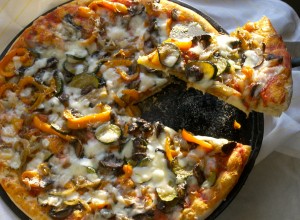
An impromptu pizza--the wonderful product of foraging.

An impromptu pizza: the wonderful product of kitchen foraging.

A recipe can be a useful thing.

A recipe is useful when we just have zilch inspiration about what to serve the in-laws.

A recipe is useful when we want to explore a cuisine that’s foreign to us. You’d better believe when I cook a Thai dish, I want some guidance from someone who’s been there.

A recipe is useful to introduce us to new and creative flavor combinations.

A recipe is useful—make that nearly essential—for a home cook baking a Sicilian cassata or any other elaborate pastry.

A recipe is useful to “visit” other cooks to see how they do things.

But is a recipe really necessary to cook?

While I make part of my living by creating, writing, testing, and editing recipes, I’m going to bite the hand that feeds me by saying, “no.”

The earliest European written recipe cook book is thought to have been created in Latin in  the 1st century. De re coquinaria is credited to the Roman gourmet Marcus Gavius Apicius. Yet modern human beings had been eating for at least 50,000 years before those recipes were written.

How?

They explored their environment . . . sniffed, tasted, applied heat, threw in some flavorful plant cuttings. They experimented. They cultivated some seeds that reproduced staple grains. They shared their learnings with family and friends. They used their physical senses with an application of common sense.

That’s what I did the other night. My weekly batch of bread dough was doing its thing while I was putting in a full day on the computer. I hadn’t planned anything for dinner. So, I did what any self-respecting human would do. I foraged.

I had the makings of a crust on hand. Such a deal! I pinched off the amount that would have been one loaf of bread and patted it into a pizza pan. (A non baker could keep purchased yeast dough on hand in the freezer for such opportunities.) In the refrigerator, I found a zucchini, half a bell pepper, a few mushrooms, an opened container of Pomi tomato sauce, and a hunk of extra-sharp Provolone cheese. I always have onions in the pantry so I sliced the onion, zuke, mushrooms, and pepper, and sautéed them in extra-virgin olive oil until they were soft and golden. I painted the crust with the Pomi, scattered on the veggies, and went crazy with the Provolone. Into a 425 degree oven for about 12 minutes and I had a triumph of woman over recipe: la pizza improvvisata.


Full disclosure: I love cookbooks. I’m a cookbook author.  I own hundreds of cookbooks. There are so many joys to be had from beautiful food books—getting dinner on the table is only one of them. But, if you are starting out in the kitchen and have no skill set to rely upon (perhaps you were raised by wolves?), I recommend cookbooks that are more than a collection of recipes, such as How to Cook Everything (Tenth Anniversary Edition) by Mark Bittman, , The New Making of a Cook by Madeleine Kamman, Ratio: The Simple Codes Behind the Craft of Everyday Cooking by Michael Ruhlman.


Filed Under: Culture, Food, Language, Lifestyle, Mediterranean diet, Recipes Tagged With: cooking without recipes, Italian pizza, pizza without a recipe

  • « Previous Page
  • 1
  • …
  • 12
  • 13
  • 14
  • 15
  • 16
  • …
  • 23
  • Next Page »
Follow Simple Italy on FacebookFollow Simple Italy on RSS
Lasagne_19 Simple Italy's Greatest Hits at a click!
Lasagne alla Bolognese and more

Recent posts

  • The Hill Towns of Molise
  • Fior di Latte Cheese
  • In the Mood for Molise, Italy
  • Silk from the Sea in Sardinia
  • Driving a Ferrari Spider

Posts by Category

  • Abruzzo (12)
  • AirBnB (1)
  • Amalfi (8)
  • Archeology (3)
  • Architecture (21)
  • Art (19)
  • Artisans (4)
  • Automobiles (1)
  • Bakery (1)
  • Basilicata (3)
  • Bologna (4)
  • Books (21)
  • Calabria (4)
  • Campania (17)
  • Cooking Classes (5)
  • Cremona (2)
  • Culture (174)
  • dreamofitaly (1)
  • Driving in Italy (2)
  • Emilia Romagna (2)
  • Ferrari (1)
  • Ferrari Museum (1)
  • Film (22)
  • Florence (30)
  • Food (134)
  • Fred Plotkin (1)
  • Friuli-Venezia Giulia (2)
  • Gardening (25)
  • Genoa (2)
  • Golf in Italy (1)
  • Guides (1)
  • History (8)
  • Hotels (14)
  • Inner Italian Q & A (11)
  • Italian seafood (7)
  • Italy Artisans (3)
  • Italy restaurants (17)
  • Language (86)
  • Le Marche (4)
  • Lifestyle (113)
  • Liguria (2)
  • Lombardy cooking (5)
  • Lucca (3)
  • Mantua (1)
  • Markets (26)
  • Mediterranean diet (55)
  • Milan (1)
  • Miscellany (86)
  • Modena (1)
  • Molise (3)
  • Mt. Etna (1)
  • Music (9)
  • Naples (2)
  • New Orleans (2)
  • Opera (1)
  • Palermo (3)
  • People (3)
  • Photography (4)
  • Piedmont cooking (1)
  • Puglia (9)
  • Quotes (4)
  • Recipes (64)
  • Rome (8)
  • Salerno (3)
  • Sardinia (4)
  • Sicily (15)
  • Test Drive (1)
  • Testimonials (2)
  • Travel (110)
  • Trentino Alto-Adige (1)
  • Tuscan cooking (17)
  • Tuscany (30)
  • Venice (2)
  • Videos (2)
  • Wine (23)

Inside SimpleItaly

  • American Couple Marries Italian-Style
  • Appearances
  • Contact us
  • Cooking Up an Italian Life
  • Le Marche Tour with Luisa
  • Links
  • Palazzo Donati Sample Itinerary
  • Palazzo Donati Tours
  • Privacy and Site Policies
  • Publications and TV
  • Sharon’s Inner Italian
  • SimpleItaly Adventure in Tuscany Tour
  • Thank You
  • Walter’s Inner Italian

Tags

Abruzzo bucket list Florence Gardening gelato Genoa Inner Italian Italian cooking italian culture italian food Italian food stores italian language italian lifestyle italian markets Italian music Italian pasta recipe italian recipes Italian tourism italian travel italian wine Italy Italy travel Lago di Como Lake Como Malika Ayane Mediterranean diet mozzarella di bufala Naples tourism Paestum Paolo Conte porcini Puglia Rome Santa Croce Sardegna Sardinia Sicily Southern Italy Stile Mediterraneo Sulmona Tuscan cooking Tuscany Uffizi Gallery Villa Pipistrelli women and travel