Simple Italy

Celebrating Your Inner Italian

  • Home
  • Contact us
  • Links

La Pizza Improvvisata

Posted June 8, 2011 by Sharon 4 Comments

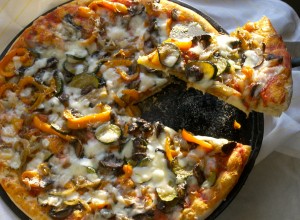
An impromptu pizza--the wonderful product of foraging.

An impromptu pizza: the wonderful product of kitchen foraging.

A recipe can be a useful thing.

A recipe is useful when we just have zilch inspiration about what to serve the in-laws.

A recipe is useful when we want to explore a cuisine that’s foreign to us. You’d better believe when I cook a Thai dish, I want some guidance from someone who’s been there.

A recipe is useful to introduce us to new and creative flavor combinations.

A recipe is useful—make that nearly essential—for a home cook baking a Sicilian cassata or any other elaborate pastry.

A recipe is useful to “visit” other cooks to see how they do things.

But is a recipe really necessary to cook?

While I make part of my living by creating, writing, testing, and editing recipes, I’m going to bite the hand that feeds me by saying, “no.”

The earliest European written recipe cook book is thought to have been created in Latin in  the 1st century. De re coquinaria is credited to the Roman gourmet Marcus Gavius Apicius. Yet modern human beings had been eating for at least 50,000 years before those recipes were written.

How?

They explored their environment . . . sniffed, tasted, applied heat, threw in some flavorful plant cuttings. They experimented. They cultivated some seeds that reproduced staple grains. They shared their learnings with family and friends. They used their physical senses with an application of common sense.

That’s what I did the other night. My weekly batch of bread dough was doing its thing while I was putting in a full day on the computer. I hadn’t planned anything for dinner. So, I did what any self-respecting human would do. I foraged.

I had the makings of a crust on hand. Such a deal! I pinched off the amount that would have been one loaf of bread and patted it into a pizza pan. (A non baker could keep purchased yeast dough on hand in the freezer for such opportunities.) In the refrigerator, I found a zucchini, half a bell pepper, a few mushrooms, an opened container of Pomi tomato sauce, and a hunk of extra-sharp Provolone cheese. I always have onions in the pantry so I sliced the onion, zuke, mushrooms, and pepper, and sautéed them in extra-virgin olive oil until they were soft and golden. I painted the crust with the Pomi, scattered on the veggies, and went crazy with the Provolone. Into a 425 degree oven for about 12 minutes and I had a triumph of woman over recipe: la pizza improvvisata.


Full disclosure: I love cookbooks. I’m a cookbook author.  I own hundreds of cookbooks. There are so many joys to be had from beautiful food books—getting dinner on the table is only one of them. But, if you are starting out in the kitchen and have no skill set to rely upon (perhaps you were raised by wolves?), I recommend cookbooks that are more than a collection of recipes, such as How to Cook Everything (Tenth Anniversary Edition) by Mark Bittman, , The New Making of a Cook by Madeleine Kamman, Ratio: The Simple Codes Behind the Craft of Everyday Cooking by Michael Ruhlman.


Filed Under: Culture, Food, Language, Lifestyle, Mediterranean diet, Recipes Tagged With: cooking without recipes, Italian pizza, pizza without a recipe

La Bella Lingua

Posted April 1, 2011 by Sharon 2 Comments

Brava, Dianne Hales!

The American author was recently knighted by the president of Italy, Giorgio Napolitano.

Three years ago, Hales was a hard-working journalist, author of a college textbook on health, among many other works. Today, she’s a rock star among Italian linguists.

Perché? (Why?)

Perché (because) Hales’ wrote La Bella Lingua, a nearly 300-page omaggio to the Italian language. For more than 20 years, Hales had kept her Inner Italian a secret. I       know I’m not alone in saying, grazie, Signora Hales, for going public with your magnificent obsession.

With humor, grace and curiosity, Hales leads us on un’avventura molto divertente (a very entertaining adventure). Whether fighting back her nervousness at interviewing    the president of La Crusca–Italy’s most august language academy–or mixing it up with comic actor and director Roberto Benigni–who put her at immediate ease by addressing her in the familiar tu—Hales’ bella figura is luminous.

She writes:

“Somewhere en route to fluency, I turned into Diana, pronounced Dee-ahn-aah, and entered a parallel universe where I wear my heels higher and my necklines lower, dance barefoot under the Tuscan moon, and swim in island coves so blue that the Italians say the color twice: azzurro-azzurro.”

Hales inspires all of us who aspire to “become Italian, one word at a time.”

Visit Hales’ site or check out the book on amazon.com.

Filed Under: Culture, Language, Travel Tagged With: Dianne Hales, italian language, l'italiano

Colin Firth’s Inner Italian

Posted March 2, 2011 by Sharon 11 Comments

Italian film director and producer Livia Giuggioli with her husband British actor Colin Firth.

Like an astronomer discovering a new star or a botanist finding a new plant species, when I uncover a previously unknown Inner Italian, my heart races.

British actor Colin Firth took home the Best Actor Oscar on Sunday night for his role in the film The King’s Speech. But, far more impressive, to me, is his connection to bel’italia.

Thanks to a Diario Di Una Studentessa Matta post by Melissa Muldoon, my amica in the blogosphere, I learned that Firth speaks beautifully in Italian. She posted a video clip from the Red Carpet where the typically stiff-upper-lip actor jokes in Italian with a reporter whom he knows.

In the blink of an eye, he becomes more warm and animated than I’ve ever seen him onscreen.

The link to Firth’s Inner Italian is his gorgeous wife Livia Giuggioli whom he married in 1997. Giuggioli is a director, documentary film producer, environmentalist, eco-entrepreneur, and mother of two sons with Firth.

According to the New York Post, “Livia’s ‘Green Carpet Challenge,’ for which she dolled up in 100 percent eco garb and jewels to each of a number of award shows, had its climactic finale Sunday night as she strolled down the carpet in a gown assembled from 11 different vintage frocks—some, appropriately, dating back to the reign of King George VI.”

In an interview several years ago with The Independent, Firth commented on his Italian language skill. “Her English is better than my Italian will ever be. But if you’re going to live your life with someone you should, as a mark of respect, try to learn their way of conceptualising things.”

Firth is also taken with the power of la famiglia, as he explains in this quote to Vanity Fair Italy. “What strikes me about the Italians is their attachment to family. Livia’s family is beautiful and very close. From the family is derived a sense of inner security and stability that is not found in other cultures. We English, on the other hand, are always wandering apart … When I met my wife, I had to court her, present myself to her father. Before this, I had never met a 26-year-old woman who was still living with her parents.”

Colin Firth. Un bravo attore! Un bravo Inner Italian!

Filed Under: Culture, Film, Inner Italian Q & A, Language, Lifestyle Tagged With: Colin Firth, Livia Giuggioli, Oscar, The King's Speech

Walter’s Birthday Ossobuco

Posted February 15, 2011 by Walter 4 Comments

Ossobucco bonus: Use a tiny spoon to capture the succulent marrow nestled inside the hole in the veal bone.

By Walter Sanders

All happy families are alike (in their tradition of birthday meals). All unhappy families are different in their own way (I guess they don’t have the birthday meal tradition).

At our house, the birthday recipient gets to choose his or her birthday meal. It’s a great deal. From first course to dessert, from soup to nuts, from music to candles, it’s the whole package. And the advantage at our home is that the meal is prepared by Sharon. So it is flawless, fun, and flavorful.

I was in a bit of a quandary on February 7th, my birthday. I wasn’t sure what I wanted. Sharon and I were out and about that day, and she suggested we go to Wegman’s, the superb, Rochester-based food retailer, to see what “spoke” to me.

I started with dessert…and chose the Wegman’s mini-marble cheesecake. That’s the birthday dessert I always want. Sharon makes the best I ever had, but as empty-nesters I didn’t want  a sweet that would be savored for days, and would last on our hips for months.

Next to the meat department: When we lived in Florence, I lusted after grilled Lombatina, the succulent veal chop served at Trattoria Benvenuto. I didn’t see any in the custom case. Not a surprise—it’s not a common cut in the U.S. Then, a brilliant entree concept…“Wait, how about veal shanks for ossobuco?”

Sharon looked at me, and admitted she had channeled that thought into my birthday-meal brain. “That’s exactly what I had in mind!” she said.

The rest was easy. We added lascinato kale and fixings for a risotto alla Milanese. I served a 2001 Castello di Brolio Chianti Classico. It was a perfect complement to the splendid meal.

The only thing better than ossobuco for your birthday? Savoring leftovers for lunch.

Ossobucco alla Milanese

(adapted from 1,000 Italian Recipes by Michele Sciccolone, Wiley)

Makes 4 servings

1/4 cup all-purpose flour

4 meaty slices veal shank (about 1 1/2-inches-thick)

Salt and freshly ground black pepper

2 tablespoons unsalted butter

1 tablespoon extra-virgin olive oil

1 small onion, finely chopped

1 small carrot, finely chopped

1 rib celery, finely chopped

2 cloves garlic, minced

1/2 cup dry white wine

1 cup chopped canned plum tomatoes with juice

1 cup chicken broth

2 anchovy fillets, minced

1 tablespoon minced fat-leaf parsley

2 teaspoons grated lemon zest

Preheat the oven to 300°F. Spread the flour on a piece of waxed paper. Dredge the veal in the flour, shaking off the excess. Season both sides lightly with salt and pepper.

In an ovenproof pot with a tight-fitting lid, melt the butter and oil over medium-high heat. Add the veal.

Cook for about 10 minutes, or until browned on the bottom. Turn and cook for about 5 minutes, or until browned on the bottom. Remove to a plate and set aside.

Add the onion, carrot, celery, and garlic to the pot. Reduce the heat to medium-low. Cook, stirring occasionally, for about 10 minutes, or until tender.

Add the wine and cook, scraping up any browned bits, for about 5 minutes, or until the wine no longer smells of alcohol. Add the tomatoes, broth, 1/2 teaspoon salt, and 1/2 teaspoon pepper. Bring to a brisk simmer. Return the meat to the pan, pushing gently to submerge in the sauce. Cover the pot and place in the center of the oven.

Bake for 1 1/2 hours. Carefully remove the lid to check the consistency of the sauce. If it is too runny, continue baking, uncovered, for about 30 minutes longer, or until the sauce is thickened. If the sauce looks too thick, add 1/4 to 1/2 cup more broth, cover and bake about 30 minutes longer, or until the veal is fork tender.

Remove the pot from the oven. Place the anchovies in a small bowl. Ladle some of the sauce into the bowl and whisk to dissolve the anchovies. Pour into the pot and stir gently to incorporate.

In a small bowl, combine the parsley and zest. Plate the shanks with the risotto (recipe follows). Spoon on the sauce and sprinkle on the parsley mixture.

Risotto alla Milanese

(from Cooking Up an Italian Life)

Serves 4 to 6 as a side dish

2 1/4      cups chicken broth

1              tablespoon butter, divided

2              teaspoons extra-virgin olive oil

1/2         small onion, finely chopped

3/4 cup plus 2 tablespoons Arborio or other superfino rice

1/8         teaspoon saffron threads, crumbled

1/8         teaspoon salt

1/4         cup dry white wine

1/2         cup (2 ounces) grated Parmesan cheese

Heat the broth to a boil in a saucepan. Reduce the heat to low.

In a heavy saucepan, melt 1/2 tablespoon butter and oil over medium-low heat. Add the onion and cook, stirring occasionally, for 10 minutes, or until soft. Add the rice, saffron, and salt. Stir to color the rice evenly. Add the wine. Increase the heat to medium-high. Cook for about 4 minutes, or until the wine is absorbed.

Reduce the heat to medium-low. Add 1/2 cup of broth. Start timing the cooking.

Simmer the rice, stirring constantly, until the broth is absorbed. Continue adding broth, 1/2 cup at a time, and stirring frequently. After 18 minutes of cooking, start testing the rice. The rice should be tender but still hold its shape. When it is cooked, remove from the heat. (All of the broth mixture may not be needed.) Add the remaining 1/2 tablespoon butter. Stir. Add the cheese and stir.

What Italian dish will you have for your birthday?

Share your pick by leaving a comment.

Filed Under: Culture, Florence, Food, Language, Lifestyle, Lombardy cooking, Markets, Recipes, Wine Tagged With: lombatina, ossobuco milanese, risotto milanese, veal chops, veal shanks, Wegman's

Buon capodanno

Posted January 2, 2011 by Sharon 1 Comment

May your 2011 be filled with
Inner Italian moments.

Auguri!

Filed Under: Culture, Language, Lifestyle, Miscellany, Travel Tagged With: Campari, capodanno, Italian New Year

Christmas Cherubs

Posted December 23, 2010 by Sharon 2 Comments

Luciano Pavarotti’s sweet, powerful voice always sounds, to me, like a benediction. Never more so than in this sentimental Italian carol Mille Cherubini in Coro, Chorus of 1,000 Cherubs. The lyrics, set to a melody by Schubert, are about a choir of cherubs looking over the baby Jesus . . . and every baby.

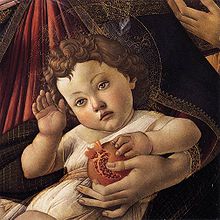
Detail from Madonna of the Pomegranate by Sandro Botticelli.

These are the lyrics in Italian and English. . .

Mille Cherubini in Coro

Dormi, dormi,
sogna, piccolo amor mio.
Dormi, sogna,
posa il capo sul mio cor.

Mille cherubini in coro
ti sorridono dal ciel.
Una dolce canzone
t’accarezza il crin
Una man ti guida lieve
fra le nuvole d’or,
sognando e vegliando
su te, mio tesor,
proteggendo il tuo cammin.
Su te, mio tesor,
proteggendo il tuo cammin.

Dormi, dormi,
sogna, piccolo amor mio.
Dormi, sogna,
posa il capo sul mio cor.

Chiudi gli occhi,
ascolta gli angioletti,
dormi, dormi,
sogna, piccolo amor.

Dormi, dormi,
sogna, piccolo amor mio.
Dormi, sogna,
posa il capo sul mio cor.

Chiudi gli occhi,
ascolta gli angioletti,
dormi, dormi,
sogna, piccolo amor.

Sogna, piccolo amor.

A Choir of a Thousand Cherubs

Sleep, sleep,
dream, my little love.
Sleep, dream, ,
rest your head on my breast.

A choir of a thousand cherubs
smiles on you from the sky
A sweet song
caresses your brow,
A hand is gently guiding you
through the clouds of gold,
dreaming and keeping watch
over you, my treasure,
protecting your path through life.
Over you, my treasure,
protecting your path through life.

Sleep, sleep,
dream, my little love.
Sleep, dream,
rest your head on my breast.

Close your eyes,
listen to the little angels,
sleep, sleep,
dream, my little love.

Sleep, sleep,
dream, my little love.
Sleep, dream, ,
rest your head on my breast.

Close your eyes,
listen to the little angels,
sleep, sleep,
dream, my little love.

Dream, my little love.

Mille Cherubini in Coro, on Pavarotti’s O Holy Night CD with Kurt Herbert Adler and The National Philharmonic, is available on amazon.com

Filed Under: Culture, Language, Miscellany, Music Tagged With: Italian carols, Italian Christmas songs, Luciano Pavarotti, Mille Cherubini in Coro

  • « Previous Page
  • 1
  • …
  • 6
  • 7
  • 8
  • 9
  • 10
  • …
  • 15
  • Next Page »
Follow Simple Italy on FacebookFollow Simple Italy on RSS
Lasagne_19 Simple Italy's Greatest Hits at a click!
Lasagne alla Bolognese and more

Recent posts

  • The Hill Towns of Molise
  • Fior di Latte Cheese
  • In the Mood for Molise, Italy
  • Silk from the Sea in Sardinia
  • Driving a Ferrari Spider

Posts by Category

  • Abruzzo (12)
  • AirBnB (1)
  • Amalfi (8)
  • Archeology (3)
  • Architecture (21)
  • Art (19)
  • Artisans (4)
  • Automobiles (1)
  • Bakery (1)
  • Basilicata (3)
  • Bologna (4)
  • Books (21)
  • Calabria (4)
  • Campania (17)
  • Cooking Classes (5)
  • Cremona (2)
  • Culture (174)
  • dreamofitaly (1)
  • Driving in Italy (2)
  • Emilia Romagna (2)
  • Ferrari (1)
  • Ferrari Museum (1)
  • Film (22)
  • Florence (30)
  • Food (134)
  • Fred Plotkin (1)
  • Friuli-Venezia Giulia (2)
  • Gardening (25)
  • Genoa (2)
  • Golf in Italy (1)
  • Guides (1)
  • History (8)
  • Hotels (14)
  • Inner Italian Q & A (11)
  • Italian seafood (7)
  • Italy Artisans (3)
  • Italy restaurants (17)
  • Language (86)
  • Le Marche (4)
  • Lifestyle (113)
  • Liguria (2)
  • Lombardy cooking (5)
  • Lucca (3)
  • Mantua (1)
  • Markets (26)
  • Mediterranean diet (55)
  • Milan (1)
  • Miscellany (86)
  • Modena (1)
  • Molise (3)
  • Mt. Etna (1)
  • Music (9)
  • Naples (2)
  • New Orleans (2)
  • Opera (1)
  • Palermo (3)
  • People (3)
  • Photography (4)
  • Piedmont cooking (1)
  • Puglia (9)
  • Quotes (4)
  • Recipes (64)
  • Rome (8)
  • Salerno (3)
  • Sardinia (4)
  • Sicily (15)
  • Test Drive (1)
  • Testimonials (2)
  • Travel (110)
  • Trentino Alto-Adige (1)
  • Tuscan cooking (17)
  • Tuscany (30)
  • Venice (2)
  • Videos (2)
  • Wine (23)

Inside SimpleItaly

  • American Couple Marries Italian-Style
  • Appearances
  • Contact us
  • Cooking Up an Italian Life
  • Le Marche Tour with Luisa
  • Links
  • Palazzo Donati Sample Itinerary
  • Palazzo Donati Tours
  • Privacy and Site Policies
  • Publications and TV
  • Sharon’s Inner Italian
  • SimpleItaly Adventure in Tuscany Tour
  • Thank You
  • Walter’s Inner Italian

Tags

Abruzzo bucket list Florence Gardening gelato Genoa Inner Italian Italian cooking italian culture italian food Italian food stores italian language italian lifestyle italian markets Italian music Italian pasta recipe italian recipes Italian tourism italian travel italian wine Italy Italy travel Lago di Como Lake Como Malika Ayane Mediterranean diet mozzarella di bufala Naples tourism Paestum Paolo Conte porcini Puglia Rome Santa Croce Sardegna Sardinia Sicily Southern Italy Stile Mediterraneo Sulmona Tuscan cooking Tuscany Uffizi Gallery Villa Pipistrelli women and travel