Simple Italy

Celebrating Your Inner Italian

  • Home
  • Contact us
  • Links

What Italy Taught Alisa About Happiness

Posted October 12, 2010 by Sharon 6 Comments

Alisa Bowman is usually busy sharing marriage-saving advice on her award-winning blog Project Happily Ever After. But in a recent post, the author of the forthcoming book Project: Happily Ever After: Saving Your Marriage When the Fairytale Falters
shared the story of how she got in touch with her Inner Italian on a stay in Tuscany with her girlfriend Deb Gordon. We loved it so much we asked her to share with SimpleItaly readers.

Alisa Bowman

What Italy Taught Me About Happiness

While in Montepluciano in Southern Tuscany, I stayed at a wonderful, old villa. It was there where I met Daniel (Dan-yel-luh, and not Dan-yuhl), who served me breakfast and dinner most of the days of my stay.

Each morning he greeted me with an exuberant smile, as if he’d been waiting all night just to see me. He reminded me of a Labrador Retriever puppy, wagging his happy tail at every turn.

One day I couldn’t help but ask, “Daniel, are you always this happy?”

He put a finger to his lips, shifted his body weight to one side, and thought deeply for a moment. Then he said, “I’m not sure what you mean.”

“You always seem so joyful. You seem happy and content all the time. You joyfully pour wine into a glass. You joyfully bring dirty dishes back to the kitchen. Is joy your nature?”

He said that it was, but he said it with an incredulous look on his face, as if he assumed that joy was the nature of all beings and that it was odd for me to think that his personal joy was anything beyond ordinary.

And maybe, in Italy—in the land of 1,000 sensual delights—it’s not out of the ordinary. Perhaps, in Italy, people like Daniel are a dime a dozen.

Here in America, though, people like Daniel are downright rare. The Daniels in this country are bordering on extinction.

So naturally I was taken with Daniel, so taken that I fantasized about winning the lottery so I could transplant Daniel to Pennsylvania where he would become my butler. (You so thought I was going to write secret Italian lover instead of butler didn’t you?)

That way Daniel could greet me every morning when his joy filled buongiorno.

But then, Deb, my travel companion, asked, “Do you really think Daniel would ever want to live in Pennsylvania when he could live here in Tuscany instead?”

Florence at Sunset

Indeed, Daniel lives in a world where he is surrounded by beauty. In Italy, creating and admiring beauty is a national pastime. The wine is beautiful. The people are beautiful. The handbags are beautiful. The countryside is beautiful. So is the architecture.

Italians are known for their olive oil, wine, Pecorino cheese (among many other varieties), and handmade pasta.

Americans are known for Ho Hos, Doritos, and spray cheese.

Italians live in homes and cities that date that back thousands of years and are works of art in and of themselves.

Americans live in sub divisions.

If I transplanted Daniel to Pennsylvania, I would suck all of the joy right out of the man.

Still, during my 9 days in Italy, I searched for a way to take a little Daniel back home with me. I made a study of the cultural differences between Italians and Americans, trying to figure out if there was something other than the landscape and setting that made Daniel so happy.

This is what I concluded.

Eating can and should be a sensual experience. I took a cooking class while in Italy. The chef encouraged me to dip my entire index finger into a bottle of olive oil and then suck the oil off my finger. He watched me as I did so, and he clapped and said “ah-ha-ah!” when a post-orgasmic smile and blush took over my face.

Then he proceeded to show me how to make red sauce. The sauce started with an entire head of minced garlic and about a cup and a half or so of olive oil.

With that much olive oil in any dish, your lips and tongue get lubed in such a way that you can’t help but have sex with your food.

But Italian eating is sensual for reasons that go beyond the olive oil. In Italy, food and beverages are works of art. The ingredients are local and they are fresh and they are grown, raised and handled with love. You eat a bite of Italian cheese drizzled with Italian honey and you close your eyes, you put your hand to your heart, and you make all sorts of grunting sounds that you once thought you would only ever make while inside a bedroom.

You eat some American Velveeta and the only grunting sounds you’ll ever make will be a result of the stomachache you experience later in the day.

One experience brings joy. The other brings pain and sadness.

Which would you rather have? I already know my answer.

Italians don’t go on diets. I’m fairly certain that things like Diet Coke, low-fat and low-carb packaged foods, and margarine are confiscated at the border.

I don’t know precisely how most Italians stay relatively thin. Maybe the happiness somehow increases their metabolisms. Maybe they eat smaller portions. I’m not sure. I didn’t see a single Italian out running or power walking, so I don’t believe they are consciously exercising off the calories, either. (The roads where I was staying had no shoulder, were narrow and were populated by speeding, aggressive motorists to such a degree that my friend and I joked, “What do Italians do when they want to commit suicide? They go for a walk.”)

Whatever the Italians do to prevent obesity, I apparently wasn’t doing it. I gained 6.5 pounds while I was there. But I’m not unhappy about that.

The hills of Tuscany.

There is only one moment, and that moment is now. While in Italy, our GPS broke and, as a result, we spent a lot of time driving aimlessly around the Italian countryside and stopping at various gas stations and asking for directions. (More about that experience tomorrow). There are many peculiarities about Italian filling stations. One of them is that every single filling station has an espresso bar. The other is that you cannot get the espresso “to go” as they don’t have to-go cups. Rather, you sit inside and you drink your espresso out of a real espresso cup. Then you get back in your car and you go.

This is even true at the airport.

From what I could tell, the “to go” container does not exist in Italy.

And this is probably because, in Italy, people do not walk while they drink espresso. They do not drive while they drink it, and I’m somewhat sure they don’t talk while they drink it, either. They do not multitask it. They single task it.

They single task eating, too. I did not see a single Italian reading or talking on their cell phones while eating. When my friend Deb pulled out her iPad at a restaurant so she could jot down a few notes about the experience, the waiter (who’d already become quite friendly with us) gave the iPad a dirty look and then put his fingers to his throat and then flicked them away.

So this morning, I single tasked eating a hardboiled egg. Let me tell you: it was the best tasting egg I’ve ever had. I did not cook it any differently than usual. I just ate it differently than I usually do.

Sex is not just for the bedroom. Everything about Italy is sensual, including the language. To speak in Italian, you must do things with your tongue that, honestly, get me hot and bothered just writing about. When I returned home, I found myself speaking English differently. My English words sound the same, but I’m speaking more slowly and I’m using my lips and my tongue differently. I’m savoring the sound and the sensation of the words.

And I’m doing the same with other experiences. It’s supposed to rain 6 inches today. When I walked out into the rain, though, I didn’t think, “Darn, I’m getting wet.” No, I savored the experience.

It may be true that Pennsylvania is no Tuscany, but that doesn’t mean I can’t still allow every experience—every taste, smell, sound and sight—to make love to my being.

And if I continue to allow these delights to have their way with me, I might continue to feel happy and joyful no matter where I find myself.

Next, Alisa’s traveling companion Deb Gordon writes on Italy and Friendship.
Filed Under: Culture, Florence, Language, Lifestyle, Travel Tagged With: driving in italy, Italy travel, women and travel

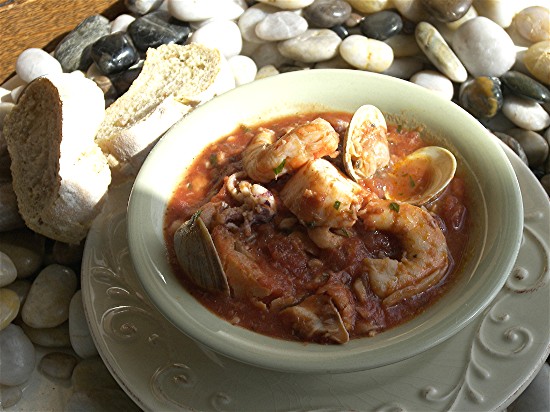
Cacciucco

Posted March 22, 2010 by Sharon 8 Comments

cacciucco

Every coastal region of Italy has a seafood stew. Tuscany— or more specifically the port town of Livorno—has cacciucco (ka-CHOO-ko). While the word is fun to pronounce, the dish is even more pleasurable to eat.

I yearn for cacciucco in the spring. It was in primavera that I first tasted cacciucco at Trattoria Benvenuto in Florence and I haven’t been the same since.

Some say the dish must have at least five types of seafood to correspond to the five Cs in the word. The more fish and shellfish, the better the flavor. And select good quality red wine and artisanal quality bread with good texture to soak up the amazing broth.

Choose the freshest fish available. Use one type or as many as three or four, to comprise 2 pounds. Sea bass, monkfish, cod, halibut, swordfish, shark, tilapia, turbot, catfish, or red snapper are all good choices.

As for the shellfish, in this recipe, I’m using littleneck clams and shrimp but baby calamari, octopus, mussels, or scallops may be substituted.

Cacciucco

Serves 6 to 8

3/4       cup olive oil
1          large red onion, coarsely chopped
4          large cloves garlic, minced
1 1/2    teaspoons dried crushed red-pepper flakes
1           cup dry red wine
1        can (28 ounces) crushed plum tomatoes
1/2       cup minced fresh flat-leaf parsley, divided
1 1/2 teaspoons salt
24       littleneck clams
24                medium or large unpeeled shrimp
2 to 2 1/2         pounds mild white-fleshed fish fillets, cut in 2-inch chunks
3          cups cold water
6 to 8 thick slices Rustic Bread, toasted

Heat the oil in a 6-quart Dutch oven over medium heat. Add the onion, garlic, and pepper flakes. Cook, stirring occasionally, for 10 minutes or until soft. Add the wine. Increase the heat to medium-high. Cook at a brisk simmer for 5 minutes or until the wine no longer smells of alcohol. Add the tomatoes, all but 2 tablespoons of the parsley, and salt. Bring to a boil then reduce the heat until sauce simmers gently. Cover and cook for 10 minutes, stirring occasionally, for the flavors to blend.

Add the clams and shrimp; stir. Add the fish and stir gently. Increase the heat to high. Cook for 2 minutes or until liquid starts to bubble. Add the water. Cover and reduce the heat so the mixture simmers but does not boil. Cook for 10 minutes or until the clams open and the other seafood is opaque in the center. Discard any clams that will not open. Spoon over bread set in pasta plates or large shallow bowls. Sprinkle with the remaining parsley.

What Italian seafood stews have you savored and where? Tell us!

Filed Under: Florence, Food, Italian seafood, Language, Mediterranean diet, Recipes, Tuscan cooking Tagged With: cacciucco, Italian seafood recipe, Italian seafood stew, Livorno

Why Italians Love To Talk About Food

Posted January 20, 2010 by Sharon 3 Comments

Photograph of Elena Kostioukovitch by Massimo Pasquale

Photograph of Elena Kostioukovitch by Massimo Pasquale

Elena Kostioukovitch is not Italian. She was born in Kiev, Ukraine. But Kostioukovitch is deeply in touch with her Inner Italian. How do I know? I’ve been reading Why Italians Love to Talk About Food, the Farrar, Straus and Giroux publication of her book.

Kostioukovitch’s day job is to translate the literary works of Umberto Eco and other authors into the Russian language. Also an essayist and literary agent, she has lived in Milan for more than two decades. She explains in the preface to her 400-plus page tome, “This book was born specifically to assemble in a single volume stories about the symbolic foods of each Italian region and their ‘ideological’ meanings.”

She creates an intellectual journey from the north of the peninsula to the south, exploring culinary history, characteristic dishes, and cultural eccentricities of each region. Her research is rigorous — footnotes and bibliography cover more than 30 pages.

We learn, for instance, that the aperitivo Campari was created by Gaspare Campari at the Caffè Zucca in Milan in 1867.

We practically taste the brine on our lips as we discover that the remaining wilderness of Puglia fosters in the locals a preference for unadulterated foods. “The tendency to eat unprocessed food is especially evident in the consumption of raw fish. In fish markets, for example, it is customary to set out plates of raw shrimp, cuttlefish, and mussels for customers who are waiting, to be eaten on the spot with a squirt of lemon.”

And who knew that Nutella, the jarred gianduia paste created by the Ferrero brothers in Piedmont, makes a political statement? Kostioukovitch explains, “Nutella, loved by children (naturally) and adults, was also prized by nonconformists and leftists. As Italy’s answer to [American peanut butter], it is winning, uplifting, and youthful, a sign of democracy and leftist ideals.”

Essays interspersed between the regional food chapters are quirky and informative, covering topics as diverse as the “Jews,” “Early Gifts from the Americas,” “Totalitarianism,” and “Joy.” I particularly appreciated “Preparation Methods,” a roster of dozens of cooking techniques written in sort of a shorthand code. Not much is spelled out for the Italian home cook in printed recipes—presumably the cook learned these methods at an older cook’s elbow.

“Soak prickly pears.”

“Extract the ink from cuttlefish.”

“Shape polenta in a cloth.”

“Crogiolare (bask or laze comfortably): cook a food over a slow fire, with a little liquid, for a long time.”

One word of warning: Perusing this volume can be hazardous on an empty stomach. Hunger ensues. References to Roman coda all vaccinara (oxtail stew), Neopolitan sartù, (a rice mold with giblets, mushrooms, peas and mozzarella), Ferrara’s pumpkin filled tortelli, Calabrian jujume (sea anemone fritters), Sicilian granita with brioche, and more dishes too numerous to recount will surely make you long to be dining at an Italian table.

Kostioukovitch bottom line is this: “Examining the culture of food, we also come to understand its unique ability to inspire joy and create harmony. Whether at table with family, in a restaurant with friends, or at a scientific conference—food is talked about in a language that is accessible to all, exciting to everyone, democratic and positive.”

What conversations have you enjoyed around an Italian table?

Comment below.

Filed Under: Culture, Food, Italian seafood, Language, Lifestyle, Mediterranean diet, Travel Tagged With: Elena Kostioukovitch, Italian cooking, italian food, Italian regional cooking, Umberto Eco

Florence Awaits

Posted December 14, 2009 by Guest Author 7 Comments

Story and Photographs by Melinda Rizzo

The Palazzo Vecchio, the town hall of Florence.

The Palazzo Vecchio, the town hall of Florence.

Florentines are accustomed to waiting.

From Michelangelo to Botticelli, DaVinci to Galileo, Florentines have cultured their passions into pearls, like a single grain of sand nestled deep inside an oyster and emerging over time to become a gem of the sea.

This year was my 30th, or Pearl, wedding anniversary.

To celebrate this milestone, my husband and I opted to take a trip to Florence, the heart and breath of Italy’s Tuscany region.

In January, we made the decision to travel to Italy at the end of November. Planning and executing this trip—one in which we’d invited a cousin and were traveling with our 12-year-old son—took time and patience. Patience, you might say, of the Florentines.

I’ve never considered myself a patient person.

Cathedrals take time to build, often centuries, still Florentines seem content to wait knowing their labors are never in vain.

The Dome of Santa Maria del Fiore Cathedral, commonly know as The Duomo.

The Dome of Santa Maria del Fiore Cathedral, commonly know as The Duomo.

As Carl Jung, a 20th century Swiss psychiatrist would contend, any work with purpose regardless of its nature, ultimately provides satisfaction and even pleasure for the worker.

Prosciutto crudo (air dried and cured pork) from Parma and arguably the pride of its area, can take as long as two years from start to finish to be ready for consumption.

Two years for a ham and cheese sandwich, but what a sandwich it makes! Prosciutto for me, and my son, is porcine transcendence.

Does anyone ordering a prosciutto focaccia pressed and toasted, consider the amount of time it took to create the ham? A moment of mastication melts these buttery mouthfuls, and they are gone.

Florentines linger over osteria menus . . .  along alleyways . . . and outside the windows of leather shops.

performersStreet performers sing operatic arias. They pump life into an accordion’s complication.
They strum a guitar or play the love theme from Florentine Franco Zeffirelli’s 1968 film Romeo and Juliet in the Piazza Signoria, where I rented our apartment. They spend time and care honing their musicianship. For those who love music, they offer kinship without translation.

Street performers share their art in exchange for spare change dropped into a basket poised at their feet. Skilled musicians bear witness to patience and waiting.

Witnessing the patience of Florentines: to execute a 17-foot-tall statue of David in marble, paint the mythological birth of Venus over the ocean waves or slice tissue thin prosciutto from the seasoned hindquarters of a pig, taught me a thing or two about this most elusive of virtues.

Consider the amount of time it takes for someone to carve mounds of
Nutella, vanilla or tutti fruitti gelato, into tempting, irresistible towering creations
decorated with fruit slices, nuts or plump, glistening blackberries and shiny
currants.gelateria

[Read more…]

Filed Under: Culture, Florence, Language, Lifestyle, Travel Tagged With: David, Duomo, Firenze, Florence, Ghiberti, italian travel, Melinda Rizzo, Michelangelo, Piazza Signoria, Uffizi Gallery

The Inner Italian Q & A: Melissa Muldoon

Posted December 3, 2009 by Sharon 16 Comments

One in an occasional series of Q & A profiles of  “wannabe” Italians


MelissaMuldoon
Melissa Muldoon is a freelance graphic designer living in the San Francisco Bay Area. Through her firm, Melissa Design, she creates graphics  for Web and print.  Raised in the Midwest, she studied studio art and history at Knox College. At the University of Illinois at Champaign, she worked as a teaching assistant and earned a Masters degree in Art History. Deciding she’d rather be “doing” art rather than “talking” about art, she pursued a career as a graphic designer. She is married to Patrick Muldoon and has three boys and a beagle. Her passion for art opened the door to Italy for her. During college she participated in a study abroad program in Florence and discovered a country full of history, culture and tradition, yet overflowing with contemporary style and quirky idiosyncrasies. Her love for art brought her “home” to Italy for the first time.

Q: Living “Italian”. . . Is it a great way to live or the greatest way to live?

A: Ma dai! Non c’e’ un modo migliore! Come on! There is no better way to live!  

Q: Why?

A: Let me just start off by saying I am a classic type A personality. I am impatient, competitive and a list maker. I don’t know what I like better, adding things to my “to do” list or checking them off.  I’m usually up late finishing a project or starting the next. I zoom from one appointment to the next and despise sitting in traffic or wasting time at stoplights. Now, while a type A lifestyle is great for getting things accomplished and moving ahead in life,  it may not be the sanest way to live.

Fortunately for me, I found Italy and discovered how to “live Italian.” Italy is my alter ego. It balances out my yin and yang. When I am in Italy, time slows down and I relax. I let go and go with the flow. My senses are reawakened and my creative side is nurtured and flourishes. I savor meals and notice things like the multi-colored marzipan pastries elegantly displayed in the panetterie and bars, or the wheels of cheese stacked up like oversized building blocks in the corner markets. I feel the cobblestones, worn and rounded by time, under my feet. I hear the clang of the church bells and the ronzare of the Vespa bikes. I meet the most interesting people, Italian locals and fellow travelers, and develop long lasting friendships.

Settimo Dalla Ricca escorts us through the Grana Padana Cheese factory in Mantova.

Settimo Dalla Ricca escorts us through the Grana Padana cheese factory in Mantova.

[Read more…]

Filed Under: Culture, Florence, Inner Italian Q & A, Language, Lifestyle, Travel Tagged With: Inner Italian, italian language, italian travel, Melissa Muldoon, www.melissadesign.com

Dream of Italy

Posted November 30, 2009 by Sharon 1 Comment

portallogoSubscribers to Kathy McCabe’s award-winning Italy travel newsletter Dream of Italy will see Sharon’s work in the November 2009 issue. She penned a profile of “Stile Mediterraneo Cooking and Wine School” owners Cinzia and Marika Rascazzo and also a feature “Sisters Share Their Private Puglia” with the siblings’ travel recommendations for their region on the heel of Italy.

If you don’t subscribe to Dream of Italy, there’s no better holiday gift for your Inner Italian. Check it out here.

Filed Under: Culture, Hotels, Language, Lifestyle, Mediterranean diet, Travel Tagged With: Cinzia Rascazzo, Dream of Italy, italian culture, italian travel, Marika Rascazzo, Puglia, Stile Mediterraneo

  • « Previous Page
  • 1
  • …
  • 8
  • 9
  • 10
  • 11
  • 12
  • …
  • 15
  • Next Page »
Follow Simple Italy on FacebookFollow Simple Italy on RSS
Lasagne_19 Simple Italy's Greatest Hits at a click!
Lasagne alla Bolognese and more

Recent posts

  • The Hill Towns of Molise
  • Fior di Latte Cheese
  • In the Mood for Molise, Italy
  • Silk from the Sea in Sardinia
  • Driving a Ferrari Spider

Posts by Category

  • Abruzzo (12)
  • AirBnB (1)
  • Amalfi (8)
  • Archeology (3)
  • Architecture (21)
  • Art (19)
  • Artisans (4)
  • Automobiles (1)
  • Bakery (1)
  • Basilicata (3)
  • Bologna (4)
  • Books (21)
  • Calabria (4)
  • Campania (17)
  • Cooking Classes (5)
  • Cremona (2)
  • Culture (174)
  • dreamofitaly (1)
  • Driving in Italy (2)
  • Emilia Romagna (2)
  • Ferrari (1)
  • Ferrari Museum (1)
  • Film (22)
  • Florence (30)
  • Food (134)
  • Fred Plotkin (1)
  • Friuli-Venezia Giulia (2)
  • Gardening (25)
  • Genoa (2)
  • Golf in Italy (1)
  • Guides (1)
  • History (8)
  • Hotels (14)
  • Inner Italian Q & A (11)
  • Italian seafood (7)
  • Italy Artisans (3)
  • Italy restaurants (17)
  • Language (86)
  • Le Marche (4)
  • Lifestyle (113)
  • Liguria (2)
  • Lombardy cooking (5)
  • Lucca (3)
  • Mantua (1)
  • Markets (26)
  • Mediterranean diet (55)
  • Milan (1)
  • Miscellany (86)
  • Modena (1)
  • Molise (3)
  • Mt. Etna (1)
  • Music (9)
  • Naples (2)
  • New Orleans (2)
  • Opera (1)
  • Palermo (3)
  • People (3)
  • Photography (4)
  • Piedmont cooking (1)
  • Puglia (9)
  • Quotes (4)
  • Recipes (64)
  • Rome (8)
  • Salerno (3)
  • Sardinia (4)
  • Sicily (15)
  • Test Drive (1)
  • Testimonials (2)
  • Travel (110)
  • Trentino Alto-Adige (1)
  • Tuscan cooking (17)
  • Tuscany (30)
  • Venice (2)
  • Videos (2)
  • Wine (23)

Inside SimpleItaly

  • American Couple Marries Italian-Style
  • Appearances
  • Contact us
  • Cooking Up an Italian Life
  • Le Marche Tour with Luisa
  • Links
  • Palazzo Donati Sample Itinerary
  • Palazzo Donati Tours
  • Privacy and Site Policies
  • Publications and TV
  • Sharon’s Inner Italian
  • SimpleItaly Adventure in Tuscany Tour
  • Thank You
  • Walter’s Inner Italian

Tags

Abruzzo bucket list Florence Gardening gelato Genoa Inner Italian Italian cooking italian culture italian food Italian food stores italian language italian lifestyle italian markets Italian music Italian pasta recipe italian recipes Italian tourism italian travel italian wine Italy Italy travel Lago di Como Lake Como Malika Ayane Mediterranean diet mozzarella di bufala Naples tourism Paestum Paolo Conte porcini Puglia Rome Santa Croce Sardegna Sardinia Sicily Southern Italy Stile Mediterraneo Sulmona Tuscan cooking Tuscany Uffizi Gallery Villa Pipistrelli women and travel