Simple Italy

Celebrating Your Inner Italian

  • Home
  • Contact us
  • Links

Semifreddo for Summer

Posted July 27, 2013 by Sharon 2 Comments

Lush lemon semifreddo is the next best thing to being in Amalfi.

Lush lemon semifreddo is the next best thing to being in Amalfi.


Semifreddo translates as “half frozen.”

But its literal moniker underplays the lush nature of this Italian spoon dessert.

I’d rather call it Fresco Com’una Nuvola–“Cool as a Cloud.”

Sort of a cross between a frozen soufflé and gelato, a semifreddo delivers the plush mouthfeel of frozen meringue with the luxurious richness of cream.

Why is semifreddo so dreamy? Because air is whipped into the egg whites and the cream prior to freezing. Gelato, on the other hand, is denser because air is whipped into the gelato base as it freezes. So, semifreddo results in a softer, more sensual sweet.

Semifreddo is so right for summer. It can be prepared hours or days in advance. Berries and peaches are its seasonal friends.

Italians like to play around with textural contrasts and frequently add layers of crumbled crisp cookies or chopped nuts between layers of semifreddo. Sauces are also a fun option. Caramel sauce with lemon or coffee. Chocolate  sauce with raspberry or strawberry. You get the idea.

Make a semifreddo soon and you’ll be on nuvola numero nove.

Click here for information about egg cooking safety.

Lemon Semifreddo
Print
Recipe type: Dessert
Cuisine: Italian
Author: Sharon Sanders
Serves: 8
The USDA recommends that, due to possible danger from Salmonella contamination, pasteurized in-shell eggs should be used for any recipe calling for uncooked or undercooked eggs.
Ingredients
  • ½ tablespoon butter, at room temperature
  • ½ cup granulated sugar plus sugar for coating the dish
  • 1½ tablespoons cornstarch
  • 1 tablespoon grated lemon zest
  • 6 tablespoons lemon juice
  • 1 egg, beaten (see note above)
  • 2 cups heavy or whipping cream
  • ¼ cup confectioners' sugar
  • 1 pint raspberries
Instructions
  1. Coat the inside of a 6-cup soufflé dish or other casserole with butter. Coat with granulated sugar. Set aside.
  2. In a medium saucepan, whisk ½ cup granulated sugar with cornstarch until blended. Add the lemon zest, lemon juice, and egg. Whisk to combine. Cook over medium heat, whisking constantly, for about 5 minutes until mixture thickens. Remove from the heat and whisk briskly. Set aside to cool, whisking occasionally.
  3. In the large bowl of an electric mixer, whip the cream until soft peaks form. Gradually add the confectioners' sugar. Whip until peaks hold their shape. Fold one-third of the cream into the lemon mixture. Fold the lemon mixture into the remaining cream. Spoon into the prepared dish. Sprinkle with granulated sugar. Place in the freezer for 12 hours or up to 3 days.
  4. To serve, remove the semifreddo from the freezer and allow to sit for 15 minutes. Scoop onto dessert dishes. Serve with the raspberries.
3.2.1230

A rasp grater makes quick work of zesting lemon. Be sure to grate only the yellow zest and not the bitter white part.
Lemon juice, zest, sugar, and egg yolks make a delectable curd as the flavor base. A flat whisk gets into saucepan corners as it simmer so lumps don’t form.
Dollop the semifreddo into a freezerproof dish or for a fancier presentation, scoop into hollowed lemon halves before freezing.

Next time: Coffee Semifreddo


Filed Under: Food, Language, Lifestyle, Recipes Tagged With: cool summer desserts, frozen Italian desserts, lemon desserts, semifreddo, summer entertaining

Porcini Mushroom Antipasto

Posted March 20, 2013 by Sharon 3 Comments

Dried porcini funghi add true Tuscan savor to this fresh mushroom antipasto.

Dried porcini funghi add true Tuscan savor to this fresh mushroom antipasto.

Too often, outside of Italy, antipasto can be a tired tray of assorted salumi. Or, “lunchmeat,” as a server an “Italian” restaurant in Chicago, once hilariously answered, in response to our query about what came on the antipasto platter.

Throughout the regions of Italy, antipasto (before the meal), are varied, seasonal, and local. Seafood, robust cheeses, grilled vegetables, crostini with myriad spreads, cured olives, frittate, and more.

Porcini-Stuffed Baby Bello Mushrooms are an antipasto that’s right for any season. By supplementing fresh baby bello mushrooms with reconstituted dried porcini, you create a win-win. The intense porcini flavor (at a fraction of the cost of fresh funghi porcini–if you could find them) with the toothsome texture of fresh mushrooms and assorted seasonings. [Read more…]

Filed Under: Culture, Food, Italy restaurants, Lifestyle, Mediterranean diet, Recipes Tagged With: Italian antipasti, Italian antipasti recipes, Italian stuffed mushrooms recipe, porcini mushroom recipe

Italian Savoy Cabbage and Rice Soup

Posted January 23, 2013 by Sharon 2 Comments

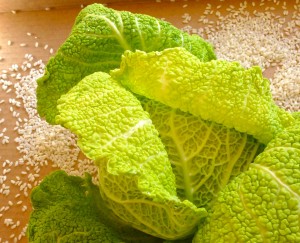
Crinkly leafed Savoy cabbage is milder and more tender than regular white cabbage.

Crinkly leafed Savoy cabbage is milder and more tender than regular white cabbage.

My Inner Italian cook is liberated from geography. When it’s sweltering at my home in eastern Pennsylvania, I can toss pasta with juicy plum tomatoes, olive oil, and basil and call it supper. Just as they do in the sunny south.

When overnight temps dip into the teens, however, I can head north to the Alpine region of Trentino Alto-Adige for mealtime inspiration. The northernmost part of this semi-autonomous region is culturally more German than Italian, with ingredients such as sauerkraut and poppy seeds showing up in local dishes. It’s the South Tyrol, a triangular point of land jutting north from Milan and Venice. Bolzano, the capital of Alto-Adige is 400 miles from Rome but a mere 170 miles from Munich, Germany.

Italian Savoy Cabbage and Rice Soup
5.0 from 1 reviews
Print
Recipe type: Soup
Cuisine: Italian
Serves: 8
Cooks in the Trentino Alto-Adige intuitively know how to do is keep body and soul sustained with hearty soups like this Savoy Cabbage and Rice Soup enriched with pancetta.
Ingredients
  • 4 ounces cubed pancetta or slab bacon
  • Olive oil
  • 2 leeks, white and green part, sliced
2 carrots, thinly sliced
  • ½ cup fruity white wine
  • 1 head (1¼ pounds) Savoy cabbage, cored and thinly sliced
  • 3 quarts (12 cups) chicken or vegetable broth
  • 1 cup medium or long-grain white or brown rice
  • 2 teaspoons thyme
  • 2 dried bay leaves
  • 1 teaspoon salt
  • ¼ cup minced flat-leaf parsley
  • 1 teaspoon black pepper
  • 2 eggs
  • Grated Parmesan cheese
Instructions
  1. Scatter the pancetta bacon or in a large pot set over medium heat. Glaze with olive oil. Cook, stirring, for about 5 minutes or until golden. Reduce the heat if the pancetta or bacon browns too fast.
  2. Add the leeks and carrots. Cook, stirring occasionally, for about 5 minutes, or until golden.
  3. Add the wine. Increase the heat to high. Boil, scraping up any browned bits, for about 5 minutes, or until reduced by half. Add the cabbage, broth, rice, thyme, bay leaves, and salt. Bring to a boil. Reduce the heat to medium-low.
  4. Cover partially and cook for 25 to 35 minutes, or until the rice is tender. Add the parsley and pepper. Remove and discard the bay leaves.
  5. Beat the eggs in a medium bowl. Gradually add 2 cups of broth skimmed from the soup. Add the egg mixture to the pot. Cook, stirring constantly, for about 2 minutes, or until the soup thickens slightly.
  6. Garnish with Parmesan to taste.
3.1.09

[Read more…]

Filed Under: Food, Lifestyle, Recipes, Trentino Alto-Adige Tagged With: food of Italian Alps, italian soup, Trentino Alto-Adige, winter soups, zuppa

Chicken Breasts Marsala

Posted January 16, 2013 by Sharon Leave a Comment

Simmer Marsala wine with skillet juices from sauteed chicken to create an unctuous sauce. reduce

Simmer Marsala wine with skillet juices from sautéed chicken to create an unctuous sauce.

Marsala is a Sicilian wine that achieved international fame when it was discovered by British sea merchant John Woodhouse in the late 18th Century. It has become a pantry staple in Italian home and restaurant kitchens. Because it’s fortified with a bit of distilled alcohol, the wine won’t spoil after opening.

Dry, sweet, and aged (vergine) Marsala wines are produced in the area around the port of Marsala in western Sicily. For savory dishes like these chicken breasts with rich cheese and slightly salty prosciutto, choose the dry version. 

Chicken Breasts Marsala
Print
Recipe type: Main course
Cuisine: Italian
Serves: 4 to 6
Ingredients
  • 2½ to 3 pounds skinless, boneless chicken breast halves
  • Salt
Ground nutmeg
  • ½ cup flour
  • 2 tablespoons butter
  • 6 to 8 thin slices (4 to 5 ounces) cooked ham or prosciutto
  • 6 to 8 thin slices (4 to 5 ounces) Gruyère cheese
  • 1 cup dry Marsala wine
Instructions
  1. Lay the chicken breasts, smooth side down, on a work surface. Loosen the tenderloins and open them like a book. With the smooth side of a meat pounder or heavy skillet, flatten the breasts to ¾-inch thickness. Season both sides with salt and a dusting of nutmeg.
  2. Place the flour on a large sheet of waxed paper. Lay an empty sheet of waxed paper beside it. Dip the chicken in the flour to coat both sides. Shake off excess and place the chicken on the empty sheet.
  3. Heat the butter in a large skillet over medium-high heat until the foam subsides. Add the chicken in a single layer. Cook for about 4 minutes each side, or until well browned. Top each chicken breast with a slice of ham and a slice of cheese. Add the Marsala to the pan. Bring to a brisk simmer. Cook, swirling occasionally, for about 5 minutes, or until it no longer smells of alcohol. Reduce the heat to low. Cover and cook for 5 to 7 minutes, or until the chicken is no longer pink in the center. With a spatula, place the chicken breasts on dinner plates. Drizzle with the wine sauce.
3.1.09


Recipe from our e-book SimpleiItaly Loves Chicken, available for purchase online at the Barnes & Noble Nook store and the amazon Kindle store.


Filed Under: Food, Mediterranean diet, Recipes, Sicily, Wine Tagged With: Chicken with Marsala, easy chicken recipe, Italian wine dishes, pollo con marsala

Biscotti Bambini

Posted October 10, 2012 by Sharon 9 Comments

Baby biscotti–ready for dunking.

In the grand American tradition of Bigger is Better, commercial biscottiare sometimes the size of Little League bats with a durable texture to match.

In Italy, biscotti are more diminutive—about the size of a fat thumb. Valued as “good keepers,” these crisp cookies can hang out for a long time in the larder. They stand ready to be plunked into a cup of cappuccino, tea or even a glass of wine. The dip moistens the biscotti and further flavors them.

Biscotti attain their crunchy demeanor by two sojourns in the oven. “Bis” means “twice” and “cotti” means cooked. I’ve found that home-baked biscotti, while still crumbly, are not the tooth breakers that the manufactured ones can be.

Because bite-sized foods are so charming, I recently prepared some biscotti bambini—biscottini—as a hostess gift. I love that you don’t have to make a career out of eating one. [Read more…]

Filed Under: Culture, Food, Language, Miscellany, Recipes Tagged With: Biscotti, biscottini, Italian cookies, Italian pastries

Basil Pesto Recipe

Posted August 22, 2012 by Sharon 4 Comments

Pick tender basil leaves and flat-leaf parsley early in the morning when it's cool.

Now that there are several pounds of peeled, quartered local peaches tucked into the freezer, I can turn my attention to making basil pesto. I hesitate to call it pesto alla Genoese (literally Genoa-style paste) because the purists are rigorous that the ingredients in this renowned condiment be basil and olive oil grown only in the region of Liguria. There’s even a Consorzio dedicated to its preservation.

Another issue is the grinding method. In Liguria, traditionalists crush the tender herb leaves, garlic, and pine nuts in a marble mortar with an olive wood pestle.

In his book Recipes from Paradise: Life and Food on the Italian Riviera, Fred Plotin writes, “A mortar and pestle mashes while the food processor or blender grinds. The flavors of herbs and nuts, their oils and essences, are released in a unique way that cannot be equaled in a machine.” He does go on to say that many cooks in Liguria use a blender but acknowledge that the pesto is not as good.

I priced a 7-inch-wide marble mortar and pestle on the Williams-Sonoma store site. At a cost of $99.95, I don’t think it’s going to be in my kitchen anytime soon. Less expensive rough granite models exist—from Mexico and Thailand—so I’ll be on the lookout for a good buy.

Adding salt and flat-leaf parsley helps to lock in the green color of the basil which can brown if handled roughly.

For now, however, I need to pick my basil before it goes to flower. I’ll make a double batch of pesto alla Pennsylvaniana. In January, it will taste like heaven even if it’s not quite Ligurian.

Basil Pesto
Makes about 2 cups

Poaching the garlic makes this pesto mellow but using raw garlic cloves is the classic choice.

1 cup extra-virgin olive oil
1 small head garlic, cloves peeled
2 cups tightly packed fresh basil leaves, divided (see note)
1 cup tightly packed flat-leaf parsley leaves, divided (see note)
1/2 cup (2 ounces) pine nuts, blanched walnuts, or raw almonds, divided
1/2 teaspoon salt, divided
1 cup (4 ounces) grated Parmesan cheese
1/4 cup (1 ounce) grated Pecorino Romano cheese

In a glass measuring cup, combine the oil and the garlic. Cover with waxed paper. Microwave for 30 seconds. Reduce the setting to low; microwave for 1 minute, or until bubbly and fragrant. Allow to cool to room temperature.
In a food processor, combine half of each of these ingredients: the basil, parsley, pine nuts, salt, and garlic oil. Pulse 20 times or until coarsely chopped. Scrape the sides of the bowl. Process for about 2 minutes or until a coarse paste forms. Transfer to a mixing bowl.

Repeat with the remaining ingredients. Transfer to the bowl. Stir in the Parmesan and the Pecorino Romano.

Flash-freeze dollops of pesto on a tray before packing into air-tight plastic freezer bags or other containers. Use a serrated knife to cut off the amount of frozen pesto you want for a recipe.

Spoon the pesto in mounds (1/4 or 1/2 cup are convenient amounts) onto a plastic wrap-lined tray. Place in the freezer for several hours, or until solid. Transfer the pesto mounds to a plastic freezer bag. Return to the freezer for up to 6 months.

Pasta with Basil Pesto: Cook 1 pound pasta until al dente. Reserve 3/4 cup cooking water. Drain the pasta and return to the cooking pot. Add 1/2 cup of frozen pesto and enough of the water to moisten the sauce. Season lightly with salt if needed.

Note: Because I grow basil and parsley without pesticides, I never wash it but rather wipe off any visible dirt with a paper towel. If you feel you must wash the leaves, dip them gently in cold water and pat dry before making the pesto.

Filed Under: Culture, Food, Gardening, Mediterranean diet, Recipes Tagged With: basil pesto, Genoa, Liguria, pesto alla genoese, preserving basil

  • « Previous Page
  • 1
  • 2
  • 3
  • 4
  • 5
  • …
  • 11
  • Next Page »
Follow Simple Italy on FacebookFollow Simple Italy on RSS
Lasagne_19 Simple Italy's Greatest Hits at a click!
Lasagne alla Bolognese and more

Recent posts

  • The Hill Towns of Molise
  • Fior di Latte Cheese
  • In the Mood for Molise, Italy
  • Silk from the Sea in Sardinia
  • Driving a Ferrari Spider

Posts by Category

  • Abruzzo (12)
  • AirBnB (1)
  • Amalfi (8)
  • Archeology (3)
  • Architecture (21)
  • Art (19)
  • Artisans (4)
  • Automobiles (1)
  • Bakery (1)
  • Basilicata (3)
  • Bologna (4)
  • Books (21)
  • Calabria (4)
  • Campania (17)
  • Cooking Classes (5)
  • Cremona (2)
  • Culture (174)
  • dreamofitaly (1)
  • Driving in Italy (2)
  • Emilia Romagna (2)
  • Ferrari (1)
  • Ferrari Museum (1)
  • Film (22)
  • Florence (30)
  • Food (134)
  • Fred Plotkin (1)
  • Friuli-Venezia Giulia (2)
  • Gardening (25)
  • Genoa (2)
  • Golf in Italy (1)
  • Guides (1)
  • History (8)
  • Hotels (14)
  • Inner Italian Q & A (11)
  • Italian seafood (7)
  • Italy Artisans (3)
  • Italy restaurants (17)
  • Language (86)
  • Le Marche (4)
  • Lifestyle (113)
  • Liguria (2)
  • Lombardy cooking (5)
  • Lucca (3)
  • Mantua (1)
  • Markets (26)
  • Mediterranean diet (55)
  • Milan (1)
  • Miscellany (86)
  • Modena (1)
  • Molise (3)
  • Mt. Etna (1)
  • Music (9)
  • Naples (2)
  • New Orleans (2)
  • Opera (1)
  • Palermo (3)
  • People (3)
  • Photography (4)
  • Piedmont cooking (1)
  • Puglia (9)
  • Quotes (4)
  • Recipes (64)
  • Rome (8)
  • Salerno (3)
  • Sardinia (4)
  • Sicily (15)
  • Test Drive (1)
  • Testimonials (2)
  • Travel (110)
  • Trentino Alto-Adige (1)
  • Tuscan cooking (17)
  • Tuscany (30)
  • Venice (2)
  • Videos (2)
  • Wine (23)

Inside SimpleItaly

  • American Couple Marries Italian-Style
  • Appearances
  • Contact us
  • Cooking Up an Italian Life
  • Le Marche Tour with Luisa
  • Links
  • Palazzo Donati Sample Itinerary
  • Palazzo Donati Tours
  • Privacy and Site Policies
  • Publications and TV
  • Sharon’s Inner Italian
  • SimpleItaly Adventure in Tuscany Tour
  • Thank You
  • Walter’s Inner Italian

Tags

Abruzzo bucket list Florence Gardening gelato Genoa Inner Italian Italian cooking italian culture italian food Italian food stores italian language italian lifestyle italian markets Italian music Italian pasta recipe italian recipes Italian tourism italian travel italian wine Italy Italy travel Lago di Como Lake Como Malika Ayane Mediterranean diet mozzarella di bufala Naples tourism Paestum Paolo Conte porcini Puglia Rome Santa Croce Sardegna Sardinia Sicily Southern Italy Stile Mediterraneo Sulmona Tuscan cooking Tuscany Uffizi Gallery Villa Pipistrelli women and travel