Simple Italy

Celebrating Your Inner Italian

  • Home
  • Contact us
  • Links

But I Don’t Want a Jaguar

Posted April 13, 2009 by Walter 6 Comments

A car with a view . . . .of the Alfa 147s that got away.

A car with a view . . . .of the Alfa Romeo 147 that got away.

By Walter Sanders

As far as I’m concerned, it’s been a good year for U.S. Airways. Sully landed safely in the Hudson, and we survived steerage on a flight to Rome.

Groggy, ragged and raw after landing 10 minutes early in Rome . . . things smoothed out after the first cappuccino at a bar in Fumicino. Lots of local color: A Miss Italy look-alike was strutting around and she twisted the necks of a bunch of Italian guys who were sipping their coffees.

Then it was upstairs (2 stories) to the well-hidden autonoleggio center. The couple ahead of me in line at Dollar/Thrifty were Brazilians. The gent seemed confused and spoke in halting Italian with a German/Portuguese accent.

It took awhile . . . but it was finally my turn . . . and I handed over the pre-paid web reservation for my carefully selected, long anticipated, sleek and speedy Alfa Romeo 147 . The signorina at the counter, who looked young enough to be playing hooky from 10th grade, reviewed my paperwork, and then looked at sheets on her desk. “We have a Jaguar for you.”

I thought she was joking. “That’s wonderful. But I want the Alfa Romeo,” I said.

“I’m so sorry, but we don’t have an Alfa Romeo available right now.”

“But I have a reservation.”

“Sorry.”

“Well how about something comparable-a BMW, a different model Alfa, a small Mercedes?”

“No, I’m sorry. In the same class as the Alfa you reserved, all we have is a Jaguar,” she said.

I called Sharon over, and reviewed the situation with her. “I don’t think the Jaguar will work for us. It’s big, it consumes a lot of expensive benzina, and it sends the wrong signal.” Sharon agreed.

“The Jaguar offer is very nice, but I don’t want a Jaguar. What other options do I have?” I asked.

The signorina looked at her sheets again. “Well, your Alfa and the Jaguar are a class F. All we have available now is class B. Sub-compacts like a Ford or a Lancia.”

A Ford? There’s no way I’m going to tool around in a Ford in Italy! A Lancia?

“Tell me about the Lancia, please.”

“It’s the Ypsilon. Nice car. Smaller than the Jaguar. Smaller than your Alfa.”

Yes, my Alfa, my lost Alfa. My Alfa that, throughout the trip I would continue to lust after as they sizzled past us on the Autostrada, ‘Hey, there’s my Alfa Romeo . . . .”

We ended up with the Lancia. Sporty, not very sexy, but more than adequate . . . .and about five-feet shorter than the damn Jaguar parked down the row in the class F section.

What experiences have you had with car rentals in Italy? Did you get your elusive Alfa? Share your stories with us.

Filed Under: Culture, Language, Lifestyle, Travel Tagged With: Italian cars, italian culture, italian travel

Tuscany in Texas?

Posted April 10, 2009 by Sharon Leave a Comment

I sniffed to myself when I scanned this morning’s Wall Street Journal “Relative Values” real estate column. A 3,700-square-foot house resembling a casa colonica with five bedrooms, three bathrooms, and one powder room on 60 acres-in a development called the Vineyard at Florence-is listed for $5.5 million. “Hah,” said I, “if I had 5-and-a-half mil, I’d high tail it to Tuscany, not the Texas hill country.”

Since the aforementioned assets are not even a blip on my radar screen, I took a free trip to The Vineyard at Florence. Gorgeous scenery, fabulous amenities, 30 acres planted in vines  . . . what’s not to like?

The site explains that the developers are The Dionysus Group, LLLP, comprised of “members who share a desire to combine the best elements of life-community, exceptional living, natural beauty and wine.”

Guess they’re nurturing their Inner Italian-just like I am . . . albeit with much better funding.

Filed Under: Culture, Language, Lifestyle, Miscellany Tagged With: italian lifestyle, Texas wine country, Vineyard at Florence, wine country

Earthquake in L’Aquila

Posted April 6, 2009 by Walter Leave a Comment

L'Aquila's Palazzo Civico in better times.

L'Aquila's Palazzo Civico in better times.

Our plan to begin posting stories of our recent Puglian adventure is delayed by the horrible news of the earthquake in L’Aquila, Italy, that occurred during the pre-dawn hours on Monday, April 6.

This one strikes home to us because we drove past L’Aquila, the capital city of the region of Abruzzo, on March 24 while on our way to the Gran Sasso in the Apennines. We then continued south to the town of Sulmona for the evening.

The territory near L’Aquila is stunning. Snowcapped mountains soar more than 2,900 meters into the sky and I, for one, had a sense of solidity from all that formidable rock. But the region is prone to earthquakes and this terremoto registered a reported 6.3 on the Richter scale. Sadly, there are many fatalities, including children, although accurate numbers are still sketchy.

The American Red Cross Web site states that they have not yet been called upon in the relief effort. The New York Times is reporting that the Italian-American Museum in Manhattan is collecting donations for earthquake relief in L’Aquila.

Filed Under: Miscellany Tagged With: Italian disaster, Italian earthquake

Chocolate Time

Posted April 1, 2009 by Sharon 1 Comment

chococapptorte

April is cruel on dessert lovers.

Citrus fruits are past their prime.

Apples and pears, in cold storage since last autumn,  are mealy.

Local strawberries, blueberries, cherries, and raspberries are a distant glimmer on the horizon.

Waiting is difficult.

But, fortunately, chocolate is perennial.

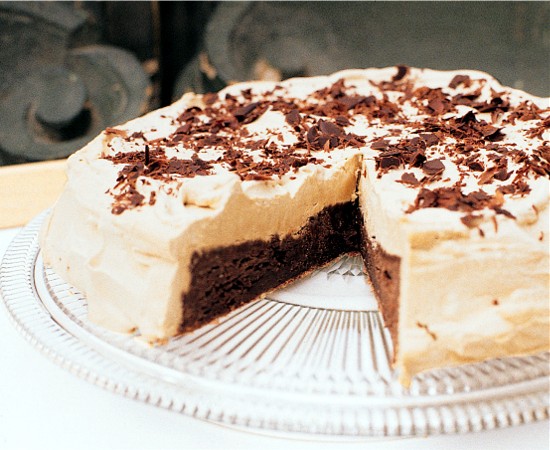
A Chocolate Torte with Cappuccino Cream in the freezer makes the time until strawberries just a bit sweeter.

Frozen Chocolate Torte with Cappuccino Cream

4          ounces unsweetened chocolate, chopped

1          cup all-purpose flour

1          teaspoon baking powder

Pinch of salt

2          sticks (1/2 cup each) unsalted butter, softened

1 3/4     cups sugar

4          large eggs

2          teaspoons vanilla extract

1          tablespoon instant espresso or regular instant coffee

1          cup whipping cream

2          tablespoons confectioners’ sugar

Bittersweet chocolate shavings for garnish

Preheat the oven to 350°F. Coat a 10-inch round springform pan with no-stick

spray.

Put the chocolate in a small microwaveable bowl. Microwave for 2 minutes. Stir. If lumps remain, microwave for about 20 seconds. Stir and set aside. On a sheet of waxed paper, combine the flour, baking powder, and salt. Stir to mix; set aside.

In the bowl of an electric mixer, beat the butter for about 2 minutes, or until fluffy. Gradually add the sugar, continuing to beat, and scraping the sides of the bowl as needed. Beat in the eggs, one at a time. Add the melted chocolate and the vanilla. Reduce the mixer speed to low. Add the reserved dry ingredients. Mix just to incorporate. Spoon into the prepared pan. Spread evenly.

Bake for about 45 minutes, or until a toothpick inserted into the center comes out clean. Remove the torte from the oven. Allow to sit for 5 minutes. Remove the outer ring of the pan. Place a freezerproof serving dish over the torte. Invert the torte onto the dish. Run the blade of a long thin knife between the top of the torte and the pan bottom to separate. Allow to cool.

In the mixing bowl of an electric mixer, stir instant espresso or regular instant coffee with 1 teaspoon cold water to dissolve. Add cream. Whip on high speed for 2 to 3 minutes or until soft peaks form. Add confectioners’ sugar. Whip for 1 to 2 minutes, or until peaks hold their shape. Spread, swirling into peaks, over the top and sides of the cooled torte.

Place in the freezer, uncovered, for 2 hours. For longer storage, cover tightly with plastic wrap and then with aluminum foil. Freeze for up to 1 week. To serve, unwrap and allow to sit at room temperature for 15 to 20 minutes. Bittersweet chocolate shavings may be scattered on top for decoration.

Makes 12 servings

©Cooking Up an Italian Life, PergolaWest, Inc.

Filed Under: Food, Recipes Tagged With: chocolate, Italian chocolate desserts, italian food, italian recipes

Kiwi l’italiana

Posted March 26, 2009 by Sharon 1 Comment

kiwi2

I was surprised when I read the sticker “produce of Italy” on the kiwi fruit I’d popped into my bag at the local supermarket. It was so unexpected . . . like encountering Andrea Bocelli at the dry cleaner. The context seemed all wrong.

The kiwi got me to thinking about fresh food imports from Italy. I don’t believe I’ve ever encountered any before, with possible exception of blood oranges. The familiar foodstuffs from Italy that I know and buy (and consider essential for “genuine” tastes) are cured, dried, or preserved in some way: Parmigiano-Reggiano cheese, canned San Marzano tomatoes, salted capers from Pantelleria, dried pasta from Abruzzo.

Yet, here was this fresh Italian kiwi, now in my kitchen. Not a typically “Italian” ingredient but, then, neither was citrus fruit when it came to Rome from southern China during the time of Emperor Augustus.

Kiwi probably also comes from China but didn’t make an impact on Western cooking until it was cultivated in New Zealand in the early 20th century. During the 1970s in France, kiwi became the darling of nouvelle cuisine, probably in large part to its startling green color. It’s been a constant in U.S. supermarkets since then.

I actually have seen kiwi growing in Italy. In June of 2002, while visiting an olive grower in Tuscia, a historic Etruscan area that comprises southern Tuscany and northern Latium, I noticed a verdant field of plants that I didn’t recognize. “Kiwi,” my host explained. “Wow,” I thought, “I didn’t expect that answer.”

A visit to the Italian Trade Commission Web site produced a link to a consortium Kiwi Latina (IGP). Latina is a province south of Rome. I doubted my kiwi could have been cultivated in March in central Italy unless in a greenhouse. On Italian Google, I searched the other name on the sticker “Star” in conjunction with “kiwi” but all I got for my effort was a link to famous movie directors from New Zealand.

Guess I won’t know where my Italian kiwi came from and I’m still uncertain whether it’s a good thing that it came so far. The 3-ounce kiwi cost 50 cents. If the kiwi were an 125-pound person flying one-way from Rome to New York, its air fare would be $334.

Have you seen any fresh foods from Italy in your supermarket? Tell us about them.

Filed Under: Culture, Food, Gardening, Miscellany Tagged With: imported Italian foods, Italian fruits, Kiwi

Making Ricotta

Posted March 22, 2009 by Sharon 9 Comments

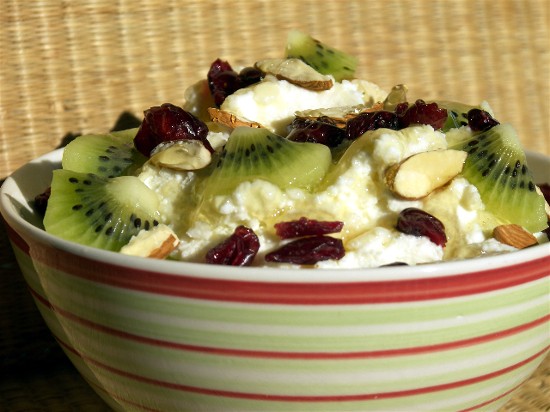
Fresh ricotta with fruits, almonds, and honey makes a heavenly breakfast.

Fresh ricotta with fruits, almonds, and honey makes a heavenly breakfast.

I didn’t truly appreciate ricotta until Sicily.

In Sicily, I tasted simple, fresh warm ricotta, with no embellishment, served in a terra cotta dish. I tasted ricotta all gussied up in cassata, a fancy sponge cake filled with sheep’s and cow’s milk ricotta (passed through a sieve to become silken), mixed with sugar, candied fruits and bitter chocolate.

Every ricotta I tasted spoke to me. They were creamy but with a slightly granular feel on the tongue. They were sweet from the lactic sugars with just a slight hint of tartness. They conveyed pure dairy freshness you could enjoy with a spoon instead from a glass.

Needless to say, the packaged supermarket ricottas in the U.S. don’t equal the fresh Sicilian. And, I’m not lucky enough to live near any delis that prepare fresh ricotta. (I’m sure they must exist.) So, I decided to try making ricotta myself. I consulted many sources which called for various ingredients to coagulate the milk: vinegar, lemon juice, buttermilk and rennet.

In Italy, ricotta (which means “re-cooked”) is a by-product of the cheese-making process. Whey, the liquid part of milk that drains off after curds are formed to make cheese, is then treated with rennet to produce loose fresh curds which are eaten fresh. The beauty of ricotta is its freshness.

Comparison tasting of homemade ricottas.

Comparison tasting of homemade ricottas.

I played with the four coagulants and staged a blind tasting on Walter. He returned the favor and fed me the ricottas so I could taste them blind. The rennet batch carried the day. To our taste, the vinegar, lemon juice, and buttermilk contributed harsh undertones that detracted from the sweet milk. But not the rennet version. It’ll tide me over until I get back to Sicily.

If you plan to try the ricotta recipe, a few pieces of equipment will make the process easier. A chinois, or other long conical sieve, works best for draining the ricotta because it allows the weight of the soft curds to press down on themselves. An instant-reading digital thermometer gives accurate temperature readings. A clean muslin kitchen towel or an old cotton pillowcase (cheesecloth also works well) are important for lining the sieve because they prevent the soft curds from passing through the sieve holes.

New England Cheesemaking Supply Company sells both animal and vegetable rennet at www.cheesemaking.com

You can make a large batch if you like but this amount is workable for a beginner.

Ricotta coagulated with rennet produces a soft, creamy, sweet cheese.

Ricotta coagulated with rennet produces a soft, creamy, sweet cheese.

Ricotta

1 quart (4 cups) whole milk

1/4 teaspoon kosher or sea salt

1/2 teaspoon liquid animal rennet stirred into 2 tablespoons cool water

Rinse a muslin towel or a double thickness of cheesecloth. Wring it out. Line a chinois or other deep conical sieve with the cloth. Place the chinois or sieve in a deep pot, bowl or other container. There must be space between the bottom of the chinois and the container for the liquid to drip off.

Heat the milk in a saucepan, preferably nonstick, over medium-high heat, stirring occasionally with a wooden spoon until a digital thermometer not touching the bottom or sides registers 200°F. Remove from the heat and stir in the salt. Cool to 125°F.

In a small cup, mix the rennet and water. Stir into the milk. Allow to sit for about 10 minutes, or until the milk thickens and looks like loose yogurt. With a slotted spoon, stir the mixture and then spoon the curds into the prepared sieve. Allow to drain for 1 hour or longer until the ricotta is desired consistency.

Gathering the ends of the cheesecloth or towel, create a pouch and lift it out of the sieve allowing excess liquid to drip off. Lay the cloth on a work surface. With a spatula, scrape all the ricotta from the towel. Eat right away or transfer to a tightly closed container. Refrigerate for up to 3 days.

Makes about 1 cup

Note

The captured whey can be used in place of yogurt or butter milk in recipes.

Have you made ricotta at home? Please share your experience with us.

Filed Under: Food, Recipes Tagged With: Italian cooking, italian food, italian recipes, making ricotta, ricotta

  • « Previous Page
  • 1
  • …
  • 37
  • 38
  • 39
  • 40
  • 41
  • …
  • 45
  • Next Page »
Sharon Home Page

Benvenuti!

Italy transformed my life and I know I’m not alone.

More about Sharon...

Follow Simple Italy on FacebookFollow Simple Italy on RSS
Lasagne_19 Simple Italy's Greatest Hits at a click!
Lasagne alla Bolognese and more

Recent posts

  • The Hill Towns of Molise
  • Fior di Latte Cheese
  • In the Mood for Molise, Italy
  • Silk from the Sea in Sardinia
  • Driving a Ferrari Spider
campari
Welcome to all who embrace la vita bella.
Even if we don't live in Italy, Italy lives inside of us.
Sharon and Walter Sanders'Italian Wedding Sharon and Walter's Italian Wedding

Posts by Category

  • Abruzzo (12)
  • AirBnB (1)
  • Amalfi (8)
  • Archeology (3)
  • Architecture (21)
  • Art (19)
  • Artisans (4)
  • Automobiles (1)
  • Bakery (1)
  • Basilicata (3)
  • Bologna (4)
  • Books (21)
  • Calabria (4)
  • Campania (17)
  • Cooking Classes (5)
  • Cremona (2)
  • Culture (174)
  • dreamofitaly (1)
  • Driving in Italy (2)
  • Emilia Romagna (2)
  • Ferrari (1)
  • Ferrari Museum (1)
  • Film (22)
  • Florence (30)
  • Food (134)
  • Fred Plotkin (1)
  • Friuli-Venezia Giulia (2)
  • Gardening (25)
  • Genoa (2)
  • Golf in Italy (1)
  • Guides (1)
  • History (8)
  • Hotels (14)
  • Inner Italian Q & A (11)
  • Italian seafood (7)
  • Italy Artisans (3)
  • Italy restaurants (17)
  • Language (86)
  • Le Marche (4)
  • Lifestyle (113)
  • Liguria (2)
  • Lombardy cooking (5)
  • Lucca (3)
  • Mantua (1)
  • Markets (26)
  • Mediterranean diet (55)
  • Milan (1)
  • Miscellany (86)
  • Modena (1)
  • Molise (3)
  • Mt. Etna (1)
  • Music (9)
  • Naples (2)
  • New Orleans (2)
  • Opera (1)
  • Palermo (3)
  • People (3)
  • Photography (4)
  • Piedmont cooking (1)
  • Puglia (9)
  • Quotes (4)
  • Recipes (64)
  • Rome (8)
  • Salerno (3)
  • Sardinia (4)
  • Sicily (15)
  • Test Drive (1)
  • Testimonials (2)
  • Travel (110)
  • Trentino Alto-Adige (1)
  • Tuscan cooking (17)
  • Tuscany (30)
  • Venice (2)
  • Videos (2)
  • Wine (23)

Inside SimpleItaly

  • American Couple Marries Italian-Style
  • Appearances
  • Contact us
  • Cooking Up an Italian Life
  • Le Marche Tour with Luisa
  • Links
  • Palazzo Donati Sample Itinerary
  • Palazzo Donati Tours
  • Privacy and Site Policies
  • Publications and TV
  • Sharon’s Inner Italian
  • SimpleItaly Adventure in Tuscany Tour
  • Thank You
  • Walter’s Inner Italian
Walter Sanders

Walter's Inner Italian

More about Walter...


International Association of Culinary Professionals member

Tags

Abruzzo bucket list Florence Gardening gelato Genoa Inner Italian Italian cooking italian culture italian food Italian food stores italian language italian lifestyle italian markets Italian music Italian pasta recipe italian recipes Italian tourism italian travel italian wine Italy Italy travel Lago di Como Lake Como Malika Ayane Mediterranean diet mozzarella di bufala Naples tourism Paestum Paolo Conte porcini Puglia Rome Santa Croce Sardegna Sardinia Sicily Southern Italy Stile Mediterraneo Sulmona Tuscan cooking Tuscany Uffizi Gallery Villa Pipistrelli women and travel