Simple Italy

Celebrating Your Inner Italian

  • Home
  • Contact us
  • Links

Torta di Fragole

Posted June 7, 2010 by Sharon 1 Comment

Torta di fragole, strawberry tart with rum pastry cream, is a celebration of spring in Italy.

When fragoline, the tiny woods strawberries, appear in markets and trattorie in late spring, it is truly cause for celebration. During their brief reign, there is no other dessert worth contemplating. Eaten simply out of hand or in a cookie crusted cream tart, now is the time to revel in this sweet seasonal gift.

Torta di Fragole (Strawberry Tart)

Makes 10 servings

Sweet Pastry Dough (recipe follows)

1/3       cup sugar

2          tablespoons all-purpose flour

1            egg plus 2 egg yolks

1          cup half-and-half or whole milk

2          tablespoons dark rum, divided

1          tablespoon butter

1          quart (1 1/2 pounds) medium or small strawberries, halved if desired

1/2       cup all-fruit apricot preserves

Coat a 12-inch round baking or pizza pan with no-stick spray. Prepare the dough. Pat into the bottom and 1 3/4 inches up the side of the pan. Prick all over with a fork. Refrigerate for 30 minutes.

Preheat the oven to 350°F.

Bake for about 30 minutes, pricking any big air bubbles with a fork, or until the entire surface is lightly browned. Remove to a rack. Store, covered with waxed paper, in a dry place for up to 24 hours.

Meanwhile, in a medium saucepan, whisk the sugar and flour. In a measuring cup, beat the egg, egg yolks, and half-and-half or milk. Add to the pan; whisk until smooth.

Cook, whisking constantly, over medium heat for 4 to 5 minutes, or until the mixture starts to bubble. Cook, whisking vigorously to prevent lumping, for 1 minute. Remove from the heat. Continue whisking until mixture cools slightly. Whisk in 1 tablespoon rum and the butter. Pour into a bowl. Set aside to cool slightly. Cover and refrigerate for at least 1 hour or as long as 1 day.

Place the preserves in a glass measuring cup. Cover and microwave for 60 to 70 seconds, or until bubbling. Press through a fine sieve. Discard the solids. Stir in the remaining 1 tablespoon rum.

Up to 2 hours before serving, spread the pastry cream evenly over the crust. Top with strawberries decorative pattern. Brush the top evenly with the apricot glaze. Refrigerate, uncovered, for up to 2 hours.

Sweet Pastry Dough

1 1/4    cups all-purpose flour

1/4       cup cornstarch

1/3       cup sugar

2          teaspoons grated lemon zest

Pinch of salt

1 1/4    sticks (10 tablespoons) cold unsalted butter, cut in small pieces

2          egg yolks, beaten with 1 tablespoon water

To prepare by hand: In a mixing bowl, combine the flour, cornstarch, sugar, lemon zest, and salt with a fork, pastry blender, or hands. Add the butter. Cut or break it up into fine bits, mixing well with the dry ingredients. Make a well in the center. Add the egg yolk mixture. Toss to mix. The mixture will look crumbly. Turn the mixture out onto a work surface. With hands and a dough scraper, work the mixture into a smooth disk.

To prepare in a food processor: In the bowl of a food processor, combine the flour, cornstarch, sugar, lemon zest, and salt. Process to mix. Add the butter. Pulse 12 to 15 times to incorporate. With the machine running, drizzle in the egg yolk mixture. Turn off the machine. Pulse 6 times. The mixture will look crumbly. Turn the mixture out onto a work surface. With hands and a dough scraper, work the mixture into a smooth disk. Refrigerate for 30 minutes, if desired, so dough is easier to handle.

Filed Under: Food, Recipes Tagged With: italian dessert recipes, Italian strawberry recipes, strawberry tart

Market to Table

Posted May 5, 2010 by Sharon 4 Comments

Berks County, PA farmers Charis and Michael, opening day of the Emmaus Farmers Market 2010.

How do I get in touch with my Inner Italian when I’m not in Italy? For seven months of the year, I purchase just-picked produce at my local farmers’ market. It’s one of the best ways I know of to eat “Italian.”

Dinner possibilities sprouted before me.

Walter grilled onions and asparagus coated in olive oil while I cooked rigatoni.

I tossed in some cooked cannellini beans and sage for the first of many simple, satisfying summer meals to come.

Sprinkle on freshly grated Parmesan or breadcrumbs crisped in olive oil for a vegan dish.

How does seasonal produce inspire your meals? Share your story.

Filed Under: Culture, Food, Gardening, Lifestyle, Markets, Mediterranean diet, Miscellany Tagged With: Emmaus Farmers' Market, italian culture, italian food, italian markets, Italian pasta recipe, vegan pasta, vegetable pasta

Cacciucco

Posted March 22, 2010 by Sharon 8 Comments

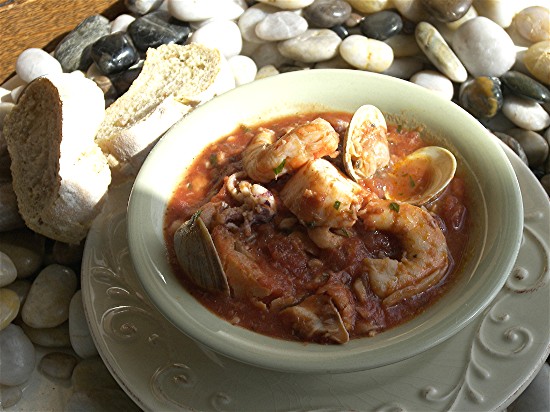
cacciucco

Every coastal region of Italy has a seafood stew. Tuscany— or more specifically the port town of Livorno—has cacciucco (ka-CHOO-ko). While the word is fun to pronounce, the dish is even more pleasurable to eat.

I yearn for cacciucco in the spring. It was in primavera that I first tasted cacciucco at Trattoria Benvenuto in Florence and I haven’t been the same since.

Some say the dish must have at least five types of seafood to correspond to the five Cs in the word. The more fish and shellfish, the better the flavor. And select good quality red wine and artisanal quality bread with good texture to soak up the amazing broth.

Choose the freshest fish available. Use one type or as many as three or four, to comprise 2 pounds. Sea bass, monkfish, cod, halibut, swordfish, shark, tilapia, turbot, catfish, or red snapper are all good choices.

As for the shellfish, in this recipe, I’m using littleneck clams and shrimp but baby calamari, octopus, mussels, or scallops may be substituted.

Cacciucco

Serves 6 to 8

3/4       cup olive oil
1          large red onion, coarsely chopped
4          large cloves garlic, minced
1 1/2    teaspoons dried crushed red-pepper flakes
1           cup dry red wine
1        can (28 ounces) crushed plum tomatoes
1/2       cup minced fresh flat-leaf parsley, divided
1 1/2 teaspoons salt
24       littleneck clams
24                medium or large unpeeled shrimp
2 to 2 1/2         pounds mild white-fleshed fish fillets, cut in 2-inch chunks
3          cups cold water
6 to 8 thick slices Rustic Bread, toasted

Heat the oil in a 6-quart Dutch oven over medium heat. Add the onion, garlic, and pepper flakes. Cook, stirring occasionally, for 10 minutes or until soft. Add the wine. Increase the heat to medium-high. Cook at a brisk simmer for 5 minutes or until the wine no longer smells of alcohol. Add the tomatoes, all but 2 tablespoons of the parsley, and salt. Bring to a boil then reduce the heat until sauce simmers gently. Cover and cook for 10 minutes, stirring occasionally, for the flavors to blend.

Add the clams and shrimp; stir. Add the fish and stir gently. Increase the heat to high. Cook for 2 minutes or until liquid starts to bubble. Add the water. Cover and reduce the heat so the mixture simmers but does not boil. Cook for 10 minutes or until the clams open and the other seafood is opaque in the center. Discard any clams that will not open. Spoon over bread set in pasta plates or large shallow bowls. Sprinkle with the remaining parsley.

What Italian seafood stews have you savored and where? Tell us!

Filed Under: Florence, Food, Italian seafood, Language, Mediterranean diet, Recipes, Tuscan cooking Tagged With: cacciucco, Italian seafood recipe, Italian seafood stew, Livorno

When Bad Wine Happens

Posted March 2, 2010 by Walter Leave a Comment

56CellarDefBy Walter Sanders

Sharon and I recently attended “An Evening in Tuscany” dinner hosted by our financial advisor’s firm.  The venue was a local country club, and the main attraction was Chris Cree, a certified Master of Wine and proprietor of the 56° Wine shop in Bernardsville, NJ.

Cree has created an admirable niche by focusing on small producers who hand-craft their wines. He and these producers share common philosophical interests: a commitment to sustainable agriculture, preserving terroir, and producing wines that rely not upon mass mechanization but a dedication to touching every aspect of the creation of better tasting wine.

The evening’s list whetted my appetite. The reception portion featured a 2008 Corzano e Paterno “Il Corzanello” Bianco, an inviting blend primarily of Trebbiano and Chardonnay.

The antipasto (beef carpaccio, arugula and Parmigiano-Reggiano cheese) was accompanied by a 2008 La Parrina Bianco, a blend of Trebbiano, Chardonnay and Sauvignon Blanc. Answering a question of ‘white wine with beef?’ Cree explained that the preparation method—shaved raw beef in a light dressing—dictated the pairing.

The primo of wild mushroom risotto and secondo of braised beef short rib, sided by greens and vegetables were complemented by a 2007 Imbottigliato Da Racine Chianti Classico and a 2006 Isole e Olena Cepparello IGT Super Tuscan, respectively.

The dessert of Moscato poached pears was accompanied by a 2001 Isole e Olena Vin Santo.

So what happened when one of the five meticulously selected pairings came up corked?

ChrisCree_welcome2No trauma, no embarrassment, but rather, Cree used the misfortune as a candid lesson about oxidization. He poured a glass from the single tainted bottle and passed it around the table so all could familiarize ourselves with the unfortunate aroma of corked wine.

That led to a discussion about what causes oxidization, anecdotes about having the courage to send back corked wine, an analysis of the range of what percentage of wines are problematic, and the industry solutions for dealing with the challenges of oxidization.

I raise a toast to Chris Cree, a true Master of Wine, who transformed the classic wine nightmare into a learning experience.

For more on 56° Wine and the challenges of and solutions to oxidization, check out the following links.
56° Wine
Wine Closures

Filed Under: Food, Lifestyle, Tuscan cooking, Wine Tagged With: Italian Wine; corked wine; Tuscan wines; Chris Cree; 56° Wine; 56 Degree Wine; wine oxidization

Ragú

Posted February 16, 2010 by Sharon 1 Comment

raguRagú is the Italian term for long-simmered, mellow meat sauce that dresses pasta or polenta. It varies from region to region, sometimes prepared with large chunks of meat, sometimes with ground, or more properly, finely minced meat.

I’ve sampled ragú of duck, rabbit, mixed meats, and sausages and have never encountered one that failed to satisfy my appetite. Arguably the most renowned of Italian meat sauces is ragú alla bolognese from the storied food city of Bologna. It is classically prepared with a combination of chopped beef, veal, or pork, and, in the good old days, was finished with heavy cream. Milk is now more often used.

Finely chopping onion, celery, and carrot into a mxiture called a battuto is the first step in making a ragu.

Finely chopping onion, celery, and carrot into a mxiture called a battuto is the first step in making a ragu.

Ragú alla bolognese is not as tomatoey as the meat sauces of the south that influenced Italian American sauces. The tomato acidity in a bolognese is balanced by the sweetness of the sautéed aromatic vegetables—the soffrito, or flavor base.

The soffrito should be lightly caramelized but not browned. This sauteed vegetable mixture is the flavor base of ragu.

A properly cooked soffrito is one of the secrets to a divine ragu.

It’s essential to cook the soffrito slowly to lightly caramelize the vegetables without browning them. I like to remove the soffrito from the pot so the meats can brown without the steam created by the veggies.

[Read more…]

Filed Under: Bologna, Food, Recipes Tagged With: Bologna, italian food, Italian meat sauce, italian recipes, ragu, ragu alla bolognese

Why Italians Love To Talk About Food

Posted January 20, 2010 by Sharon 3 Comments

Photograph of Elena Kostioukovitch by Massimo Pasquale

Photograph of Elena Kostioukovitch by Massimo Pasquale

Elena Kostioukovitch is not Italian. She was born in Kiev, Ukraine. But Kostioukovitch is deeply in touch with her Inner Italian. How do I know? I’ve been reading Why Italians Love to Talk About Food, the Farrar, Straus and Giroux publication of her book.

Kostioukovitch’s day job is to translate the literary works of Umberto Eco and other authors into the Russian language. Also an essayist and literary agent, she has lived in Milan for more than two decades. She explains in the preface to her 400-plus page tome, “This book was born specifically to assemble in a single volume stories about the symbolic foods of each Italian region and their ‘ideological’ meanings.”

She creates an intellectual journey from the north of the peninsula to the south, exploring culinary history, characteristic dishes, and cultural eccentricities of each region. Her research is rigorous — footnotes and bibliography cover more than 30 pages.

We learn, for instance, that the aperitivo Campari was created by Gaspare Campari at the Caffè Zucca in Milan in 1867.

We practically taste the brine on our lips as we discover that the remaining wilderness of Puglia fosters in the locals a preference for unadulterated foods. “The tendency to eat unprocessed food is especially evident in the consumption of raw fish. In fish markets, for example, it is customary to set out plates of raw shrimp, cuttlefish, and mussels for customers who are waiting, to be eaten on the spot with a squirt of lemon.”

And who knew that Nutella, the jarred gianduia paste created by the Ferrero brothers in Piedmont, makes a political statement? Kostioukovitch explains, “Nutella, loved by children (naturally) and adults, was also prized by nonconformists and leftists. As Italy’s answer to [American peanut butter], it is winning, uplifting, and youthful, a sign of democracy and leftist ideals.”

Essays interspersed between the regional food chapters are quirky and informative, covering topics as diverse as the “Jews,” “Early Gifts from the Americas,” “Totalitarianism,” and “Joy.” I particularly appreciated “Preparation Methods,” a roster of dozens of cooking techniques written in sort of a shorthand code. Not much is spelled out for the Italian home cook in printed recipes—presumably the cook learned these methods at an older cook’s elbow.

“Soak prickly pears.”

“Extract the ink from cuttlefish.”

“Shape polenta in a cloth.”

“Crogiolare (bask or laze comfortably): cook a food over a slow fire, with a little liquid, for a long time.”

One word of warning: Perusing this volume can be hazardous on an empty stomach. Hunger ensues. References to Roman coda all vaccinara (oxtail stew), Neopolitan sartù, (a rice mold with giblets, mushrooms, peas and mozzarella), Ferrara’s pumpkin filled tortelli, Calabrian jujume (sea anemone fritters), Sicilian granita with brioche, and more dishes too numerous to recount will surely make you long to be dining at an Italian table.

Kostioukovitch bottom line is this: “Examining the culture of food, we also come to understand its unique ability to inspire joy and create harmony. Whether at table with family, in a restaurant with friends, or at a scientific conference—food is talked about in a language that is accessible to all, exciting to everyone, democratic and positive.”

What conversations have you enjoyed around an Italian table?

Comment below.

Filed Under: Culture, Food, Italian seafood, Language, Lifestyle, Mediterranean diet, Travel Tagged With: Elena Kostioukovitch, Italian cooking, italian food, Italian regional cooking, Umberto Eco

  • « Previous Page
  • 1
  • …
  • 16
  • 17
  • 18
  • 19
  • 20
  • …
  • 23
  • Next Page »
Follow Simple Italy on FacebookFollow Simple Italy on RSS
Lasagne_19 Simple Italy's Greatest Hits at a click!
Lasagne alla Bolognese and more

Recent posts

  • The Hill Towns of Molise
  • Fior di Latte Cheese
  • In the Mood for Molise, Italy
  • Silk from the Sea in Sardinia
  • Driving a Ferrari Spider

Posts by Category

  • Abruzzo (12)
  • AirBnB (1)
  • Amalfi (8)
  • Archeology (3)
  • Architecture (21)
  • Art (19)
  • Artisans (4)
  • Automobiles (1)
  • Bakery (1)
  • Basilicata (3)
  • Bologna (4)
  • Books (21)
  • Calabria (4)
  • Campania (17)
  • Cooking Classes (5)
  • Cremona (2)
  • Culture (174)
  • dreamofitaly (1)
  • Driving in Italy (2)
  • Emilia Romagna (2)
  • Ferrari (1)
  • Ferrari Museum (1)
  • Film (22)
  • Florence (30)
  • Food (134)
  • Fred Plotkin (1)
  • Friuli-Venezia Giulia (2)
  • Gardening (25)
  • Genoa (2)
  • Golf in Italy (1)
  • Guides (1)
  • History (8)
  • Hotels (14)
  • Inner Italian Q & A (11)
  • Italian seafood (7)
  • Italy Artisans (3)
  • Italy restaurants (17)
  • Language (86)
  • Le Marche (4)
  • Lifestyle (113)
  • Liguria (2)
  • Lombardy cooking (5)
  • Lucca (3)
  • Mantua (1)
  • Markets (26)
  • Mediterranean diet (55)
  • Milan (1)
  • Miscellany (86)
  • Modena (1)
  • Molise (3)
  • Mt. Etna (1)
  • Music (9)
  • Naples (2)
  • New Orleans (2)
  • Opera (1)
  • Palermo (3)
  • People (3)
  • Photography (4)
  • Piedmont cooking (1)
  • Puglia (9)
  • Quotes (4)
  • Recipes (64)
  • Rome (8)
  • Salerno (3)
  • Sardinia (4)
  • Sicily (15)
  • Test Drive (1)
  • Testimonials (2)
  • Travel (110)
  • Trentino Alto-Adige (1)
  • Tuscan cooking (17)
  • Tuscany (30)
  • Venice (2)
  • Videos (2)
  • Wine (23)

Inside SimpleItaly

  • American Couple Marries Italian-Style
  • Appearances
  • Contact us
  • Cooking Up an Italian Life
  • Le Marche Tour with Luisa
  • Links
  • Palazzo Donati Sample Itinerary
  • Palazzo Donati Tours
  • Privacy and Site Policies
  • Publications and TV
  • Sharon’s Inner Italian
  • SimpleItaly Adventure in Tuscany Tour
  • Thank You
  • Walter’s Inner Italian

Tags

Abruzzo bucket list Florence Gardening gelato Genoa Inner Italian Italian cooking italian culture italian food Italian food stores italian language italian lifestyle italian markets Italian music Italian pasta recipe italian recipes Italian tourism italian travel italian wine Italy Italy travel Lago di Como Lake Como Malika Ayane Mediterranean diet mozzarella di bufala Naples tourism Paestum Paolo Conte porcini Puglia Rome Santa Croce Sardegna Sardinia Sicily Southern Italy Stile Mediterraneo Sulmona Tuscan cooking Tuscany Uffizi Gallery Villa Pipistrelli women and travel