Simple Italy

Celebrating Your Inner Italian

  • Home
  • Contact us
  • Links

Tuscan Porcini Soup

Posted November 24, 2010 by Sharon 2 Comments

One taste of zuppa di porcini whisks me to rural Tuscany in autumn. My friend Anna Maria Gaggio showed me how to make this dish in the kitchen of her Tuscan farmhouse, using fresh porcini gathered by her husband Mario.

Because imported porcini are outrageously expensive, I recreate the soup using a mixture of fresh baby bella mushrooms and reconstituted dried porcini. The flavor is intense because the dried mushrooms concentrate the essence.

The portions in this recipe are adequate for a light meal with a salad. Half portions make a wonderful first course for a holiday meal. If you like, prepare the soup a few days ahead of time, refrigerate and reheat before serving.

Zuppa di Porcini

Serves 4 to 6

1          ounce dried porcini mushrooms

2                    cans fat-free reduced-sodium (14 1/2 ounces each) chicken broth, divided

1/3       cup olive oil

1 1/4    pounds baby bella mushrooms, sliced

4          cloves garlic, minced

1          tablespoon minced fresh rosemary leaves

1/4       teaspoon dried red-pepper flakes

3/4       teaspoon salt

1                    can (14 1/2 ounces) diced tomatoes, drained

4        cups water

4 to 6   slices (1-inch-thick) toasted rustic bread

2          ounces (1/2 cup) grated Parmesan cheese

Place the porcini and 1 cup of broth in a microwaveable glass measuring cup. Cover with plastic wrap, leaving a vent. Microwave for 3 minutes or until bubbling. Set aside for 10 minutes to soften.

Meanwhile, warm the oil in a large pot over high heat. Add the baby bella mushrooms, garlic, rosemary, red-pepper flakes, and salt. Cook, stirring, for about 5 minutes or until the mushrooms start to give off liquid. Turn off the heat.

Drain the porcini through a fine sieve lined with a coffee filter. Save the broth. Rinse the porcini and chop. Add the porcini, mushroom broth, chicken broth, water, and tomatoes to the pot. Cook over medium-low heat for 20 minutes for the flavors to blend.

Place a slice of toasted bread in the bottom of each soup bowl. Ladle the soup over the bread. Sprinkle with the Parmesan.

Note

Fresh rosemary is preferable to commercially dried leaves but if necessary, 2 teaspoons of dried rosemary may replace the fresh. Home-dried leaves, which crumble more readily than the commercially packaged rosemary, are also good to use. When you buy a bunch of fresh rosemary for a recipe, if you don’t use it all right away,  it makes sense to dry or freeze the remaining branches so they don’t go to waste.

Filed Under: Culture, Food, Language, Lifestyle, Mediterranean diet, Recipes, Tuscan cooking, Tuscany Tagged With: funghi porcini, Italian winter soups, porcini, porcini mushrooms, rosemary, zuppa di porcini

Panzanella

Posted August 5, 2010 by Sharon 6 Comments


I crave panzanella in August. This home-spun jumble of stale bread, succulent tomatoes, aromatic basil, olive oil, wine vinegar, cucumber and onion is restorative. Each refreshing bite perks me up, makes me feel more  like a budding flower and less like a scorched weed.

I first tasted panzanella in the countryside outside of Florence. Friends told me that the dish evolved as thrifty country cooks combined stale bread with juicy seasonal produce to create a quick, inexpensive salad.

These days, the challenge to putting together a good panzanella is in obtaining ingredients that will give the dish a genuine flavor and the proper texture. The keys are the bread, the tomatoes, and the olive oil.

Bread

Panzanella requires a rustic whole-grain loaf–with no fat or sweeteners–that won’t dissolve into goo when moistened. (LaBrea Bakery whole grain loaf is one commercially-produced example. To find a store near you, go to La Brea Bakery.) Many so-called Italian breads are made from white flour and dough enhancers and are just too fluffy to hold their crumb. If you’re a baker, you can prepare the Italian Wheat Berry Bread for the panzanella. If you think your bread won’t hold up to the water bath, I recommend skipping that process. Instead, simple toast the bread lightly and then cut it into cubes before tossing with the vegetables and dressing.

Tomatoes

Choose very ripe fruit that’s grown in your area. I like heirloom varieties which are like tomato-juice machines.

Olive oil
The fruity taste of extra-virgin oil is essential. When it’s mixed with the vegetables and basil, it produces a seasonal elixir.

While I prefer the classic simplicity of the following recipe, you can add protein or other vegetables to a panzanella to make it a one-dish meal. Add-ins include lettuce, radishes, celery, fennel, prosciutto, canned tuna, Parmigiano Reggiano, Gruyère, capers, artichoke hearts, hard-cooked eggs and roasted red peppers.

Panzanella (Tuscan Bread and Tomato Salad)

Makes 6 to 8 servings

1 loaf (about 1 pound) rustic Italian Wheat Berry Bread, cut into 1/2-inch cubes, dried

1/3 cup extra-virgin olive oil

2 tablespoons red or white wine vinegar

Salt and pepper

1 1/2 pounds ripe locally-grown tomatoes, cut into chunks

1 medium cucumber, peeled, quartered lengthwise, sliced

1/2 medium red onion (about 4 ounces), halved and thinly sliced

1/2 cup slivered fresh basil

Place the bread in a large bowl. Cover with cold water. Allow to soak for 30 to 60 seconds until bread is saturated. Test by squashing a piece between thumb and finger. Drain. Scoop the bread in cupped handfuls, squeezing out excess water but taking care not to pulverize the bread. Transfer to a platter. Continue until all the bread is squeezed.

In a large bowl, whisk the oil, vinegar, and 1/4 teaspoon salt. Add the tomatoes, cucumber, onion, and basil. Toss. Add the bread and toss. Season to taste with pepper and more salt, if needed.

What’s your go-to Italian summer dish? Tell us about it.

Filed Under: Culture, Florence, Food, Mediterranean diet, Recipes, Tuscan cooking Tagged With: Italian summer salad, Tuscan bread and tomato salad, Tuscan cooking

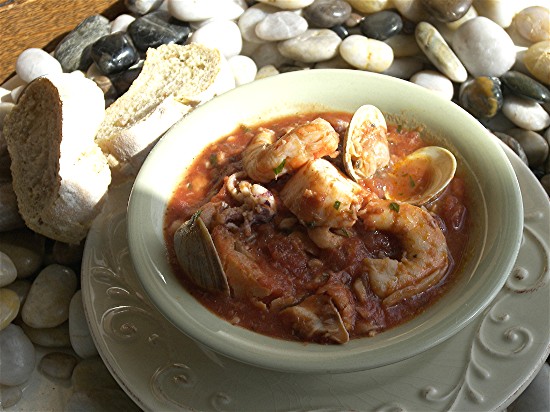
Cacciucco

Posted March 22, 2010 by Sharon 8 Comments

cacciucco

Every coastal region of Italy has a seafood stew. Tuscany— or more specifically the port town of Livorno—has cacciucco (ka-CHOO-ko). While the word is fun to pronounce, the dish is even more pleasurable to eat.

I yearn for cacciucco in the spring. It was in primavera that I first tasted cacciucco at Trattoria Benvenuto in Florence and I haven’t been the same since.

Some say the dish must have at least five types of seafood to correspond to the five Cs in the word. The more fish and shellfish, the better the flavor. And select good quality red wine and artisanal quality bread with good texture to soak up the amazing broth.

Choose the freshest fish available. Use one type or as many as three or four, to comprise 2 pounds. Sea bass, monkfish, cod, halibut, swordfish, shark, tilapia, turbot, catfish, or red snapper are all good choices.

As for the shellfish, in this recipe, I’m using littleneck clams and shrimp but baby calamari, octopus, mussels, or scallops may be substituted.

Cacciucco

Serves 6 to 8

3/4       cup olive oil
1          large red onion, coarsely chopped
4          large cloves garlic, minced
1 1/2    teaspoons dried crushed red-pepper flakes
1           cup dry red wine
1        can (28 ounces) crushed plum tomatoes
1/2       cup minced fresh flat-leaf parsley, divided
1 1/2 teaspoons salt
24       littleneck clams
24                medium or large unpeeled shrimp
2 to 2 1/2         pounds mild white-fleshed fish fillets, cut in 2-inch chunks
3          cups cold water
6 to 8 thick slices Rustic Bread, toasted

Heat the oil in a 6-quart Dutch oven over medium heat. Add the onion, garlic, and pepper flakes. Cook, stirring occasionally, for 10 minutes or until soft. Add the wine. Increase the heat to medium-high. Cook at a brisk simmer for 5 minutes or until the wine no longer smells of alcohol. Add the tomatoes, all but 2 tablespoons of the parsley, and salt. Bring to a boil then reduce the heat until sauce simmers gently. Cover and cook for 10 minutes, stirring occasionally, for the flavors to blend.

Add the clams and shrimp; stir. Add the fish and stir gently. Increase the heat to high. Cook for 2 minutes or until liquid starts to bubble. Add the water. Cover and reduce the heat so the mixture simmers but does not boil. Cook for 10 minutes or until the clams open and the other seafood is opaque in the center. Discard any clams that will not open. Spoon over bread set in pasta plates or large shallow bowls. Sprinkle with the remaining parsley.

What Italian seafood stews have you savored and where? Tell us!

Filed Under: Florence, Food, Italian seafood, Language, Mediterranean diet, Recipes, Tuscan cooking Tagged With: cacciucco, Italian seafood recipe, Italian seafood stew, Livorno

When Bad Wine Happens

Posted March 2, 2010 by Walter Leave a Comment

56CellarDefBy Walter Sanders

Sharon and I recently attended “An Evening in Tuscany” dinner hosted by our financial advisor’s firm.  The venue was a local country club, and the main attraction was Chris Cree, a certified Master of Wine and proprietor of the 56° Wine shop in Bernardsville, NJ.

Cree has created an admirable niche by focusing on small producers who hand-craft their wines. He and these producers share common philosophical interests: a commitment to sustainable agriculture, preserving terroir, and producing wines that rely not upon mass mechanization but a dedication to touching every aspect of the creation of better tasting wine.

The evening’s list whetted my appetite. The reception portion featured a 2008 Corzano e Paterno “Il Corzanello” Bianco, an inviting blend primarily of Trebbiano and Chardonnay.

The antipasto (beef carpaccio, arugula and Parmigiano-Reggiano cheese) was accompanied by a 2008 La Parrina Bianco, a blend of Trebbiano, Chardonnay and Sauvignon Blanc. Answering a question of ‘white wine with beef?’ Cree explained that the preparation method—shaved raw beef in a light dressing—dictated the pairing.

The primo of wild mushroom risotto and secondo of braised beef short rib, sided by greens and vegetables were complemented by a 2007 Imbottigliato Da Racine Chianti Classico and a 2006 Isole e Olena Cepparello IGT Super Tuscan, respectively.

The dessert of Moscato poached pears was accompanied by a 2001 Isole e Olena Vin Santo.

So what happened when one of the five meticulously selected pairings came up corked?

ChrisCree_welcome2No trauma, no embarrassment, but rather, Cree used the misfortune as a candid lesson about oxidization. He poured a glass from the single tainted bottle and passed it around the table so all could familiarize ourselves with the unfortunate aroma of corked wine.

That led to a discussion about what causes oxidization, anecdotes about having the courage to send back corked wine, an analysis of the range of what percentage of wines are problematic, and the industry solutions for dealing with the challenges of oxidization.

I raise a toast to Chris Cree, a true Master of Wine, who transformed the classic wine nightmare into a learning experience.

For more on 56° Wine and the challenges of and solutions to oxidization, check out the following links.
56° Wine
Wine Closures

Filed Under: Food, Lifestyle, Tuscan cooking, Wine Tagged With: Italian Wine; corked wine; Tuscan wines; Chris Cree; 56° Wine; 56 Degree Wine; wine oxidization

Piccolo Forno

Posted March 20, 2009 by Sharon 3 Comments

The Piccolo Forno oven consumes a cord of kiln dried oak, cherry and maple wood every three months.

The Piccolo Forno oven consumes a cord of kiln-dried oak, cherry, and maple wood every three months.

I observed that Piccolo Forno was no run-of-the-mill Italian eatery before I even entered. As we stood on the threshold, a wait person, with the bearing of a dancer, stepped through the front door balancing a tray with a bowlful of steaming pasta e fagioli, complete with napkins and cutlery. She was delivering the fragrant bowl to a shopkeeper down the street, just as you still see waiters do in the small Italian towns or, even these days, in neighborhoods in the big cities.

Piccolo Forno is a Tuscan, or to be specific, Luccan, pizzeria that just happens to reside in the historic Lawrenceville neighborhood of Pittsburgh. Owner and chef Domenic Branduzzi and his mother Carla create genuine Tuscan food that probably rivals his uncle’s pizzeria Bar Branduzzi in the village of Corsagna, a 30 minute drive north of Lucca in Tuscany.

Luccan chef Domenic Branduzzi.

Luccan chef Domenic Branduzzi.

When I meet Domenic after our lunch, I tease him about the butter that comes with the bread basket-something you would never see in Italy- but he takes it good naturedly. That is likely his only concession to American tastes. “I do what I can do. I try to stay Tuscan,” Domenic says. “I’m happy and privileged to do this. My Mom cooks her heart out. These things are passed down. My parents believed in this.”

For many years, his parents Carla and Antonio operated Il Piccolo Forno Bakery in the Strip District, before his father died three years ago. The bakery is now closed. The couple met in Tuscany when Carla, a Pennsylvanian born of Italian immigrants, traveled to Italy in her 20s to study cooking.

“I spent four years learning to cook. It’s the greatest thing Italy has to offer,” says Carla, whose youthful demeanor makes her seem more like Domenic’s older sister than his mother. “I encouraged Antonio to go to the state school for baking.” All the while she was working with Antonio in the Pittsburgh bakery she was also raising Domenic, who was born in Lucca, and Domenic’s teenaged sisters Angela and Anna Maria.

“I cook to fill up my soul,” says Carla, and after one bite of her Lasagna Toscana, you say a prayer of thanks. The creation literally melts on your tongue: twelve gossamer sheets of home-made pasta, meat ragú, and bechamel. Carla’s hunger for learning seems insatiable. Her next goal is to attend the Italian Institute for Advanced Culinary and Pastry Arts in Calabria.

Meanwhile, Domenic refines the skills he learned during summers at Bar Branduzzi in Tuscany, Regina Margherita (the pizzeria that was in the building he now occupies) and at his folks’ Il Piccolo Forno Bakery. He explains that his pizzas are Tuscan style, with a crisper crust than Neapolitan. “The Neapolitan pizza is baked at 1000 degrees so it’s softer because it doesn’t bake as long. The Tuscan pizza is baked at 650 degrees so it bakes longer and becomes more crisp.”

The Pizze menu choices made me nostalgic for Florence. Like the Quattro Stagioni which features tomatoes and fresh mozzarella with the pie divided into four quadrants, each ingredient representing a season-prosciutto, roasted red peppers, mushrooms, and artichokes.

<i>Insalata di Rucola</i> with baby rocket, cherry tomatoes, radicchio, toasted walnuts and Parmigiano-Reggiano cheese.

Insalata di Rucola with baby rocket, cherry tomatoes, radicchio, toasted walnuts and Parmigiano-Reggiano cheese.

In addition to pizzas, you can order antipasti, insalate (like the Insalata di Rucola above), panini and dolci.

The pastas, as mentioned before, are all hand crafted by Carla and we were particularly enamored of the Cavatelli con Fagioli e Bietola (beans and chard). The ridged curls of soft dough are made with ricotta added to the egg/flour dough. Carla shared the recipe with me and as soon as the hand-cranked cavatelli machine arrives in the mail, I will try her recipe and share it with you.

bizcards1As we sipped the last drops of our espresso, the shopkeeper who had lunched on the pasta e fagioli came in to return the plate. She seemed like just one more member of the happy Piccolo Forno family.

Filed Under: Culture, Food, Tuscan cooking Tagged With: Italian cooking, italian food, Pittsburgh restaurants, Tuscan cooking

  • « Previous Page
  • 1
  • 2
  • 3
Follow Simple Italy on FacebookFollow Simple Italy on RSS
Lasagne_19 Simple Italy's Greatest Hits at a click!
Lasagne alla Bolognese and more

Recent posts

  • The Hill Towns of Molise
  • Fior di Latte Cheese
  • In the Mood for Molise, Italy
  • Silk from the Sea in Sardinia
  • Driving a Ferrari Spider

Posts by Category

  • Abruzzo (12)
  • AirBnB (1)
  • Amalfi (8)
  • Archeology (3)
  • Architecture (21)
  • Art (19)
  • Artisans (4)
  • Automobiles (1)
  • Bakery (1)
  • Basilicata (3)
  • Bologna (4)
  • Books (21)
  • Calabria (4)
  • Campania (17)
  • Cooking Classes (5)
  • Cremona (2)
  • Culture (174)
  • dreamofitaly (1)
  • Driving in Italy (2)
  • Emilia Romagna (2)
  • Ferrari (1)
  • Ferrari Museum (1)
  • Film (22)
  • Florence (30)
  • Food (134)
  • Fred Plotkin (1)
  • Friuli-Venezia Giulia (2)
  • Gardening (25)
  • Genoa (2)
  • Golf in Italy (1)
  • Guides (1)
  • History (8)
  • Hotels (14)
  • Inner Italian Q & A (11)
  • Italian seafood (7)
  • Italy Artisans (3)
  • Italy restaurants (17)
  • Language (86)
  • Le Marche (4)
  • Lifestyle (113)
  • Liguria (2)
  • Lombardy cooking (5)
  • Lucca (3)
  • Mantua (1)
  • Markets (26)
  • Mediterranean diet (55)
  • Milan (1)
  • Miscellany (86)
  • Modena (1)
  • Molise (3)
  • Mt. Etna (1)
  • Music (9)
  • Naples (2)
  • New Orleans (2)
  • Opera (1)
  • Palermo (3)
  • People (3)
  • Photography (4)
  • Piedmont cooking (1)
  • Puglia (9)
  • Quotes (4)
  • Recipes (64)
  • Rome (8)
  • Salerno (3)
  • Sardinia (4)
  • Sicily (15)
  • Test Drive (1)
  • Testimonials (2)
  • Travel (110)
  • Trentino Alto-Adige (1)
  • Tuscan cooking (17)
  • Tuscany (30)
  • Venice (2)
  • Videos (2)
  • Wine (23)

Inside SimpleItaly

  • American Couple Marries Italian-Style
  • Appearances
  • Contact us
  • Cooking Up an Italian Life
  • Le Marche Tour with Luisa
  • Links
  • Palazzo Donati Sample Itinerary
  • Palazzo Donati Tours
  • Privacy and Site Policies
  • Publications and TV
  • Sharon’s Inner Italian
  • SimpleItaly Adventure in Tuscany Tour
  • Thank You
  • Walter’s Inner Italian

Tags

Abruzzo bucket list Florence Gardening gelato Genoa Inner Italian Italian cooking italian culture italian food Italian food stores italian language italian lifestyle italian markets Italian music Italian pasta recipe italian recipes Italian tourism italian travel italian wine Italy Italy travel Lago di Como Lake Como Malika Ayane Mediterranean diet mozzarella di bufala Naples tourism Paestum Paolo Conte porcini Puglia Rome Santa Croce Sardegna Sardinia Sicily Southern Italy Stile Mediterraneo Sulmona Tuscan cooking Tuscany Uffizi Gallery Villa Pipistrelli women and travel