Simple Italy

Celebrating Your Inner Italian

  • Home
  • Contact us
  • Links

Chocolate Time

Posted April 1, 2009 by Sharon 1 Comment

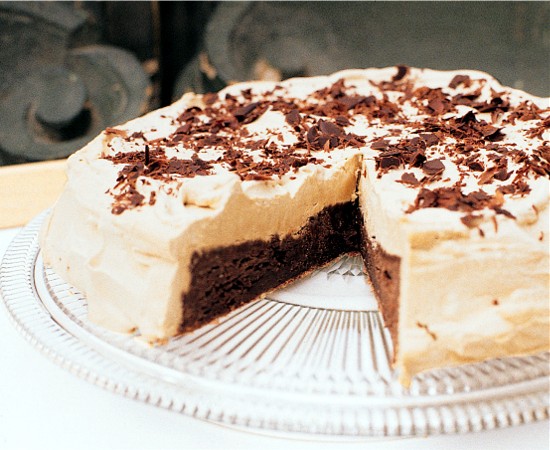
chococapptorte

April is cruel on dessert lovers.

Citrus fruits are past their prime.

Apples and pears, in cold storage since last autumn,  are mealy.

Local strawberries, blueberries, cherries, and raspberries are a distant glimmer on the horizon.

Waiting is difficult.

But, fortunately, chocolate is perennial.

A Chocolate Torte with Cappuccino Cream in the freezer makes the time until strawberries just a bit sweeter.

Frozen Chocolate Torte with Cappuccino Cream

4          ounces unsweetened chocolate, chopped

1          cup all-purpose flour

1          teaspoon baking powder

Pinch of salt

2          sticks (1/2 cup each) unsalted butter, softened

1 3/4     cups sugar

4          large eggs

2          teaspoons vanilla extract

1          tablespoon instant espresso or regular instant coffee

1          cup whipping cream

2          tablespoons confectioners’ sugar

Bittersweet chocolate shavings for garnish

Preheat the oven to 350°F. Coat a 10-inch round springform pan with no-stick

spray.

Put the chocolate in a small microwaveable bowl. Microwave for 2 minutes. Stir. If lumps remain, microwave for about 20 seconds. Stir and set aside. On a sheet of waxed paper, combine the flour, baking powder, and salt. Stir to mix; set aside.

In the bowl of an electric mixer, beat the butter for about 2 minutes, or until fluffy. Gradually add the sugar, continuing to beat, and scraping the sides of the bowl as needed. Beat in the eggs, one at a time. Add the melted chocolate and the vanilla. Reduce the mixer speed to low. Add the reserved dry ingredients. Mix just to incorporate. Spoon into the prepared pan. Spread evenly.

Bake for about 45 minutes, or until a toothpick inserted into the center comes out clean. Remove the torte from the oven. Allow to sit for 5 minutes. Remove the outer ring of the pan. Place a freezerproof serving dish over the torte. Invert the torte onto the dish. Run the blade of a long thin knife between the top of the torte and the pan bottom to separate. Allow to cool.

In the mixing bowl of an electric mixer, stir instant espresso or regular instant coffee with 1 teaspoon cold water to dissolve. Add cream. Whip on high speed for 2 to 3 minutes or until soft peaks form. Add confectioners’ sugar. Whip for 1 to 2 minutes, or until peaks hold their shape. Spread, swirling into peaks, over the top and sides of the cooled torte.

Place in the freezer, uncovered, for 2 hours. For longer storage, cover tightly with plastic wrap and then with aluminum foil. Freeze for up to 1 week. To serve, unwrap and allow to sit at room temperature for 15 to 20 minutes. Bittersweet chocolate shavings may be scattered on top for decoration.

Makes 12 servings

©Cooking Up an Italian Life, PergolaWest, Inc.
Filed Under: Food, Recipes Tagged With: chocolate, Italian chocolate desserts, italian food, italian recipes

Making Ricotta

Posted March 22, 2009 by Sharon 9 Comments

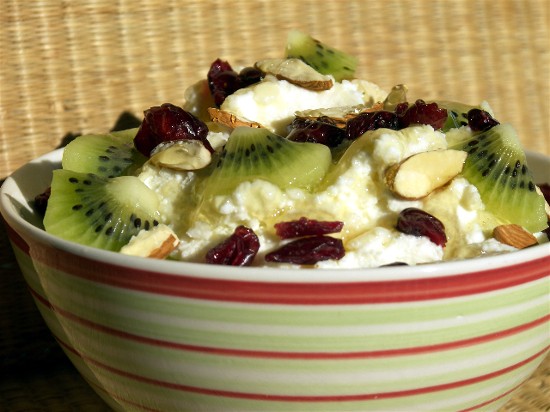
Fresh ricotta with fruits, almonds, and honey makes a heavenly breakfast.

Fresh ricotta with fruits, almonds, and honey makes a heavenly breakfast.

I didn’t truly appreciate ricotta until Sicily.

In Sicily, I tasted simple, fresh warm ricotta, with no embellishment, served in a terra cotta dish. I tasted ricotta all gussied up in cassata, a fancy sponge cake filled with sheep’s and cow’s milk ricotta (passed through a sieve to become silken), mixed with sugar, candied fruits and bitter chocolate.

Every ricotta I tasted spoke to me. They were creamy but with a slightly granular feel on the tongue. They were sweet from the lactic sugars with just a slight hint of tartness. They conveyed pure dairy freshness you could enjoy with a spoon instead from a glass.

Needless to say, the packaged supermarket ricottas in the U.S. don’t equal the fresh Sicilian. And, I’m not lucky enough to live near any delis that prepare fresh ricotta. (I’m sure they must exist.) So, I decided to try making ricotta myself. I consulted many sources which called for various ingredients to coagulate the milk: vinegar, lemon juice, buttermilk and rennet.

In Italy, ricotta (which means “re-cooked”) is a by-product of the cheese-making process. Whey, the liquid part of milk that drains off after curds are formed to make cheese, is then treated with rennet to produce loose fresh curds which are eaten fresh. The beauty of ricotta is its freshness.

Comparison tasting of homemade ricottas.

Comparison tasting of homemade ricottas.

I played with the four coagulants and staged a blind tasting on Walter. He returned the favor and fed me the ricottas so I could taste them blind. The rennet batch carried the day. To our taste, the vinegar, lemon juice, and buttermilk contributed harsh undertones that detracted from the sweet milk. But not the rennet version. It’ll tide me over until I get back to Sicily.

If you plan to try the ricotta recipe, a few pieces of equipment will make the process easier. A chinois, or other long conical sieve, works best for draining the ricotta because it allows the weight of the soft curds to press down on themselves. An instant-reading digital thermometer gives accurate temperature readings. A clean muslin kitchen towel or an old cotton pillowcase (cheesecloth also works well) are important for lining the sieve because they prevent the soft curds from passing through the sieve holes.

New England Cheesemaking Supply Company sells both animal and vegetable rennet at www.cheesemaking.com

You can make a large batch if you like but this amount is workable for a beginner.

Ricotta coagulated with rennet produces a soft, creamy, sweet cheese.

Ricotta coagulated with rennet produces a soft, creamy, sweet cheese.

Ricotta

1 quart (4 cups) whole milk

1/4 teaspoon kosher or sea salt

1/2 teaspoon liquid animal rennet stirred into 2 tablespoons cool water

Rinse a muslin towel or a double thickness of cheesecloth. Wring it out. Line a chinois or other deep conical sieve with the cloth. Place the chinois or sieve in a deep pot, bowl or other container. There must be space between the bottom of the chinois and the container for the liquid to drip off.

Heat the milk in a saucepan, preferably nonstick, over medium-high heat, stirring occasionally with a wooden spoon until a digital thermometer not touching the bottom or sides registers 200°F. Remove from the heat and stir in the salt. Cool to 125°F.

In a small cup, mix the rennet and water. Stir into the milk. Allow to sit for about 10 minutes, or until the milk thickens and looks like loose yogurt. With a slotted spoon, stir the mixture and then spoon the curds into the prepared sieve. Allow to drain for 1 hour or longer until the ricotta is desired consistency.

Gathering the ends of the cheesecloth or towel, create a pouch and lift it out of the sieve allowing excess liquid to drip off. Lay the cloth on a work surface. With a spatula, scrape all the ricotta from the towel. Eat right away or transfer to a tightly closed container. Refrigerate for up to 3 days.

Makes about 1 cup

Note

The captured whey can be used in place of yogurt or butter milk in recipes.

Have you made ricotta at home? Please share your experience with us.

Filed Under: Food, Recipes Tagged With: Italian cooking, italian food, italian recipes, making ricotta, ricotta

Piccolo Forno

Posted March 20, 2009 by Sharon 3 Comments

The Piccolo Forno oven consumes a cord of kiln dried oak, cherry and maple wood every three months.

The Piccolo Forno oven consumes a cord of kiln-dried oak, cherry, and maple wood every three months.

I observed that Piccolo Forno was no run-of-the-mill Italian eatery before I even entered. As we stood on the threshold, a wait person, with the bearing of a dancer, stepped through the front door balancing a tray with a bowlful of steaming pasta e fagioli, complete with napkins and cutlery. She was delivering the fragrant bowl to a shopkeeper down the street, just as you still see waiters do in the small Italian towns or, even these days, in neighborhoods in the big cities.

Piccolo Forno is a Tuscan, or to be specific, Luccan, pizzeria that just happens to reside in the historic Lawrenceville neighborhood of Pittsburgh. Owner and chef Domenic Branduzzi and his mother Carla create genuine Tuscan food that probably rivals his uncle’s pizzeria Bar Branduzzi in the village of Corsagna, a 30 minute drive north of Lucca in Tuscany.

Luccan chef Domenic Branduzzi.

Luccan chef Domenic Branduzzi.

When I meet Domenic after our lunch, I tease him about the butter that comes with the bread basket-something you would never see in Italy- but he takes it good naturedly. That is likely his only concession to American tastes. “I do what I can do. I try to stay Tuscan,” Domenic says. “I’m happy and privileged to do this. My Mom cooks her heart out. These things are passed down. My parents believed in this.”

For many years, his parents Carla and Antonio operated Il Piccolo Forno Bakery in the Strip District, before his father died three years ago. The bakery is now closed. The couple met in Tuscany when Carla, a Pennsylvanian born of Italian immigrants, traveled to Italy in her 20s to study cooking.

“I spent four years learning to cook. It’s the greatest thing Italy has to offer,” says Carla, whose youthful demeanor makes her seem more like Domenic’s older sister than his mother. “I encouraged Antonio to go to the state school for baking.” All the while she was working with Antonio in the Pittsburgh bakery she was also raising Domenic, who was born in Lucca, and Domenic’s teenaged sisters Angela and Anna Maria.

“I cook to fill up my soul,” says Carla, and after one bite of her Lasagna Toscana, you say a prayer of thanks. The creation literally melts on your tongue: twelve gossamer sheets of home-made pasta, meat ragú, and bechamel. Carla’s hunger for learning seems insatiable. Her next goal is to attend the Italian Institute for Advanced Culinary and Pastry Arts in Calabria.

Meanwhile, Domenic refines the skills he learned during summers at Bar Branduzzi in Tuscany, Regina Margherita (the pizzeria that was in the building he now occupies) and at his folks’ Il Piccolo Forno Bakery. He explains that his pizzas are Tuscan style, with a crisper crust than Neapolitan. “The Neapolitan pizza is baked at 1000 degrees so it’s softer because it doesn’t bake as long. The Tuscan pizza is baked at 650 degrees so it bakes longer and becomes more crisp.”

The Pizze menu choices made me nostalgic for Florence. Like the Quattro Stagioni which features tomatoes and fresh mozzarella with the pie divided into four quadrants, each ingredient representing a season-prosciutto, roasted red peppers, mushrooms, and artichokes.

<i>Insalata di Rucola</i> with baby rocket, cherry tomatoes, radicchio, toasted walnuts and Parmigiano-Reggiano cheese.

Insalata di Rucola with baby rocket, cherry tomatoes, radicchio, toasted walnuts and Parmigiano-Reggiano cheese.

In addition to pizzas, you can order antipasti, insalate (like the Insalata di Rucola above), panini and dolci.

The pastas, as mentioned before, are all hand crafted by Carla and we were particularly enamored of the Cavatelli con Fagioli e Bietola (beans and chard). The ridged curls of soft dough are made with ricotta added to the egg/flour dough. Carla shared the recipe with me and as soon as the hand-cranked cavatelli machine arrives in the mail, I will try her recipe and share it with you.

bizcards1As we sipped the last drops of our espresso, the shopkeeper who had lunched on the pasta e fagioli came in to return the plate. She seemed like just one more member of the happy Piccolo Forno family.

Filed Under: Culture, Food, Tuscan cooking Tagged With: Italian cooking, italian food, Pittsburgh restaurants, Tuscan cooking

Savory Saviors

Posted February 28, 2009 by Sharon 1 Comment

Black pepper, fresh lemon, and Italian flat-leaf parsley come to the rescue in the kitchen.

Black pepper, fresh lemon, and Italian flat-leaf parsley come to the rescue in the kitchen.

Lemon, parsley, and pepper are heaven sent at this purgatory time of year. Summer’s juicy fruits and vegetables were sooooooo long ago. Spring with its perky greens seems soooooo far away.

Don’t get me wrong. I dig turnips, potatoes, onions, carrots and other root vegetables. I’ve done the stews, the soups, the ragouts, and the roasts. But they cry out for something to lift them above the tundra. The Milanese got it right with their gremolata, a minced mix of flat-leaf parsley, lemon zest and garlic that is sprinkled over unctuous ossobuco alla milanese just before serving. Just that sprinkle of fresh herb and citrus enlivens the dish and plays counterpoint to the richness.

Black pepper plays a terrific devil’s advocate when it’s not buried in a sauce. Grind Tellicherry peppercorns coarsely over chicken or turkey scaloppina or braised cauliflower and you’ve added instant visual, textural and flavor interest.

This is why my refrigerator is rarely absent lemons, black peppercorns, and washed/dried/bagged-with-a-paper towel flat-leaf parsley. A bit of any or all of them will make your tastebuds swear that summer wasn’t all that long ago and that spring is almost here.

o       Squeeze lemon juice over pan-grilled pork chops, roasted chicken, braised broccoli raab or Tuscan kale.

o       Sprinkle minced parsley over white beans, any winter pasta sauce, root vegetables roasted in olive oil, minestrone.

o       Grind black pepper coarsely over pastas, beans, pizza bianca, root vegetable pureed soups.

What ingredients do you rely upon to lift your winter weary palate?

Filed Under: Food Tagged With: Italian cooking, italian food

Orange Blush

Posted February 6, 2009 by Sharon 2 Comments

Cold sheets of rain were lashing the harbor wall on that first morning in Ortygia on the southeastern coast of Sicily. But inside the breakfast room at the Hotel Gutkowski, the sun was dazzling, taking the form of garnet juice shimmering with color as vibrant as a Gauguin sunset. As the guests jostled to take their spots at the self-service electric juicer,   a small mountain of blood oranges stood at the ready. This is citrus that’s used to attracting attention.

Arancie di sangue, blood oranges, are the tomatoes of winter.

Arancie di sangue, blood oranges, are the tomatoes of winter.

Blood oranges have a blush skin and deeply red pigmented flesh that’s sweet, floral, sometimes with hints of raspberry. They are, in short, exquisite. Wildly popular in Italy, they are thought to be the result of a mutation that occurred in 17th century Sicily, according to Food Reference.com

Lucky for us, blood oranges are now cultivated in California and Texas so we can find them at fruitstands and some supermarkets. Italian imports are sometimes available in specialty stores.

At this time of year, oranges step easily into the role that tomatoes play in summer salads. The flavors are tart-sweet, the flesh soft and juicy. To make a Sicilian style salad with oranges, in a large bowl, whisk some extra virgin olive oil, a squeeze of blood orange juice, and some Kosher or sea salt. Add arugula, baby spinach, romaine or other greens, some thinly sliced red onions, and chunks or slices of blood orange wedges. Toss to coat with dressing and grind on some black pepper.

Filed Under: Food Tagged With: blood oranges, italian food, Sicilian orange salad

Good Chicken Hunting

Posted January 30, 2009 by Sharon 3 Comments

The search for a sensational pollo alla cacciatora is over.

The search for a sensational pollo alla cacciatora is over.

The other day as I researched this recipe, I pondered on Facebook, “What makes a really good pollo alla cacciatora?

The suggestions were thoughtful.

“It should be cooked slowly so the flavors blend.”

“Eating it in Rome.”

“I put many different mushrooms in mine. To me that’s the best.”

My favorite came from Marge, who recommended “A really good-looking hunter in the kitchen.” Definitely the most enticing but, if acted upon, might have impeded my cooking progress.

Marge was right about one thing, though. “Alla cacciatora” translates as “like a hunter.” So I got to tracking a prototypical recipe in the classic 1,200 page Le Ricette Regionali Italiane and bagged three-from Emilia-Romagna, Umbria, and Sicilia (with the addendum con melanzane).

[Read more…]

Filed Under: Miscellany Tagged With: italian food, italian recipes, pollo alla cacciatora, porcini

  • « Previous Page
  • 1
  • 2
  • 3
  • 4
  • Next Page »
Follow Simple Italy on FacebookFollow Simple Italy on RSS
Lasagne_19 Simple Italy's Greatest Hits at a click!
Lasagne alla Bolognese and more

Recent posts

  • The Hill Towns of Molise
  • Fior di Latte Cheese
  • In the Mood for Molise, Italy
  • Silk from the Sea in Sardinia
  • Driving a Ferrari Spider

Posts by Category

  • Abruzzo (12)
  • AirBnB (1)
  • Amalfi (8)
  • Archeology (3)
  • Architecture (21)
  • Art (19)
  • Artisans (4)
  • Automobiles (1)
  • Bakery (1)
  • Basilicata (3)
  • Bologna (4)
  • Books (21)
  • Calabria (4)
  • Campania (17)
  • Cooking Classes (5)
  • Cremona (2)
  • Culture (174)
  • dreamofitaly (1)
  • Driving in Italy (2)
  • Emilia Romagna (2)
  • Ferrari (1)
  • Ferrari Museum (1)
  • Film (22)
  • Florence (30)
  • Food (134)
  • Fred Plotkin (1)
  • Friuli-Venezia Giulia (2)
  • Gardening (25)
  • Genoa (2)
  • Golf in Italy (1)
  • Guides (1)
  • History (8)
  • Hotels (14)
  • Inner Italian Q & A (11)
  • Italian seafood (7)
  • Italy Artisans (3)
  • Italy restaurants (17)
  • Language (86)
  • Le Marche (4)
  • Lifestyle (113)
  • Liguria (2)
  • Lombardy cooking (5)
  • Lucca (3)
  • Mantua (1)
  • Markets (26)
  • Mediterranean diet (55)
  • Milan (1)
  • Miscellany (86)
  • Modena (1)
  • Molise (3)
  • Mt. Etna (1)
  • Music (9)
  • Naples (2)
  • New Orleans (2)
  • Opera (1)
  • Palermo (3)
  • People (3)
  • Photography (4)
  • Piedmont cooking (1)
  • Puglia (9)
  • Quotes (4)
  • Recipes (64)
  • Rome (8)
  • Salerno (3)
  • Sardinia (4)
  • Sicily (15)
  • Test Drive (1)
  • Testimonials (2)
  • Travel (110)
  • Trentino Alto-Adige (1)
  • Tuscan cooking (17)
  • Tuscany (30)
  • Venice (2)
  • Videos (2)
  • Wine (23)

Inside SimpleItaly

  • American Couple Marries Italian-Style
  • Appearances
  • Contact us
  • Cooking Up an Italian Life
  • Le Marche Tour with Luisa
  • Links
  • Palazzo Donati Sample Itinerary
  • Palazzo Donati Tours
  • Privacy and Site Policies
  • Publications and TV
  • Sharon’s Inner Italian
  • SimpleItaly Adventure in Tuscany Tour
  • Thank You
  • Walter’s Inner Italian

Tags

Abruzzo bucket list Florence Gardening gelato Genoa Inner Italian Italian cooking italian culture italian food Italian food stores italian language italian lifestyle italian markets Italian music Italian pasta recipe italian recipes Italian tourism italian travel italian wine Italy Italy travel Lago di Como Lake Como Malika Ayane Mediterranean diet mozzarella di bufala Naples tourism Paestum Paolo Conte porcini Puglia Rome Santa Croce Sardegna Sardinia Sicily Southern Italy Stile Mediterraneo Sulmona Tuscan cooking Tuscany Uffizi Gallery Villa Pipistrelli women and travel