Simple Italy

Celebrating Your Inner Italian

  • Home
  • Contact us
  • Links

Why Italians Love To Talk About Food

Posted January 20, 2010 by Sharon 3 Comments

Photograph of Elena Kostioukovitch by Massimo Pasquale

Photograph of Elena Kostioukovitch by Massimo Pasquale

Elena Kostioukovitch is not Italian. She was born in Kiev, Ukraine. But Kostioukovitch is deeply in touch with her Inner Italian. How do I know? I’ve been reading Why Italians Love to Talk About Food, the Farrar, Straus and Giroux publication of her book.

Kostioukovitch’s day job is to translate the literary works of Umberto Eco and other authors into the Russian language. Also an essayist and literary agent, she has lived in Milan for more than two decades. She explains in the preface to her 400-plus page tome, “This book was born specifically to assemble in a single volume stories about the symbolic foods of each Italian region and their ‘ideological’ meanings.”

She creates an intellectual journey from the north of the peninsula to the south, exploring culinary history, characteristic dishes, and cultural eccentricities of each region. Her research is rigorous — footnotes and bibliography cover more than 30 pages.

We learn, for instance, that the aperitivo Campari was created by Gaspare Campari at the Caffè Zucca in Milan in 1867.

We practically taste the brine on our lips as we discover that the remaining wilderness of Puglia fosters in the locals a preference for unadulterated foods. “The tendency to eat unprocessed food is especially evident in the consumption of raw fish. In fish markets, for example, it is customary to set out plates of raw shrimp, cuttlefish, and mussels for customers who are waiting, to be eaten on the spot with a squirt of lemon.”

And who knew that Nutella, the jarred gianduia paste created by the Ferrero brothers in Piedmont, makes a political statement? Kostioukovitch explains, “Nutella, loved by children (naturally) and adults, was also prized by nonconformists and leftists. As Italy’s answer to [American peanut butter], it is winning, uplifting, and youthful, a sign of democracy and leftist ideals.”

Essays interspersed between the regional food chapters are quirky and informative, covering topics as diverse as the “Jews,” “Early Gifts from the Americas,” “Totalitarianism,” and “Joy.” I particularly appreciated “Preparation Methods,” a roster of dozens of cooking techniques written in sort of a shorthand code. Not much is spelled out for the Italian home cook in printed recipes—presumably the cook learned these methods at an older cook’s elbow.

“Soak prickly pears.”

“Extract the ink from cuttlefish.”

“Shape polenta in a cloth.”

“Crogiolare (bask or laze comfortably): cook a food over a slow fire, with a little liquid, for a long time.”

One word of warning: Perusing this volume can be hazardous on an empty stomach. Hunger ensues. References to Roman coda all vaccinara (oxtail stew), Neopolitan sartù, (a rice mold with giblets, mushrooms, peas and mozzarella), Ferrara’s pumpkin filled tortelli, Calabrian jujume (sea anemone fritters), Sicilian granita with brioche, and more dishes too numerous to recount will surely make you long to be dining at an Italian table.

Kostioukovitch bottom line is this: “Examining the culture of food, we also come to understand its unique ability to inspire joy and create harmony. Whether at table with family, in a restaurant with friends, or at a scientific conference—food is talked about in a language that is accessible to all, exciting to everyone, democratic and positive.”

What conversations have you enjoyed around an Italian table?

Comment below.

Filed Under: Culture, Food, Italian seafood, Language, Lifestyle, Mediterranean diet, Travel Tagged With: Elena Kostioukovitch, Italian cooking, italian food, Italian regional cooking, Umberto Eco

Eat Food, Live Well

Posted January 10, 2010 by Sharon Leave a Comment

articleInlineThe wise Michael Pollan has done it again.

He’s preaching the Italian gospel of eating (although he doesn’t state it that way) — trying to save us from the foolish excess of ingesting manufactured stuff disguised as edibles.

For quick reference, he has distilled his mantra of “Eat food. Not too much. Mostly plants,” into a pocket book called Food Rules: An Eater’s Manual.

Read about it at the New York Time’s Well blog.

Filed Under: Culture, Food, Lifestyle, Mediterranean diet Tagged With: Healthy eating, Italian eating, Mediterranean diet, Michael Pollan

Dream of Italy

Posted November 30, 2009 by Sharon 1 Comment

portallogoSubscribers to Kathy McCabe’s award-winning Italy travel newsletter Dream of Italy will see Sharon’s work in the November 2009 issue. She penned a profile of “Stile Mediterraneo Cooking and Wine School” owners Cinzia and Marika Rascazzo and also a feature “Sisters Share Their Private Puglia” with the siblings’ travel recommendations for their region on the heel of Italy.
If you don’t subscribe to Dream of Italy, there’s no better holiday gift for your Inner Italian. Check it out here.

Filed Under: Culture, Hotels, Language, Lifestyle, Mediterranean diet, Travel Tagged With: Cinzia Rascazzo, Dream of Italy, italian culture, italian travel, Marika Rascazzo, Puglia, Stile Mediterraneo

Italian Wheat-Berry Bread

Posted November 11, 2009 by Sharon 9 Comments

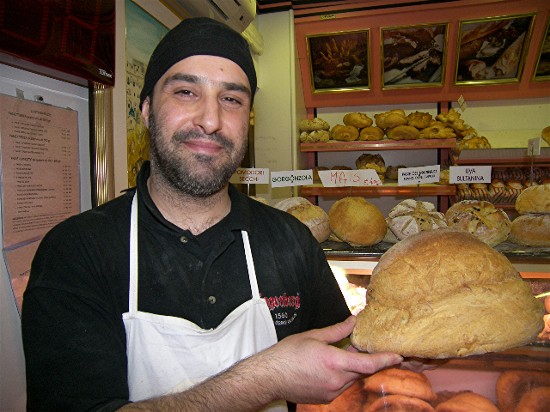
Nunzio Martino, holding a loaf of the local bread, at his family's bakery in Matera, Italy.

Nunzio Martino, holding a loaf of Matera's traditional durum wheat bread, at his family's bakery.

When I visited Martino Casa del Pane (House of Bread) in Matera shortly before their midday closing, the foot traffic was as thick as rush hour in Manhattan. Artisanal bread is a big deal in Italy and nowhere more so than Matera, the ancient Basilicata city that is built on caves. Neighboring Puglia is the biggest durum wheat producer in Italy so fine flour is close at hand.

The Casa del Pane produces a variety of loaves — olive, potato, dried tomato, Gorgonzola, corn flour — to name a few. The business is run by Papa Giovanni and sons Nunzio, Giuseppe, Minno and daughter Teresa.

panemateraAfter eating bread in Italy, I inevitably return home fired up to create loaves of my own. Granted, the bread does not taste exactly like the oven-baked beauties from Casa del Pane but necessity is the mother of bread making.

Lately, I’ve been changing my standard rustic bread formula to make a heartier loaf studded with chewy whole wheat berries, which are simply whole grains of wheat. I also add some whole wheat flour, semolina, and a few tablespoons of ground flaxseed for added nutrients. The resulting loaves are  filled with good grain flavor but surprising light with a crisp crust.

Bread11I start one or two days ahead by mixing a biga, (sponge) a paste made from flour, water, and  dry yeast. As it ferments, it develops flavor that will enhance the finished bread.

Bread1Mix the sponge in a 4-cup glass measuring cup or clear glass bowl and you’ll be able to see its bubbling action throughout the process. You’ll also give the mixture the room it needs to expand to three times its original volume. Cover it with plastic wrap and tuck it in a cool spot (or in the refrigerator) for 12 to 48 hours. The thick mixture will bubble up and rise, and then fall slightly. At the end, it will look like pancake batter. If some of the liquid separates from the batter part, don’t worry.

(Clockwise from top left) Whole wheat flour, ground flaxseed, semolina flour, and cooked wheat berries add flavor and texture to rustic Italian bread.

(Clockwise from top left) Whole wheat flour, ground flaxseed, semolina, and cooked wheat berries add flavor and texture to rustic Italian bread.

To prepare the dough, the sponge is mixed with more flour and water, salt, and any add-ins you like — from wheat berries to herbs to grated cheeses. Knead the dough on a lightly floured surface for 4 to 6 minutes, or until the dough is resilient. Even novice bakers will sense when the dough has been sufficiently kneaded: It feels alive.

If you’re making bread for the first time, you may want to prepare by hand rather than using a machine. The experience will be more tactile and pleasurable, not to mention educational, as you feel how soft and moist this dough should be. But the recipe will also work in a food processor or electric mixer fitted with a dough hook. A plastic dough scraper makes quick work of cleaning the mixing bowl. Bake the bread on heavy baking pans that don’t buckle with the high heat. If you have a ceramic baking stone, preheat it and bake the loaves directly on it for a crisper crust.

After the baked bread is cool, store in a brown paper bag for a day or two. Or, do as I do and slice and freeze the loaves.

[Read more…]

Filed Under: Food, Mediterranean diet, Travel Tagged With: italian bread, Italian cooking, italian culture, italian food, italian lifestyle, Matera

Barilla Shares the Table

Posted October 14, 2009 by Sharon 1 Comment

Anyone who has spent time in Italy knows that meals are about so much more than the food. Meals are daily opportunities for fellowship between family and friends. To promote that life enhancement here in the U.S., Barilla has launched “Share the Table,” the Barilla Family Dinnertime Project.

By registering on the site and making the promise to improve the time you spend with your family around the table and join the Share the Table community, you’ll receive a “Guide to Making Family Dinnertime More Meaningful” with exclusive recipes from Chef Mario Batali, as well as access to online information and support.

For each person who promises to “Share the Table,” Barilla will donate $1 to Meals on Wheels Association of America–up to $150,000–to support senior nutrition programs serving more than one million meals per day.

Filed Under: Culture, Food, Lifestyle, Mediterranean diet Tagged With: Barilla, family meals, italian meals, Meals on Wheels, pasta, Share the Table

The Puglia Coast

Posted June 22, 2009 by Sharon 3 Comments

Octopus salad with fennel and extra virgin olive oil.

Octopus salad prepared with fennel, red bell peppers, extra virgin olive oil and coarsely ground black pepper.

Chill rain and high winds aren’t exactly a siren song call to the beach. When Walter and I visited Puglia this spring, the region was experiencing the wettest primavera for scores, perhaps hundreds of years. (The longevity of the record seemed to grow with each subsequent local we met).

While we didn’t get to wiggle our toes in warm sand, we did sample a taste of the sea at Il Vecchio Forno, a very good seafood restaurant in the shore town of Barletta on the Adriatic coast north of Bari.

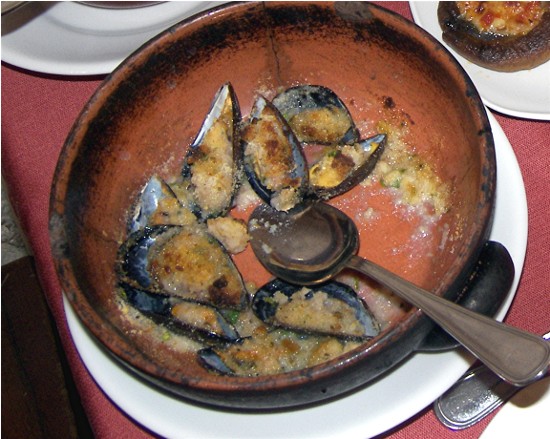
A gratin of mussels blanketed in breadcrumbs and olive oil.

A gratin of mussels blanketed in breadcrumbs and olive oil.

We savored many courses, all prepared simply from pristinely fresh seafood. Most memorable are a gratin of mussels, fish fritters, fried anchovies, octopus salad, seafood risotto, and a grilled spigola (sea bass) with lemon.

Il Vecchio Forno

Via Cialdini 61

Barletta, Puglia

Filed Under: Food, Italian seafood, Italy restaurants, Mediterranean diet, Puglia, Travel Tagged With: italian culture, italian food, Italian seafood, seafood in Puglia

  • « Previous Page
  • 1
  • …
  • 7
  • 8
  • 9
  • 10
  • Next Page »
Follow Simple Italy on FacebookFollow Simple Italy on RSS
Lasagne_19 Simple Italy's Greatest Hits at a click!
Lasagne alla Bolognese and more

Recent posts

  • The Hill Towns of Molise
  • Fior di Latte Cheese
  • In the Mood for Molise, Italy
  • Silk from the Sea in Sardinia
  • Driving a Ferrari Spider

Posts by Category

  • Abruzzo (12)
  • AirBnB (1)
  • Amalfi (8)
  • Archeology (3)
  • Architecture (21)
  • Art (19)
  • Artisans (4)
  • Automobiles (1)
  • Bakery (1)
  • Basilicata (3)
  • Bologna (4)
  • Books (21)
  • Calabria (4)
  • Campania (17)
  • Cooking Classes (5)
  • Cremona (2)
  • Culture (174)
  • dreamofitaly (1)
  • Driving in Italy (2)
  • Emilia Romagna (2)
  • Ferrari (1)
  • Ferrari Museum (1)
  • Film (22)
  • Florence (30)
  • Food (134)
  • Fred Plotkin (1)
  • Friuli-Venezia Giulia (2)
  • Gardening (25)
  • Genoa (2)
  • Golf in Italy (1)
  • Guides (1)
  • History (8)
  • Hotels (14)
  • Inner Italian Q & A (11)
  • Italian seafood (7)
  • Italy Artisans (3)
  • Italy restaurants (17)
  • Language (86)
  • Le Marche (4)
  • Lifestyle (113)
  • Liguria (2)
  • Lombardy cooking (5)
  • Lucca (3)
  • Mantua (1)
  • Markets (26)
  • Mediterranean diet (55)
  • Milan (1)
  • Miscellany (86)
  • Modena (1)
  • Molise (3)
  • Mt. Etna (1)
  • Music (9)
  • Naples (2)
  • New Orleans (2)
  • Opera (1)
  • Palermo (3)
  • People (3)
  • Photography (4)
  • Piedmont cooking (1)
  • Puglia (9)
  • Quotes (4)
  • Recipes (64)
  • Rome (8)
  • Salerno (3)
  • Sardinia (4)
  • Sicily (15)
  • Test Drive (1)
  • Testimonials (2)
  • Travel (110)
  • Trentino Alto-Adige (1)
  • Tuscan cooking (17)
  • Tuscany (30)
  • Venice (2)
  • Videos (2)
  • Wine (23)

Inside SimpleItaly

  • American Couple Marries Italian-Style
  • Appearances
  • Contact us
  • Cooking Up an Italian Life
  • Le Marche Tour with Luisa
  • Links
  • Palazzo Donati Sample Itinerary
  • Palazzo Donati Tours
  • Privacy and Site Policies
  • Publications and TV
  • Sharon’s Inner Italian
  • SimpleItaly Adventure in Tuscany Tour
  • Thank You
  • Walter’s Inner Italian

Tags

Abruzzo bucket list Florence Gardening gelato Genoa Inner Italian Italian cooking italian culture italian food Italian food stores italian language italian lifestyle italian markets Italian music Italian pasta recipe italian recipes Italian tourism italian travel italian wine Italy Italy travel Lago di Como Lake Como Malika Ayane Mediterranean diet mozzarella di bufala Naples tourism Paestum Paolo Conte porcini Puglia Rome Santa Croce Sardegna Sardinia Sicily Southern Italy Stile Mediterraneo Sulmona Tuscan cooking Tuscany Uffizi Gallery Villa Pipistrelli women and travel