Simple Italy

Celebrating Your Inner Italian

  • Home
  • Contact us
  • Links

Mad Men Rome

Posted October 6, 2009 by Sharon 3 Comments

250px-MadmenlogoInner Italians who are fans of the award winning AMC TV program Mad Men received a gift-within-a-gift with Sunday night’s “Souvenir,” the eighth episode of the third season. (You can still catch it at various times on October 6 and 7. (Check the AMC schedule for days and times.)

We learn that gorgeous Betty Draper, frustrated early 1960s homemaker and wife of sizzling ad man Don Draper, has an Inner Italian that’s been stifled in the suburbs (just in case we don’t “get” that Betty’s really trapped, the Drapers reside in Ossining, NY, where Sing Sing Maximum Security Prison is located). Betty’s along for the ride on Don’s two-day visit to Rome (hmm, let’s see . . . fly across the Atlantic, have dinner, fly back across the Atlantic?) to check out client Conrad (call me Conny) Hilton’s property, the Rome Cavalieri.

250px-Piazza_della_repubblica_hdr

To many Americans in the early 1960s, Rome seemed the height of jet-set glamour -- la dolce vita -- the sweet life.

Betty no sooner says grazie to the bellman than she’s on the phone in fluent Italian (albeit, not with a fabulous accent — not sure here if creator Matthew Weiner wanted her to speak with an accent or if actress January Jones had bad coaching) making an appointment at the parrucchiere (hair stylist). Next we see her in an outdoor cafe straight out of Fellini’s La Dolce Vita, which was released in the U.S. in 1961, just a couple years before the Drapers fictional jaunt.

Betty is straight-up channeling the sultry ‘60s Italian actress Virna Lisi with a blonde updo, major eyeliner, and a very little black dress. Two Italian men at the next table take notice. Betty chooses to go with the man at the opposite table, who is her own husband Don, acting mysterious, just as he does when he’s away from her in Manhattan. (Check out the insightful blog commentary by Adam Wilson How Betty Draper Learned Italian (and Why I Don’t Care) at thefastertimes.com.

Rome has revitalized the troubled Draper marriage as we see when Don and Betty return to their room after dinner. The view from their window, with St. Peter’s dome in the distance, looks like the photograph on the “Deluxe Room” page at the Cavalieri Hilton Web site. (This show is known for its near fetishism in period detail, but seriously, this view looks like the art department just enlarged the photo.)

Back at home in her knotty pine kitchen, Betty — usually seen in demure shirtwaists — is wearing a vibrant Emilio Pucci (or maybe a knock off) silk jersey print dress, cutting edge fashion at the time. Pucci was a Florentine nobleman whose early ‘60s designs cut the thread with the staid ‘50s.

Although she looks fabulous in the Pucci, Betty’s boring old life is not a good fit. As she tells Don, “I hate this place. I hate our friends. I hate this town.” She’d rather be in Italy, certamente. But all she gets is a souvenir charm of the Colosseum from Don.

What would Italians make of this episode? I’m not sure and they won’t have a chance to find out until probably 2011. The second season of Mad Men premieres December 28, 2009 on Fox TV Italy. Click here for some amusing clips of the hard-drinking, hard-smoking, hard-loving, and occasionally hard-working Sterling Cooper Advertising Agency gang speaking in Italian.

Filed Under: Culture, Language, Lifestyle, Miscellany, Travel Tagged With: AMC TV, Betty Draper, italian culture, italian language, italian travel, Mad Men, Rome

“More” Sicily

Posted September 29, 2009 by Sharon 1 Comment

The Greek temple of Concordia in Agrigento, Sicily.

The Greek temple of Concordia in Agrigento, Sicily.

The abiding artistic influence of Italy and the circularity of life are touchingly explored in “Inheriting Sicily,” an article by author and poet Honor Moore in the October 2009 issue of More magazine, on newsstands now.

My grandmother went to Sicily in 1954; Now, 55 years later, she was sending me, writes Moore, who also confides that she was seeking renewed inspiration after the rigors of a year-long book tour.

Her grandmother, the gifted Boston society painter Margarett Sargent, had toured Sicily long after her own career abruptly and tragically ended in the 1930s. But it was also in Italy — Florence in the early 1900s — that Sargent’s desire to create art was ignited. “She came back ‘crazy for Donatello’ . . .,” writes Moore, whose book about her grandmother’s life The White Blackbird , published by W.W. Norton & Co, is now out in paperback.

The view from the Temples at Agrigento, on the southern coast of Sicily.

The view from the temples at Agrigento, on the southern coast of Sicily.

Moore’s descriptions, and Harf Zimmermann’s gorgeous photographs, of the seaside resort Taormina, (“said to be the most romantic place in Sicily,”) Agrigento’s Valley of the Greek Temples, and imposing Mt. Etna, brought back a rush of vivid recollections from my trip to Sicily in 2006.

The stunning coastline viewed from mountaintop Taormina.

The stunning northeastern coastline of Sicily viewed from mountaintop Taormina.

Have you been to Sicily? What spoke to you on this timeless island?

Filed Under: Culture, Florence, Mt. Etna, Travel Tagged With: Agrigento, Donatello, Honor Moore, Italiy travel, Margarett Sargent, More magazine, Mt. Etna, Sicily travel, Taormina

Bed & Breakfast Cavallino

Posted September 21, 2009 by Walter Leave a Comment

B&BCavallino

By Walter Sanders

Sharon and I wanted to explore Lecce, the spectacular capital city of Puglia — often referred to as the “Florence of the South.”

We needed to find a place to stay that would position us near Lecce, yet keep us within easy striking distance of nearby attractions and points south. Plus, we didn’t want the hassles of city parking.

It was my turn to choose a place so I perused booking.com for accommodations near Lecce.

The B&B Cavallino looked perfect: an intimate property (3 suites), outside of Lecce, reasonably priced and boasting some of the highest customer ratings of any lodging establishment in the area. We e-mailed and were able to procure a room.

B&B Cavallino proprietor Paola Danielli (right) and her husband Paolo Mercurio.

B&B Cavallino proprietor Paola Danielli (right) and her husband Paolo Mercurio.

Upon arrival, we met the luminous proprietor Paola Danielli. Efficient, lovely, charming (and fluent in English), she showed us to our “room.” What an exciting surprise! We had a spacious apartment with two floors, two terraces, a kitchen, and a huge bedroom overlooking a quiet green campo.

The apartment really felt like our home away from home for the next few days. Every morning before we set out, we brewed our own coffee and feasted on a lavish tray of local pastries that Paola had purchased for us. As Sharon always says, “You have to love a country where they eat cookies for breakfast.”

cavallinocolazione The only minor glitch during our stay    turned out to be the source of more joking   than frustration. Due to local street repairs,   access to and from the southern route to the Salento peninsula ran through an AGIP gas station. It was so well trafficked, we took to calling it the AGIP autostrada.

We couldn’t have been more fortunate in finding this jewel of a B&B. It’s easiest to reach by car, however, with proper advisal the hosts will provide transfers to and from the Lecce train station.

B&B Cavallino is the perfect starting point to explore the many attractions of the Salento peninsula south of Lecce.

Filed Under: Culture, Food, Hotels, Language, Lifestyle, Puglia, Travel Tagged With: B&B Cavallino, Italian B&Bs, Lecce, Puglia, Salento

The Inner Italian Q & A: Piero Antuono

Posted June 30, 2009 by Sharon 3 Comments

One in an occasional series of interviews–with wannabe Italians or expatriate Italians–who try to “live Italian” wherever they are.

antuono

I was born and grew up in the shadow of the Duomo in Florence until, at the age of 30, I was imported to Wisconsin as a souvenir by my American wife, who was living in Florence. I remember seeing her one day crossing Piazza Santa Croce and thinking she was the cutest girl ever–and I still do. So here I am in Milwaukee. Next year will mark my 30th in the U.S. which means I’ve had three decades of training and working on the “bella vita.”

La vita é bella? Yes of course la vita é sempre bella,  but one needs to work at it and make sure that every day there are reasons to feel that the “…vita é veramante bella…” I think one needs to know how to pause (. . . in your head at least if you cannot otherwise) and appreciate the small things that bring Italy closer. Things which remind me I am not that far anyway, things which allow me to detach, disengage, slow down.  It can be a caffé at the right time, a quick call to a friend, reading the news or listening to radio from Italy. Working at a university, travel is something which happens and I make sure it happens enough so I can visit Italy and reset my system. The most important things are not things at all, but rather a state of mind.

Q: Living “Italian”. . . Is it a good lifestyle or the best lifestyle?

A: I do not think it is a good life style (living “Italian” in Italy is stressful.) I do not think it is the best one (I am sure there are healthier ones.)  I think it is the only one.

Q: Why?

A: Because to vivere “Italian” implies (as for other Mediterranean societies) many social interactions during the day. These casual extemporaneous connections–some good,  some bad–are the condiments that add some spice to life. Even superficial chats with strangers at the bus stop, at the newsstand, or at the market are opportunities to give an “emotional valence” to what would be otherwise  routine. Sharing personal stories and family problems with friends, colleagues, and neighbors is a way of lessening the burden. After all, the word privacy in Italian does not exist.

Q: What does “living Italian” in the U.S. mean to you?

A: Being able to switch. Switching from living the U.S. life in the U.S. to the Italian life in the U.S. and to the Italian life in Italy.  Accepting that change is inevitable after so many years in the U.S.  Switching can last seconds or days. The secret is to switch without becoming schizophrenic. Feeling out of place or misplaced sometimes is okay.

Q: What nurtures your Inner Italian?

A: Being able to talk on subjects with Italian friends without being considered critical, offensive, politically incorrect, crude, rude, or insensitive because of the different cultural values.

Q: What Italian movie, or movie set in Italy, do you most like? Why?

A: Tea with Mussolini. Possibly not a great film, but my mother had a small part in it at 82 years of age. The plot was reminiscent of her life in many ways.

Q: If you could live in one place in Italy for the rest of your life, where would it be and why?

A: Anywhere where olive trees grow.

Q: Last Italian meal. . .what would it be?

A: The company would be the most important ingredient of the meal. The setting would be the second. The food would be the third. And if I could do the cooking with my friends, I would be in heaven already.

* * *

How do you nurture your Inner Italian? Share your comments.

Filed Under: Culture, Florence, Inner Italian Q & A, Language, Lifestyle, Miscellany, Travel Tagged With: Florence, Inner Italian, italian culture, italian language, italian lifestyle

The Puglia Coast

Posted June 22, 2009 by Sharon 3 Comments

Octopus salad with fennel and extra virgin olive oil.

Octopus salad prepared with fennel, red bell peppers, extra virgin olive oil and coarsely ground black pepper.

Chill rain and high winds aren’t exactly a siren song call to the beach. When Walter and I visited Puglia this spring, the region was experiencing the wettest primavera for scores, perhaps hundreds of years. (The longevity of the record seemed to grow with each subsequent local we met).

While we didn’t get to wiggle our toes in warm sand, we did sample a taste of the sea at Il Vecchio Forno, a very good seafood restaurant in the shore town of Barletta on the Adriatic coast north of Bari.

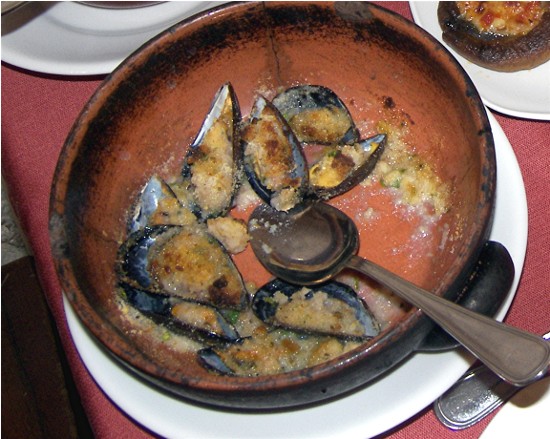
A gratin of mussels blanketed in breadcrumbs and olive oil.

A gratin of mussels blanketed in breadcrumbs and olive oil.

We savored many courses, all prepared simply from pristinely fresh seafood. Most memorable are a gratin of mussels, fish fritters, fried anchovies, octopus salad, seafood risotto, and a grilled spigola (sea bass) with lemon.

Il Vecchio Forno

Via Cialdini 61

Barletta, Puglia

Filed Under: Food, Italian seafood, Italy restaurants, Mediterranean diet, Puglia, Travel Tagged With: italian culture, italian food, Italian seafood, seafood in Puglia

Antinori’s Tormaresca in Puglia

Posted June 7, 2009 by Walter 3 Comments

Adriatic coastal vineyard at Masseria Maime.

Tormaresca vines planted on the Adriatic coast at Masseria Maime in Puglia.

After 26 generations and more than 600 years in the wine business, the Antinori family of Tuscany has expanded its involvement in Puglia. This is a big deal. It certainly got my wine juices going as we received confirmation to visit the new Tormaresca operation at Masseria Maìme in the Salento DOC.

In 1971, Marchese Piero Antinori, helped light the dawn of the super-Tuscan blends with a Sangiovese/Cabernet sauvignon blend called Tignanello. (Piero’s uncle, Marchese Mario Incisa della Rochetta of Sassicaia, first commercially released his fabled super-Tuscan Sassicaia in 1968.)

In the 1990s, the Antinori family invested in Puglia, the heel of Italy, a region that has traditionally been recognized more for the quantity, than the quality, of its wine grapes. A number of economic and terroir factors helped drive the decision. Land prices (especially compared to Tuscany) were inexpensive. Soil conditions and climate were conducive to expanding production of native grape types and some international varieties as well.

Maria Tolentino De Bellis, Tormaresca’s marketing and PR representative, suggested we meet at the San Pietro Vernotico train station. I thought it was odd that we couldn’t just connect at the winery. It didn’t take long to realize that the Antinori presence in Puglia was large – but subtle. Maria drove us up a gravel road marked only by a modest, hand-painted sign that read Vigneti del Sud, “Southern Vineyards,” with no mention of the super-star Antinori name.

The sun is a powerful prescence on the Salento Peninsula.

The sun is a powerful prescence on the Salento Peninsula.

At the cantina, she introduced us to Giuseppe “Peppino” Palumbo, the CEO of Tormaresca. He was dressed in work clothes and had the sun-drenched, weathered look of an executive who spends more time in the vineyards then he does in the board room.

I asked Peppino about the branding strategy behind the Puglian venture.

“Tormaresca is a fantasy name, a play on the Puglian dialect, and means Tower by the Sea,” he explained. “It’s also an extension of the Antinori philosophy to respect local tradition and original vines, while leveraging technology to improve the results. We respect the past, but we never stop innovating.”

We jumped into his SUV, and bumped out on rough trails alongside the vineyards. Peppino pointed out some Negroamaro grapes planted with a cordon trained system, as well as some older vines still in the traditional Alberello system — without support.

We headed east until we reached the beach grass and dunes of the Adriatic shore. “The terroir and growing conditions are perfect,” he said.

Back at the cantina, Peppino raved about indigenous Puglian grapes. “Negroamaro is wonderful. Primitivo (identified by enologists at U Cal Davis as the genetic clone of California Zinfandel) is well suited for this climate. And Aglianco, the red grape we grow further north at our Bocca Di Lupo vineyard, earned a 91 from Parker.”

I asked Peppino about two ancient Puglian grape types, Sussumaniello and Ottavianello I had learned about from Cinzia Rascazzo of Stile Mediterraneo.

Peppino looked pleased about the question and smiled. “Yes, we found some growing here and will preserve and cultivate them. We are experimenting with them now to complement Negroamaro and add a little color.”

The time was running late, and I asked Peppino if I could use a phone to call our next stop to let them know I’d be a little tardy.

“Who are you visiting next?” he asked.

“Candido” I answered.

“I have them in my cell phone.” He noticed that I looked a little surprised. “We’re not rivals. We both flow together in the same current of wine, and the trip is easier if we run together, not against each other.”

For a sampling of Tormaresca here in the U.S., pour these two.

Neprica IGT (Negroamaro, Primitivo and Cabernet grapes) I love this super-Puglian which is every bit as intriguing as a more expensive super-Tuscan.

Neprica is an I.G.T. blend of Negroamaro, Primitivo, and Cabernet grapes.

Neprica is an IGT blend of Negroamaro, Primitivo, and Cabernet grapes.

Masseria Maìme IGT (Negroamaro grapes) is spectacular with grilled meats and fish.

Maime is 100 percent Negroamaro grapes.

Masseria Maime is 100 percent Negroamaro grapes.

Coming next: Our visit to Candido Wines.

Filed Under: Culture, Language, Puglia, Travel, Wine Tagged With: Antinori, italian culture, italian wine, Puglia, Salento, Tormaresca, Travel, Tuscany

  • « Previous Page
  • 1
  • …
  • 15
  • 16
  • 17
  • 18
  • 19
  • Next Page »
Follow Simple Italy on FacebookFollow Simple Italy on RSS
Lasagne_19 Simple Italy's Greatest Hits at a click!
Lasagne alla Bolognese and more

Recent posts

  • The Hill Towns of Molise
  • Fior di Latte Cheese
  • In the Mood for Molise, Italy
  • Silk from the Sea in Sardinia
  • Driving a Ferrari Spider

Posts by Category

  • Abruzzo (12)
  • AirBnB (1)
  • Amalfi (8)
  • Archeology (3)
  • Architecture (21)
  • Art (19)
  • Artisans (4)
  • Automobiles (1)
  • Bakery (1)
  • Basilicata (3)
  • Bologna (4)
  • Books (21)
  • Calabria (4)
  • Campania (17)
  • Cooking Classes (5)
  • Cremona (2)
  • Culture (174)
  • dreamofitaly (1)
  • Driving in Italy (2)
  • Emilia Romagna (2)
  • Ferrari (1)
  • Ferrari Museum (1)
  • Film (22)
  • Florence (30)
  • Food (134)
  • Fred Plotkin (1)
  • Friuli-Venezia Giulia (2)
  • Gardening (25)
  • Genoa (2)
  • Golf in Italy (1)
  • Guides (1)
  • History (8)
  • Hotels (14)
  • Inner Italian Q & A (11)
  • Italian seafood (7)
  • Italy Artisans (3)
  • Italy restaurants (17)
  • Language (86)
  • Le Marche (4)
  • Lifestyle (113)
  • Liguria (2)
  • Lombardy cooking (5)
  • Lucca (3)
  • Mantua (1)
  • Markets (26)
  • Mediterranean diet (55)
  • Milan (1)
  • Miscellany (86)
  • Modena (1)
  • Molise (3)
  • Mt. Etna (1)
  • Music (9)
  • Naples (2)
  • New Orleans (2)
  • Opera (1)
  • Palermo (3)
  • People (3)
  • Photography (4)
  • Piedmont cooking (1)
  • Puglia (9)
  • Quotes (4)
  • Recipes (64)
  • Rome (8)
  • Salerno (3)
  • Sardinia (4)
  • Sicily (15)
  • Test Drive (1)
  • Testimonials (2)
  • Travel (110)
  • Trentino Alto-Adige (1)
  • Tuscan cooking (17)
  • Tuscany (30)
  • Venice (2)
  • Videos (2)
  • Wine (23)

Inside SimpleItaly

  • American Couple Marries Italian-Style
  • Appearances
  • Contact us
  • Cooking Up an Italian Life
  • Le Marche Tour with Luisa
  • Links
  • Palazzo Donati Sample Itinerary
  • Palazzo Donati Tours
  • Privacy and Site Policies
  • Publications and TV
  • Sharon’s Inner Italian
  • SimpleItaly Adventure in Tuscany Tour
  • Thank You
  • Walter’s Inner Italian

Tags

Abruzzo bucket list Florence Gardening gelato Genoa Inner Italian Italian cooking italian culture italian food Italian food stores italian language italian lifestyle italian markets Italian music Italian pasta recipe italian recipes Italian tourism italian travel italian wine Italy Italy travel Lago di Como Lake Como Malika Ayane Mediterranean diet mozzarella di bufala Naples tourism Paestum Paolo Conte porcini Puglia Rome Santa Croce Sardegna Sardinia Sicily Southern Italy Stile Mediterraneo Sulmona Tuscan cooking Tuscany Uffizi Gallery Villa Pipistrelli women and travel