Simple Italy

Celebrating Your Inner Italian

  • Home
  • Contact us
  • Links

Ciceri e tria

Posted June 4, 2009 by Sharon 4 Comments

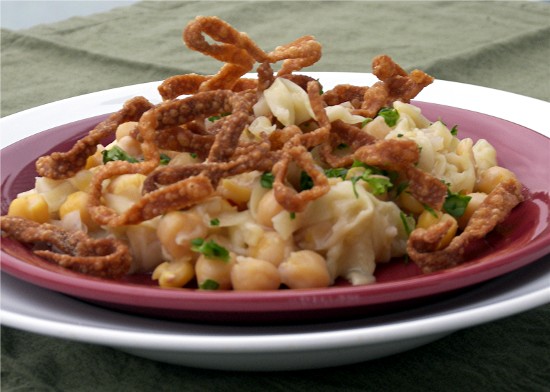
Ciceri e tria, chickpeas and tagliatelle, from Lecce in Puglia.

Ciceri e tria, chickpeas with both fresh and fried tagliatelle, is a specialty from Lecce in Puglia.

Ciceri are chickpeas. Tria are tagliatelle, in the dialect of Puglia. Combined, they make Ciceri e tria a distinctive dish from the baroque city of Lecce.

Like the ‘Ncapriata in Two Cooks in Puglia, this recipe comes from Cinzia and Marika Rascazzo, sisters and proprietors of the Stile Mediterraneo cooking program.

“The recipes are the real traditional ones from Lecce,” Cinzia says in a recent e-mail. “We inherited them from my nonna and we teach them at our school.” Nonna ‘Nzina, short for Vincenza turned 95 in May, looks like she’s 70, and cooks every day.

“She is super well,” says Cinzia. “For her, the most important thing is food. She gets mad if my mother does not buy her the best ingredients. She spends the whole day cooking-maybe just four hours for a minestrone!”

Cinzia, who holds an MBA from Harvard University and Marika, a practicing cardiologist, are passionate about passing on their nonna’s culinary legacy and the culture that it represents. “Our cooking is based on which town you are in, which season it is, and peoples’ taste. In general, we never cover ingredients’ flavors,” Cinzia says.

Dried chickpeas soak overnight before being simmered with aromatics.

Dried chickpeas soak overnight before being simmered with aromatics.

In preparing Ciceri e tria, the first ingredient required is time. Dried chickpeas are soaked overnight and then simmered until tender with aromatic vegetables. The tagliatelle noodles are prepared from scratch by combining water and salt into golden durum wheat, the hardest type of wheat, which is also high in gluten. Durum is a major agricultural product of the Tavoliere plain in northern Puglia.

After the noodles are rolled and cut, a portion, about one-quarter, of them are deep-fried in olive oil. (These fried noodles make an irresistible pre-dinner nosh sprinkled with salt and Parmesan cheese!)
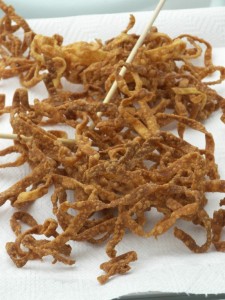
friedtria

The remaining tagliatelle are cooked with the chickpeas. (When I tested the recipe, my first batch of tagliatelle turned gummy when I added them to the chickpeas. I had better luck boiling the noodles separately and then draining them before adding them to the chickpeas but this is NOT Nonna “Nzina’s method.) The three elements are stirred together just before serving and garnished with fresh parsley and hot red pepper to taste.

[Read more…]

Filed Under: Culture, Food, Language, Lifestyle, Mediterranean diet, Puglia, Recipes, Travel Tagged With: chickpeas, homemade pasta, Italian cooking, italian culture, Lecce, Puglia, Stile Mediterraneo, tagliatelle

Two Cooks in Puglia

Posted May 29, 2009 by Sharon 1 Comment

Sharon (center) with Rosalba De Carlo (left) and Cinzia Rascazzo at Alle due Corti ristorante in Lecce.

Sharon (center) with Rosalba De Carlo (left) and Cinzia Rascazzo at Alle due Corti ristorante in Lecce.

In the baroque town of Lecce, Walter and I meet two dynamic women who are fighting for their lives. Not literally for physical survival-although it may come to that-but for the endurance of their culinary tradition. They may be of different generations but their focus is the same: To preserve the traditions of Pugliese cooking.

If you think this sounds melodramtic, consider this: A McDonald’s sits in the historic Piazza San Oronzo in Lecce, a town that up until a few decades ago was a relatively remote outpost in southern Italy. The food of this area was the now much-lauded ‘Mediterranean diet.’ But, back to our heroines. . .

Thirty-something Cinzia Rascazzo, with her sister Marika Rascazzo, operates Stile Mediterraneo, a custom tour business that focuses on Pugliese culture, cooking, olive oil and wine.

alleduecortisignRosalba De Carlo is a generation older. She’s the proprietor of the esteemed Alle due Corti ristorante where we are lunching with Cinzia on a cloudy Saturday afternoon. We are honored to be eating here and meeting Rosalba. In 2008, she was recognized as an exemplar of the gastronomic culture of Salento, the southern tip of the Italian “heel” during an Economic Sustainability Conference in conjunction with UNESCO and ISNART (the national institute of tourism research).

Seated in the cozy backroom, we ask Cinzia to choose dishes for us. She explains that we will be eating mostly vegetables because Lecce sits inland, away from the coast. (I smile to myself because the distance to the Adriatic Sea is probably no more than 10 miles, practically beachfront property by U.S. standards.) “There is a Spanish influence, similar to Catalan, here in Lecce,” Cinzia says.

Dishes are served in locally crafted terra cotta plates. The peperoni agrodolce are slowly cooked in olive oil and a bit of sugar until they almost melt. Vinegar and bread crumbs complete the preparation. “The Pugliese put breadcrumbs on everthing,” Cinzia explains, laughing. And with good reason. Pugliese bread is renowned because it is made with the superior hard durum wheat that is cultivated in the northern part of the region.

Local pastas are also made from durum wheat mixed with water. We sample orecchiette (shaped like little ears) in a green vegetable puree and strascinate (ragged curled strands) in a tomato sauce.

Polpettone (balls) prepared from eggplant were a revelation. So light, so flavorful. The eggplant is peeled and cooked then passed through a food mill. It’s mixed with grated aged pecorino cheese, breadcrumbs, and egg, shaped into balls and deep fried in olive oil. (Full disclosure: After returning home, I asked Cinzia to share a recipe via e-mail. I tried but I couldn’t replicate the taste and texture. Some dishes must be eaten in their place of origin and I think this is one of them.)

Probably the most amazing tasting that day was ‘ncapriata. Made from only three ingredients-fava beans, chicory and extra-virgin olive oil-this is the poster child of Puglia’s cucina povera. Just beans, greens, and oil but when the base ingredients are so distinctive, and the cooks know how work magic, the results are spectacular.

ncapriataCinzia shares her recipe and gives this advice for enjoying ‘ncapriata. “The chicory and fava beans are meant to be eaten together! You can also serve them with small pieces of traditional durum wheat bread. You can add more extra virgin olive oil at the table.”

‘Ncapriata  (fava bean puree and wild chicory)

Makes 5 servings

1 pound dried peeled fava beans

Salt

2 pounds wild chicory or cooking greens such as dandelion, mustard or curly endive

1 whole garlic clove

Red pepper flakes

5 tablespoons extra-virgin olive oil plus extra for garnish

Place the beans in a large bowl and cover generously with cold water. Soak for at least 8 hours.

Drain and rinse the beans. Place them in a large heavy pot and cover with fresh water. Place over low heat. When the water starts boiling, skim the foam from the surface with a spoon. Discard the foam. Continue skimming and discarding the foam as long as it appears. Cook, stirring occasionally, over low heat for about 2 hours. The beans will gradually dissolve into a puree. If the mixture is too thick, add water from time to time if needed.

Meanwhile, bring a large pot of salted water to a boil. Wash the greens. Chop them coarsely. Add to the boiling water. Stir and cover. Cook for about 5 minutes or until al dente. Drain the greens.

Return the same cooking pot to medium-low heat. Add 2 tablespoons oil, the garlic and pepper flakes to taste. Cook over low heat for about two minutes. Add the greens, stir and cover. Cook on low heat for 5-10 minutes, or until tender. Season to taste with salt. Remove the garlic and discard.

When the fava beans are completely dissolved, remove from the heat and add 3 tablespoons of oil (or more if you like) while stirring with a wooden spoon. Season to taste with salt. Thin with some water if needed to create a very thick puree.

Ladle the fava puree into one side of a pasta bowl. Place some greens next to the puree. Drizzle with a bit more oil at the table if desired.

Coming next: More about Stile Mediterraneo plus a recipe for ciceri e tria (chickpeas with tagliatelle).

Filed Under: Culture, Food, Italy restaurants, Language, Lifestyle, Puglia, Recipes, Travel Tagged With: italian culture, Italy travel, Puglia, Stile Mediterraneo

Ovid to the Internet

Posted May 25, 2009 by Sharon Leave a Comment

ovid

The great Roman poet Ovid was born in 43 B.C. in the outskirts of Sulmona and the town proudly claims him as its native son. A bronze statue of him commands the Piazza XX Septembre.

Ovid likely wrote his poems about love and life on wax tablets or rolls of papyrus.

These days, it’s microprocessors and LCD screens that facilitate communication in Sulmona and beyond. Through this miraculous technology, we “visited” the Albergo Stella on venere.com, just one of many accommodations middlemen. Turns out we paid $97.82 for a small but spotless room with bath, free parking, and continental breakfast in the morning.

Roberto Bono, co-owner of Albergo Stella in Sulmona.

Roberto Bono, co-owner of Albergo Stella in Sulmona.

Albergo Stella is owned by the Bono brothers, Roberto and Giuseppe. Roberto operates the hotel and the Caffé Bono. Giuseppe, the wine guy, maintains the impressive enoteca adjacent to the Caffé. These enthusiastic entrepreneurs even have plans to open another Caffé on the other side of town despite the current economic downturn which has increased unemployment in town.

Roberto noticed that we booked our room online and volunteered that, next time, we should make the reservation directly. “I’ll give you a great room rate and save the 15 percent commission I pay the booking service.”

He also asked if we were set with lodging reservations for the rest of our trip. We explained that we were going to wing it and re-create the good old days when we first met and fell in love in Florence and traveled all over Europe by the seat of our pants.

“Just in case,” he said, “remember www.booking.com. It has a great selection of European hotels and B & B establishments.”

We thanked Roberto but secretly thought to ourselves, “We don’t need that. Now that we’re back in Italy, our old radar will kick in.” Less than 48 hours later, we were humbled into logging onto booking.com. The night after we left the Stella, we had to settle for a Best Western in the seaside resort of Barletta. Arriving as sun set, and dealing with traffic from hell, our dreams of winging it took flight for the night.

Filed Under: Abruzzo, Culture, Hotels, Lifestyle, Travel Tagged With: Abruzzo, Italian hotels, italian travel, Ovid

Land of Honey

Posted May 15, 2009 by Walter 2 Comments

honeyshopFull disclosure: I’m a honey consumer, a big-time honey consumer. I make a five-pound jug disappear every 6 to 9 months and I can find legitimate ways to enjoy honey three meals a day. I’m also intrigued about flavored honeys. The only one I ever met that I didn’t like was a buckwheat honey. I ended up diluting that bad boy with clover honey.

I was thrilled to see honey on the bar counters in Abruzzo . . . and even more excited to see the locals using it to sweeten their cappuccini and espressi. As we walked through Sulmona on market day we spotted the Non Solo Miele (Not Just Honey) shop. We popped in and were invited to sample some of the floral varieties, including a complex, slightly bitter, chestnut honey which the proprietor informed us was rich in iron.

I’ve since learned that Abruzzo has been a center of honey production since ancient times. Today a wide variety of blended and monofloral honeys are created by the people and bees in the region.  To read more about Abruzzese honeys, visit Discover Abruzzo.

Filed Under: Abruzzo, Culture, Food, Language, Lifestyle, Travel Tagged With: Abruzzo, honey, Italy food, Italy travel, Sulmona

Ristorante Clemente

Posted May 8, 2009 by Sharon 15 Comments

Ristorante Clemente in Sulmona offers the genuine dishes of Abruzzo.

Ristorante Clemente in Sulmona offers the genuine dishes of Abruzzo.

We weren’t being fair to Ristorante Clemente. We knew it . . . but we couldn’t help ourselves. We had allotted one night, one dinner in Abruzzo, a region in which neither of us had passed time. We sought to “taste Abruzzo” in that one meal. No small order.

We were in the small city of Sulmona on our way to Puglia. Our Ital’guru Fred Plotkin, author of Italy for the Gourmet Traveler, picks Sulmona as his “Classic Town” of the mountainous region east of Rome. Ristorante Clemente appears first on his “Dining List” and his description appealed to us. For insurance, we inquired of our hotelier and a local barista where we should dine. “Clemente,” they both answered. We even scouted out the restaurant location, tucked on a tiny back street, so we’d have no problem finding it later in the dark.

So it was that Walter roused me from a my nap at 7:15 p.m. so we could arrive when the doors opened for dinner service. He worried that a place this touted would fill up fast. No such problem transpired. Upon entry, we were invited to choose our own table and selected one deep in the rear of the main room under a splendid stone vaulted ceiling. Stone and gesso walls the color of cantaloupe cream, exciting food-related art work, photos of family members and a couple canvasses and prints of Sulmona created a cozy setting.

Chef Clemente Maiorano (right), son Alessandro (left), and another sous chef in the Clemente kitchen.

Chef Clemente Maiorano (right), son Alessandro (left), and another sous chef in the Clemente kitchen.

Chef/owner Clemente Maiorano, with warm brown eyes and salt-and-pepper Julius Caesar haircut-greeted us with a one-page menu. We asked if we could place our appetites in his able hands. He seemed pleased and disappeared through the archway into the kitchen. The waiter took over and reminded us how perfect service in Italy can be. Not obsequious, not aloof, just professional.

[Read more…]

Filed Under: Abruzzo, Culture, Food, Italy restaurants, Language, Lifestyle, Travel, Wine Tagged With: Abruzzo, italian food, italian wine, Italy, Ristorante Clemente, Sulmona

Chuck Olson: Art and Parma

Posted April 24, 2009 by Walter Leave a Comment

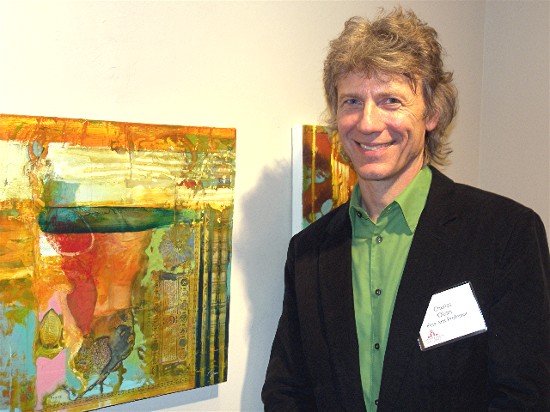
Artist Chuck Olson conducts a Springtime in Parma arts program for St. Francis University students.

Artist Chuck Olson conducts the Springtime in Italy arts program in Parma for St. Francis University students.

By Walter Sanders

We can find Inner Italians almost anywhere. And so it was that we encountered artist Chuck Olson’s Italian connection in Old City Philadelphia at the opening of his most recent exhibit at the Rosenfeld Gallery.

Sharon’s alma mater St. Francis University in Loretto, PA, hosted the event for Olson, 56, who is Chair of the school’s Fine Arts Department. He has been teaching there since 1976.

Look at Chuck Olson and you see a confident, polished and worldly gentleman. Yet, until he was 29, he had never traveled further from his western Pennsylvania home than Youngstown, Ohio. To polish his pronunciation skills of French artists and authors, he took an elementary French language class, then an additional 27 credits in French. “Studying a foreign language helped me understand and appreciate the power of a new cultural dynamic,” Olson said.

He met Marie, a French woman, in the United States and in 1987 they married. Marie shared her roots in western France with Chuck, and eventually, their two children. Every summer, the family rented a French farmhouse. “We prefer really experiencing a place, rather than collecting destinations.”

In 2006, Olson was given the opportunity to direct the Springtime in Italy arts program in Parma. “I took a risk. Many people in their 50s tend to withdraw but I jumped at the chance. Initially I didn’t know the language, I didn’t know a soul in Parma, but the journey has been amazing. After three years, I can stroll into the Mayor’s office after a warm welcome by his security people and discuss our programs,” Olson said.

“Italy was a different experience for me . . . the light, the foliage, the language. The food was different, even the bread. The people were more open and sharing. That helped me shape my teaching philosophy. My students’ experiences won’t be limited by lack of imagination. So I encourage them to travel on the weekends, participating in and sharing every cultural difference they can. The students come away with experiences that are legitimately their own.”

Italy has been fertile ground for Olson to develop interpersonal relationships. “I enjoy making connections between good people. Many of these relationships blossom, and a few whither on the vine.”  It is the magic of Italy that inspires people to connect with others.

To view more of Olson’s acrylic paintings, visit The Rosenfeld Gallery.

Filed Under: Culture, Language, Lifestyle, Miscellany, Travel Tagged With: artist Chuck Olson, Italian art, italian culture, italian language, Parma, St. Francis University

  • « Previous Page
  • 1
  • …
  • 16
  • 17
  • 18
  • 19
  • Next Page »
Follow Simple Italy on FacebookFollow Simple Italy on RSS
Lasagne_19 Simple Italy's Greatest Hits at a click!
Lasagne alla Bolognese and more

Recent posts

  • The Hill Towns of Molise
  • Fior di Latte Cheese
  • In the Mood for Molise, Italy
  • Silk from the Sea in Sardinia
  • Driving a Ferrari Spider

Posts by Category

  • Abruzzo (12)
  • AirBnB (1)
  • Amalfi (8)
  • Archeology (3)
  • Architecture (21)
  • Art (19)
  • Artisans (4)
  • Automobiles (1)
  • Bakery (1)
  • Basilicata (3)
  • Bologna (4)
  • Books (21)
  • Calabria (4)
  • Campania (17)
  • Cooking Classes (5)
  • Cremona (2)
  • Culture (174)
  • dreamofitaly (1)
  • Driving in Italy (2)
  • Emilia Romagna (2)
  • Ferrari (1)
  • Ferrari Museum (1)
  • Film (22)
  • Florence (30)
  • Food (134)
  • Fred Plotkin (1)
  • Friuli-Venezia Giulia (2)
  • Gardening (25)
  • Genoa (2)
  • Golf in Italy (1)
  • Guides (1)
  • History (8)
  • Hotels (14)
  • Inner Italian Q & A (11)
  • Italian seafood (7)
  • Italy Artisans (3)
  • Italy restaurants (17)
  • Language (86)
  • Le Marche (4)
  • Lifestyle (113)
  • Liguria (2)
  • Lombardy cooking (5)
  • Lucca (3)
  • Mantua (1)
  • Markets (26)
  • Mediterranean diet (55)
  • Milan (1)
  • Miscellany (86)
  • Modena (1)
  • Molise (3)
  • Mt. Etna (1)
  • Music (9)
  • Naples (2)
  • New Orleans (2)
  • Opera (1)
  • Palermo (3)
  • People (3)
  • Photography (4)
  • Piedmont cooking (1)
  • Puglia (9)
  • Quotes (4)
  • Recipes (64)
  • Rome (8)
  • Salerno (3)
  • Sardinia (4)
  • Sicily (15)
  • Test Drive (1)
  • Testimonials (2)
  • Travel (110)
  • Trentino Alto-Adige (1)
  • Tuscan cooking (17)
  • Tuscany (30)
  • Venice (2)
  • Videos (2)
  • Wine (23)

Inside SimpleItaly

  • American Couple Marries Italian-Style
  • Appearances
  • Contact us
  • Cooking Up an Italian Life
  • Le Marche Tour with Luisa
  • Links
  • Palazzo Donati Sample Itinerary
  • Palazzo Donati Tours
  • Privacy and Site Policies
  • Publications and TV
  • Sharon’s Inner Italian
  • SimpleItaly Adventure in Tuscany Tour
  • Thank You
  • Walter’s Inner Italian

Tags

Abruzzo bucket list Florence Gardening gelato Genoa Inner Italian Italian cooking italian culture italian food Italian food stores italian language italian lifestyle italian markets Italian music Italian pasta recipe italian recipes Italian tourism italian travel italian wine Italy Italy travel Lago di Como Lake Como Malika Ayane Mediterranean diet mozzarella di bufala Naples tourism Paestum Paolo Conte porcini Puglia Rome Santa Croce Sardegna Sardinia Sicily Southern Italy Stile Mediterraneo Sulmona Tuscan cooking Tuscany Uffizi Gallery Villa Pipistrelli women and travel