Simple Italy

Celebrating Your Inner Italian

  • Home
  • Contact us
  • Links

The Clooney Effect

Posted June 29, 2011 by Sharon 7 Comments

This much is true. I was on Lake Como last week participating in a fabulous fam trip sponsored Central Holidays.

However, I will neither confirm nor deny rumors that I had anything to do with Oscar-winner George Clooney’s breakup with the Sardinian velina Elisabetta Canalis.

As for the insinuations that I was stalking George? Laughable. I never got any closer to his villa than the distance from the sight-seeing boat.

All I know about the situation is what I read in the media.

As I sipped my secondo cappuccino on the morning of Tuesday, June 21, I read in La Provincia that George and Ely had been spotted sharing a romantic dinner on the lake. The article featured a photo capture from The Globe Web site. “La Favola Continua” . . . “the fairytale continues” proclaimed the headline.

So, I was as shocked as everyone with the announcement a day later:

“We are not together anymore,” People.com quoted the celebrities as saying in a joint statement.

“It’s very difficult and very personal, and we hope everyone can respect our privacy.”

No reason was given for the split.

Media reports point to George’s displeasure with Elisabetta publicly using the “M” word.

As George told CNN’s Piers Morgan in a recent interview, he has tried marriage and — basta –once is enough. (Here’s a trivia nugget: George’s ex-wife, actress Talia Balsam plays the role of Mona Sterling on AMC’s Mad Men. She’s married to actor John Slattery who plays Roger Sterling.)

While us glamor-starved gawkers fret over George’s romantic relationships, the folks on Lake Como care only about his residential entanglements. His purchase of a villa on Lake Como has been very, very, very good for local tourism– “The Clooney Effect,” as Leoni Luca, Vice Sindaco for the commune di Bellagio put it.

Frankly, I think George might want to spend a little bit less time dating and focus on keeping up the property. The roof really looks as if  it needs some work.

Filed Under: Architecture, Culture, Film, Miscellany, Travel Tagged With: Elisabetta Canalis, George Clooney, Lago di Como, Lake Como

Spaghetti Al Farouk

Posted June 20, 2011 by Sharon 4 Comments


As I meandered through the recipes of The Glorious Pasta of Italy by Domenica Marchetti, with France Ruffenach’s sensual photographs, my appetite revved from 0 to 60 in no time.

What to savor first?

Mafalde with Roasted Tomatoes, Robiola, and Crushed Fennel Seeds?

Maccheroni alla Chitarra with Ragù all’Abruzzese and Palottine?

The Candy-Wrapped Tortelli with Rainbow Chard and Ricotta (whimsically named because the pasta is twisted to resemble hard candy wrappers)?

Bigoli with Spicy Sardine Sauce?

Or… BLT Bucatini?

Turns out—none of the above.

The answer presented itself definitively on page 127: Spaghetti al Farouk. It wasn’t only the spaghetti, cream, seafood, and saffron that got to me. It was the charming anecdote that seasoned the dish. The story behind the pasta reminded me of the scene in Fellini’s Amacord where the Middle Eastern potentate arrives at the Grand Hotel with his harem.

Domenica describes is like this. . .

“This is a unique dish, and one that is near and dear to my heart. When I was a girl, my family owned a beach house on Abruzzo’s Adriatic coast. I have many wonderful memories of whiling away summer days on the beach with friends and enjoying late-night marathon meals that featured freshly caught local seafood. One of our favorite restaurants was right on the beach. My memory says it was on the outskirts of the port city of Pescara, but my mother swears it was in nearby Francavilla. Since she is originally from the region, I will defer to her on that detail. Neither of us remembers the name of the restaurant, but we do remember that it was a casual place with a reputation for impeccable fish and seafood. One of its signature dishes was Spaghetti al Farouk, a fanciful curried pasta dish that brimmed with fresh mussels, shrimp/prawns, and pannocchie (something like crayfish or tiny lobsters.) The dish was named for the deposed Egyptian king who fled to Italy in 1952, and the sauce was spicy, silky, and a deep gold. My mother re-created the recipe in her own kitchen in the 1970s, and I still have a typed copy that she gave me. I’ve tinkered with the sauce over the years, lightening it a bit and trying different quantities of the various spices. In all honesty, I can’t tell you whether it is anything like the original—it’s been some thirty years—but I can tell you that it is a sauce like no other.

Spaghetti al Farouk

Makes 4 to 6 servings

2 tablespoons extra-virgin olive oil

1 tablespoon unsalted butter

1 large yellow onion, chopped

Large pinch of saffron threads, pounded to a powder (see cook’s note)

1 tablespoon curry powder (preferably spicy)

1/2 teaspoon ground ginger

1/4 teaspoon minced fresh thyme

1 fresh bay leaf

1/2 teaspoon kosher or fine sea salt

Freshly ground black pepper

Juice of 1/2 lemon

3/4 cup/180 ml dry white wine

1 cup/240 ml heavy/double cream

1 pound/455 g dried spaghetti

12 mussels, well scrubbed and debearded if necessary (see cook’s note)

16 large shrimp/prawns, peeled and deveined

6 ounces/170 g frozen shelled cooked langoustine tails (see cook’s note)

Bring a large pot of water to a rolling boil and salt generously.

In a frying pan large enough to hold all of the seafood, warm the olive oil and butter over medium heat. When the butter is melted and begins to sizzle, add the onion and stir to coat with the oil and butter. Sauté, stirring frequently, for about 7 minutes, or until the onion is softened but not browned. Stir in the saffron, curry powder, ginger, thyme, bay leaf, salt, and a generous grind of pepper, taking care to incorporate all of the herbs and spices. Stir in the lemon juice, raise the heat to medium-high, and pour in the wine. Let the sauce simmer briskly for about 3 minutes, or until slightly thickened. Reduce the heat to medium and stir in the cream. Bring the sauce back to a very gentle simmer. If the pasta water is not yet boiling, reduce the heat under the sauce to low and wait until the pasta water boils.

Add the pasta to the boiling water, stir to separate the noodles, and cook according to the manufacturer’s instructions until al dente. Once the pasta is in the water, proceed with finishing the sauce.

Add the mussels, shrimp/prawns, and langoustine tails to the simmering sauce, cover, and cook for 5 to 8 minutes, or until the mussels open, the shrimp/prawns are just cooked through, and the langoustine tails are heated through. Discard any mussels that failed to open.

Drain the pasta into a colander set in the sink, reserving about 1 cup/240ml of the cooking water. If the frying pan is large enough to contain both the pasta and the sauce, add the pasta to the frying pan and gently toss the pasta and sauce to combine thoroughly, adding a splash or two of the cooking water if necessary to loosen the sauce. If the frying pan is not large enough, return the pasta to the pot, add about two-thirds of the sauce, toss to combine thoroughly, and then top with the remaining sauce when serving. Transfer the dressed pasta to a warmed serving bowl or shallow individual bowls. If you are preparing individual servings, be sure to divide the seafood evenly among them. Serve immediately.

Cook’s note: Saffron

Beautiful red-gold saffron threads (zafferano) are the dried stigmas of the purple-striped flowers of the Crocus sativus plant. Saffron from Abruzzo’s Navelli plain is among the best in the world. The spice is sold in two forms, powder and threads. The powder dissolves more easily, but it is also more easily tampered with. To be sure you are getting pure saffron, buy the threads and gently pound them to a powder before using. I use a mortar and pestle for pounding, but you can also press down on the threads with a heavy object, such as the flat side of a meat pounder or mallet.

Cook’s note: Shellfish

Much of the shellfish available these days is farm raised and therefore contains less dirt and grit than shellfish harvested from the wild. To clean mussels, scrub their shells with a stiff brush under cold running water. Discard any that do not close tightly when handled. If the mussels have beards, the fibrous tufts they use to hold on to pilings and rocks, you need to remove them. Using a towel or just bare fingers, grasp the beard gently but firmly and yank it toward the shell’s hinge. This will remove the fibers without tearing the mussel meat.

Frozen langoustine tails lack the flavor of fresh ones, but they are much more readily available and they have a nice, meaty texture that captures the sauce and absorbs its flavor.

Text copyright ©2011 by Domenica Marchetti

Photographs copyright ©2011 by France Ruffenach

Filed Under: Abruzzo, Culture, Food, Italian seafood, Miscellany, Recipes Tagged With: Domenica Marchetti, Italian seafood pasta, The Glorious Pasta of Italy

La Pizza Improvvisata

Posted June 8, 2011 by Sharon 4 Comments

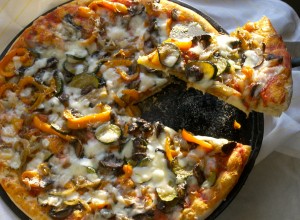
An impromptu pizza--the wonderful product of foraging.

An impromptu pizza: the wonderful product of kitchen foraging.

A recipe can be a useful thing.

A recipe is useful when we just have zilch inspiration about what to serve the in-laws.

A recipe is useful when we want to explore a cuisine that’s foreign to us. You’d better believe when I cook a Thai dish, I want some guidance from someone who’s been there.

A recipe is useful to introduce us to new and creative flavor combinations.

A recipe is useful—make that nearly essential—for a home cook baking a Sicilian cassata or any other elaborate pastry.

A recipe is useful to “visit” other cooks to see how they do things.

But is a recipe really necessary to cook?

While I make part of my living by creating, writing, testing, and editing recipes, I’m going to bite the hand that feeds me by saying, “no.”

The earliest European written recipe cook book is thought to have been created in Latin in  the 1st century. De re coquinaria is credited to the Roman gourmet Marcus Gavius Apicius. Yet modern human beings had been eating for at least 50,000 years before those recipes were written.

How?

They explored their environment . . . sniffed, tasted, applied heat, threw in some flavorful plant cuttings. They experimented. They cultivated some seeds that reproduced staple grains. They shared their learnings with family and friends. They used their physical senses with an application of common sense.

That’s what I did the other night. My weekly batch of bread dough was doing its thing while I was putting in a full day on the computer. I hadn’t planned anything for dinner. So, I did what any self-respecting human would do. I foraged.

I had the makings of a crust on hand. Such a deal! I pinched off the amount that would have been one loaf of bread and patted it into a pizza pan. (A non baker could keep purchased yeast dough on hand in the freezer for such opportunities.) In the refrigerator, I found a zucchini, half a bell pepper, a few mushrooms, an opened container of Pomi tomato sauce, and a hunk of extra-sharp Provolone cheese. I always have onions in the pantry so I sliced the onion, zuke, mushrooms, and pepper, and sautéed them in extra-virgin olive oil until they were soft and golden. I painted the crust with the Pomi, scattered on the veggies, and went crazy with the Provolone. Into a 425 degree oven for about 12 minutes and I had a triumph of woman over recipe: la pizza improvvisata.


Full disclosure: I love cookbooks. I’m a cookbook author.  I own hundreds of cookbooks. There are so many joys to be had from beautiful food books—getting dinner on the table is only one of them. But, if you are starting out in the kitchen and have no skill set to rely upon (perhaps you were raised by wolves?), I recommend cookbooks that are more than a collection of recipes, such as How to Cook Everything (Tenth Anniversary Edition) by Mark Bittman, , The New Making of a Cook by Madeleine Kamman, Ratio: The Simple Codes Behind the Craft of Everyday Cooking by Michael Ruhlman.


Filed Under: Culture, Food, Language, Lifestyle, Mediterranean diet, Recipes Tagged With: cooking without recipes, Italian pizza, pizza without a recipe

Formaggiomania

Posted May 10, 2011 by Sharon 6 Comments


What’s one way to tell if you’ve done a half-way decent job at mothering?

When your daughter returns from a business trip to Rome with a big chunk of formaggio pecorino stagionato. This cheese is the color of antique parchment studded with salt crystals that look like pin pricks. Truly, it looks a little intimidating. But on the tongue, it’s sweet and sharp and surprisingly mellow.

Emma had fun purchasing the aged sheep’s milk at the famed Volpetti food shop in the Testaccio neighborhood. “The guy was so nice. He let me taste it,” she said. (Did I mention that she’s young and beautiful?)

Although Emma can’t remember where it was produced. I checked the product list on the Volpetti Web site and if forced to guess, I’d say Messina in Sicily.

Looking at the photograph, does anyone have a more informed opinion? In the meantime, I’ll be nibbling.

Filed Under: Culture, Food, Markets, Miscellany, Rome, Travel Tagged With: formaggio pecorino, italian food, pecorino, Rome, Testaccio, Volpetti

My Calabria

Posted April 24, 2011 by Sharon 5 Comments


At the southern tip of the Italian peninsula lies an Italy that few people know: a land of fragrant citron and bergamot orchards, ancient olive groves and terraced vineyards; a place of persistent tradition and ritual where the annual swordfish catch and hot pepper harvest are celebrated with elaborate festivals, and where women still roll pasta dough around knitting needles.

The land is Calabria, the long, skinny toe of Italy. In her stunning new cookbook My Calabria, author Rosetta Costantino seduces us with the food and heritage of the region where she was born. Hers is the first English-language book to document la cucina Calabrese.

Costantino, with the assistance of co-writer Janet Fletcher and photographer Sara Remington, casts a spell on readers, enabling us to practically smell and taste these wonderful rustic foods.

Calabrian cooks and Calabrian cooking are intimately linked to the land and the sea. In a region that has known its share of poverty, the legacy of foraging and agriculture is rich and diverse . . . sweet red onions from Tropea, noce pesca gialla (thin-skinned yellow nectarines), diavoletti (hot peppers), pepe rosso (elongated sweet peppers), fico dottato, (golden-fleshed fig), fico del paradise (red-fleshed fig), elegant purple melanzane, wild asparagus, tuna, swordfish, shrimp, anchovies, sardines.

Dietary staples include breads, hand-made pastas, and cheeses.

One rustic bread is the friselle, a dried rusk that is often rehydrated with juicy sweet tomatoes and fruity olive oil.

Pastas are myriad. Dromësat, a specialty of Calabrians of Albanian descent, resembles couscous. Cannaruozzoli is similar to ditali while schiaffettoni are small squares usually rolled around meat filling like a small cannelloni.

The cheeses are localized and depend upon the terrain. Coastal pastures and mountain meadows nurture cows who give milk for the luscious butirro, which is like caciocavallo on the outside with butter in the center.  Sheep and goats cling to the steep mountainsides to produce milk for Pecorino Crotonese and the ricotta that’s made from its whey. Unlike other parts of Italy, Calabrian pecorino is not necessarily all sheep’s milk. It can contain goat’s milk as well.

Pork is the king of meat, as Costantino writes in an essay called, “From One Hog, Food for a Year.” Fresh meat, fresh salsiccia, lardo, pancetta, and assorted dried cured salumi are some of the appetizing by-products. [Read more…]

Filed Under: Calabria, Culture, Food, Gardening, Mediterranean diet, Travel Tagged With: Calabrian cooking, cucina calabrese, Janet Fletcher, regional Italian cooking, Rosetta Costantino, Sara Remington

Cucina Casalinga

Posted April 6, 2011 by Sharon 4 Comments

Cucina casalinga means home cooking.

As reported in the Wall Street Journal, some Calabrian mammas–preparing and shipping meals for their far-flung offspring–are living proof of the on-going power cucina caslinga in Italian life.

Filed Under: Culture, Food, Lifestyle Tagged With: Calabria, cucina caslinga, Italian mammas

  • « Previous Page
  • 1
  • …
  • 23
  • 24
  • 25
  • 26
  • 27
  • …
  • 45
  • Next Page »
Sharon Home Page

Benvenuti!

Italy transformed my life and I know I’m not alone.

More about Sharon...

Follow Simple Italy on FacebookFollow Simple Italy on RSS
Lasagne_19 Simple Italy's Greatest Hits at a click!
Lasagne alla Bolognese and more

Recent posts

  • The Hill Towns of Molise
  • Fior di Latte Cheese
  • In the Mood for Molise, Italy
  • Silk from the Sea in Sardinia
  • Driving a Ferrari Spider
campari
Welcome to all who embrace la vita bella.
Even if we don't live in Italy, Italy lives inside of us.
Sharon and Walter Sanders'Italian Wedding Sharon and Walter's Italian Wedding

Posts by Category

  • Abruzzo (12)
  • AirBnB (1)
  • Amalfi (8)
  • Archeology (3)
  • Architecture (21)
  • Art (19)
  • Artisans (4)
  • Automobiles (1)
  • Bakery (1)
  • Basilicata (3)
  • Bologna (4)
  • Books (21)
  • Calabria (4)
  • Campania (17)
  • Cooking Classes (5)
  • Cremona (2)
  • Culture (174)
  • dreamofitaly (1)
  • Driving in Italy (2)
  • Emilia Romagna (2)
  • Ferrari (1)
  • Ferrari Museum (1)
  • Film (22)
  • Florence (30)
  • Food (134)
  • Fred Plotkin (1)
  • Friuli-Venezia Giulia (2)
  • Gardening (25)
  • Genoa (2)
  • Golf in Italy (1)
  • Guides (1)
  • History (8)
  • Hotels (14)
  • Inner Italian Q & A (11)
  • Italian seafood (7)
  • Italy Artisans (3)
  • Italy restaurants (17)
  • Language (86)
  • Le Marche (4)
  • Lifestyle (113)
  • Liguria (2)
  • Lombardy cooking (5)
  • Lucca (3)
  • Mantua (1)
  • Markets (26)
  • Mediterranean diet (55)
  • Milan (1)
  • Miscellany (86)
  • Modena (1)
  • Molise (3)
  • Mt. Etna (1)
  • Music (9)
  • Naples (2)
  • New Orleans (2)
  • Opera (1)
  • Palermo (3)
  • People (3)
  • Photography (4)
  • Piedmont cooking (1)
  • Puglia (9)
  • Quotes (4)
  • Recipes (64)
  • Rome (8)
  • Salerno (3)
  • Sardinia (4)
  • Sicily (15)
  • Test Drive (1)
  • Testimonials (2)
  • Travel (110)
  • Trentino Alto-Adige (1)
  • Tuscan cooking (17)
  • Tuscany (30)
  • Venice (2)
  • Videos (2)
  • Wine (23)

Inside SimpleItaly

  • American Couple Marries Italian-Style
  • Appearances
  • Contact us
  • Cooking Up an Italian Life
  • Le Marche Tour with Luisa
  • Links
  • Palazzo Donati Sample Itinerary
  • Palazzo Donati Tours
  • Privacy and Site Policies
  • Publications and TV
  • Sharon’s Inner Italian
  • SimpleItaly Adventure in Tuscany Tour
  • Thank You
  • Walter’s Inner Italian
Walter Sanders

Walter's Inner Italian

More about Walter...


International Association of Culinary Professionals member

Tags

Abruzzo bucket list Florence Gardening gelato Genoa Inner Italian Italian cooking italian culture italian food Italian food stores italian language italian lifestyle italian markets Italian music Italian pasta recipe italian recipes Italian tourism italian travel italian wine Italy Italy travel Lago di Como Lake Como Malika Ayane Mediterranean diet mozzarella di bufala Naples tourism Paestum Paolo Conte porcini Puglia Rome Santa Croce Sardegna Sardinia Sicily Southern Italy Stile Mediterraneo Sulmona Tuscan cooking Tuscany Uffizi Gallery Villa Pipistrelli women and travel