Simple Italy

Celebrating Your Inner Italian

  • Home
  • Contact us
  • Links

Pancetta “Butcher”

Posted October 21, 2009 by Walter 4 Comments

butchersign

By Walter Sanders

I caught the tail-end of a Ruth Reichl interview on NPR the other day. Ruth, the editor-in-chief of Gourmet magazine, is getting a ton of air time in the wake of that iconic publication’s demise and her new cookbook.

She was asked about her favorite, go-to, family, comfort food, a meal she enjoys making and eating at home. She answered quickly, decisively: “Spaghetti carbonara.” Then she rattled off her recipe, threw in some technique details, and convinced me that she was practicing what she was preaching.

I’ve met people whose love for Italian food could be traced to their first encounter with an authentic carbonara. But I haven’t met many whose career was shaped by its defining ingredient and flavor – pancetta – cured pork belly.

WarrenOffice

Chef Warren Stephens in his “office.”

Warren Stephens is chef and a business partner with Butcher and Calcasieu, two enterprises of the wildly successful Link Restaurant Group of New Orleans.  He had his pancetta moment in Tuscany. Stephens, born and raised in North Carolina, always felt drawn to food. But when he visited a friend living in Tuscany, and tasted his first carbonara, he became fascinated by the alluring flavor of pancetta. “I bought hunks of it, and experimented with cutting, cooking, and tasting it. That led to me to exploring more about pork products, and eventually returning to the U.S. to make and sell my own cured meats.”

[Read more…]

Filed Under: Culture, Food, Language, New Orleans, Recipes, Travel Tagged With: bacon, Butcher, Carbonara, Cochon, Donald Link, Gourmet, Link Restaurant Group, New Orleans, pancetta, Ruth Reichl, spaghetti, Warren Stephens

Unimpeachable

Posted September 9, 2009 by Sharon 2 Comments

Torta di pesche in a tender butter cookie crust.

Torta di pesche in a tender butter cookie crust.

I’m living in a kind of peach frenzy.

Peaches and ricotta for breakfast. Baked peaches blanketed with pastry cream. Peach sorbetto.  Peach tart in a sweet cookie crust.

Pondering how long my supplies will last, I just spoke on the phone to the friendly clerk at Bechtold’s Orchard in Bucks County, PA. She said peaches will be available for about one more week. O-N-E week?  Sadly, the days of peaches dwindle down to a precious few.

Like a squirrel frantically stashing nuts for the bleak days to come, I’m stockpiling peaches in my freezer. It’s easy enough to do. Submerge the ripe but firm peaches in a pot of boiling water for 30 to 60 seconds. Transfer them with a slotted spoon to a big bowl of ice water.

A Bechtold's Orchard peach emerging from a refresing ice water bath.

A Bechtold's Orchard peach emerging from a refresing ice water bath.

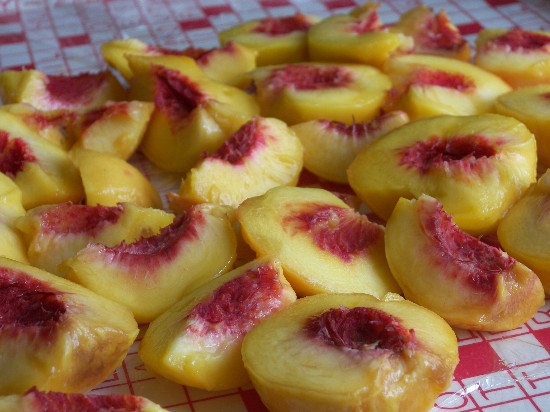
Start peeling with a sharp paring knife at the stem end and the skin slips off as easily as a satin robe gliding off the shoulder of a 1930s glamour queen. Halve or quarter the peaches and lay them on a tray lined with plastic wrap. Place in the freezer for a day and then pack the frozen peaches into a resealable plastic freezer bag or plastic freezer container.

Peeled peaches ready to be flash frozen.

Peeled peaches ready to be flash frozen.

And, while you still have the chance, you can bake a homey Italian peach tart with the following recipe. It’s sweetened with fruit preserves to intensify the flavor of the fresh fruit filling. Sometimes I replace half the preserves with ginger-peach chutney from Tait Farm Foods in Centre Hall, PA. It makes a sweet, slightly hot filling that’s bliss.

[Read more…]

Filed Under: Culture, Food, Gardening, Language, Lifestyle, Miscellany, Recipes Tagged With: freezing peaches, Italian baking, italian recipes, peaches, summer fruit, torta di pesche

Linguine al Limone

Posted June 24, 2009 by Sharon 9 Comments

Linguine al limone is a silken melange that complements grilled summer seafood.

Linguine al limone is a silken melange that complements grilled summer seafood.

She had me at “limone.” That’s because lemon is perhaps the best flavor on the planet.

When Sara posted a comment longing for a recipe for chitarra al limone she ate in Sulmona, she set me on a delectable sleuthing mission.

Sara wrote:

Sulmona’s where I had maybe the best pasta dish of my life…but I can’t remember the name of the restaurant. The dish was chitarra al limone, unlike any I’ve had before or since. I’ve tried several recipes, but nothing comes close. When I asked the owner for her secret, she said “limone!” I said, I know…and what else? She smiled and said, “solo limone, signora.”

She’s going to her grave with the secret. I thought it might be that they used that panna that comes in little tiny cartons and doesn’t need refrigeration, but I tried it and that wasn’t it. The secret’s still in Sulmona…

When I asked Sara for more description, she offered this:

It was very very light and I don’t remember that it was creamy, buttery or eggy. It was as if essence of lemon and very little else coated each strand… I’ve tried just olive oil and lemon with a touch of cream but that just wasn’t the same.

Armed with these clues, I speculated that the dish had to contain cheese, probably Parmigiano-Reggiano, to counter the tartness of the lemon and help create the luxurious mouth feel that she described.  I’m thinking that Sara’s signora wasn’t being coy when she said “solo limone.” To her, cheese is probably just a “given” not worth mentioning.

I consulted the usual reference suspects: Ada Boni’s Italian Regional Cooking, Le Ricette Regionali Italiane (Solares), Artusi’s The Art of Eating Well, The Ultimate Italian Cookbook by Carla Capalbo and Marcella’s Italian Kitchen. None offers a recipe for chitarra al limone. Giuliano Bugialli’s Bugialli on Pasta has a Spaghetti al Limone recipe “from all over Italy” containing quite a bit of butter and cream, more of a lemon- flavored cream sauce than the intense lemon sauce desired by Sara. Michele Scicolone has a Linguine with Lemon recipe in 1,000 Italian Recipes but it’s made with butter. For an Abruzzese dish, I felt that olive oil would be more traditional.

[Read more…]

Filed Under: Abruzzo, Culture, Food, Language, Recipes Tagged With: Abruzzo, Italian cooking, italian food, linguine al limone, pasta al limone

Ciceri e tria

Posted June 4, 2009 by Sharon 4 Comments

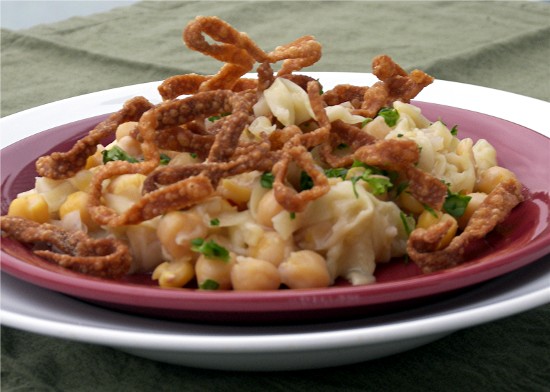
Ciceri e tria, chickpeas and tagliatelle, from Lecce in Puglia.

Ciceri e tria, chickpeas with both fresh and fried tagliatelle, is a specialty from Lecce in Puglia.

Ciceri are chickpeas. Tria are tagliatelle, in the dialect of Puglia. Combined, they make Ciceri e tria a distinctive dish from the baroque city of Lecce.

Like the ‘Ncapriata in Two Cooks in Puglia, this recipe comes from Cinzia and Marika Rascazzo, sisters and proprietors of the Stile Mediterraneo cooking program.

“The recipes are the real traditional ones from Lecce,” Cinzia says in a recent e-mail. “We inherited them from my nonna and we teach them at our school.” Nonna ‘Nzina, short for Vincenza turned 95 in May, looks like she’s 70, and cooks every day.

“She is super well,” says Cinzia. “For her, the most important thing is food. She gets mad if my mother does not buy her the best ingredients. She spends the whole day cooking-maybe just four hours for a minestrone!”

Cinzia, who holds an MBA from Harvard University and Marika, a practicing cardiologist, are passionate about passing on their nonna’s culinary legacy and the culture that it represents. “Our cooking is based on which town you are in, which season it is, and peoples’ taste. In general, we never cover ingredients’ flavors,” Cinzia says.

Dried chickpeas soak overnight before being simmered with aromatics.

Dried chickpeas soak overnight before being simmered with aromatics.

In preparing Ciceri e tria, the first ingredient required is time. Dried chickpeas are soaked overnight and then simmered until tender with aromatic vegetables. The tagliatelle noodles are prepared from scratch by combining water and salt into golden durum wheat, the hardest type of wheat, which is also high in gluten. Durum is a major agricultural product of the Tavoliere plain in northern Puglia.

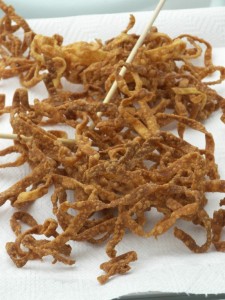
After the noodles are rolled and cut, a portion, about one-quarter, of them are deep-fried in olive oil. (These fried noodles make an irresistible pre-dinner nosh sprinkled with salt and Parmesan cheese!)

friedtria

The remaining tagliatelle are cooked with the chickpeas. (When I tested the recipe, my first batch of tagliatelle turned gummy when I added them to the chickpeas. I had better luck boiling the noodles separately and then draining them before adding them to the chickpeas but this is NOT Nonna “Nzina’s method.) The three elements are stirred together just before serving and garnished with fresh parsley and hot red pepper to taste.

[Read more…]

Filed Under: Culture, Food, Language, Lifestyle, Mediterranean diet, Puglia, Recipes, Travel Tagged With: chickpeas, homemade pasta, Italian cooking, italian culture, Lecce, Puglia, Stile Mediterraneo, tagliatelle

Two Cooks in Puglia

Posted May 29, 2009 by Sharon 1 Comment

Sharon (center) with Rosalba De Carlo (left) and Cinzia Rascazzo at Alle due Corti ristorante in Lecce.

Sharon (center) with Rosalba De Carlo (left) and Cinzia Rascazzo at Alle due Corti ristorante in Lecce.

In the baroque town of Lecce, Walter and I meet two dynamic women who are fighting for their lives. Not literally for physical survival-although it may come to that-but for the endurance of their culinary tradition. They may be of different generations but their focus is the same: To preserve the traditions of Pugliese cooking.

If you think this sounds melodramtic, consider this: A McDonald’s sits in the historic Piazza San Oronzo in Lecce, a town that up until a few decades ago was a relatively remote outpost in southern Italy. The food of this area was the now much-lauded ‘Mediterranean diet.’ But, back to our heroines. . .

Thirty-something Cinzia Rascazzo, with her sister Marika Rascazzo, operates Stile Mediterraneo, a custom tour business that focuses on Pugliese culture, cooking, olive oil and wine.

alleduecortisignRosalba De Carlo is a generation older. She’s the proprietor of the esteemed Alle due Corti ristorante where we are lunching with Cinzia on a cloudy Saturday afternoon. We are honored to be eating here and meeting Rosalba. In 2008, she was recognized as an exemplar of the gastronomic culture of Salento, the southern tip of the Italian “heel” during an Economic Sustainability Conference in conjunction with UNESCO and ISNART (the national institute of tourism research).

Seated in the cozy backroom, we ask Cinzia to choose dishes for us. She explains that we will be eating mostly vegetables because Lecce sits inland, away from the coast. (I smile to myself because the distance to the Adriatic Sea is probably no more than 10 miles, practically beachfront property by U.S. standards.) “There is a Spanish influence, similar to Catalan, here in Lecce,” Cinzia says.

Dishes are served in locally crafted terra cotta plates. The peperoni agrodolce are slowly cooked in olive oil and a bit of sugar until they almost melt. Vinegar and bread crumbs complete the preparation. “The Pugliese put breadcrumbs on everthing,” Cinzia explains, laughing. And with good reason. Pugliese bread is renowned because it is made with the superior hard durum wheat that is cultivated in the northern part of the region.

Local pastas are also made from durum wheat mixed with water. We sample orecchiette (shaped like little ears) in a green vegetable puree and strascinate (ragged curled strands) in a tomato sauce.

Polpettone (balls) prepared from eggplant were a revelation. So light, so flavorful. The eggplant is peeled and cooked then passed through a food mill. It’s mixed with grated aged pecorino cheese, breadcrumbs, and egg, shaped into balls and deep fried in olive oil. (Full disclosure: After returning home, I asked Cinzia to share a recipe via e-mail. I tried but I couldn’t replicate the taste and texture. Some dishes must be eaten in their place of origin and I think this is one of them.)

Probably the most amazing tasting that day was ‘ncapriata. Made from only three ingredients-fava beans, chicory and extra-virgin olive oil-this is the poster child of Puglia’s cucina povera. Just beans, greens, and oil but when the base ingredients are so distinctive, and the cooks know how work magic, the results are spectacular.

ncapriataCinzia shares her recipe and gives this advice for enjoying ‘ncapriata. “The chicory and fava beans are meant to be eaten together! You can also serve them with small pieces of traditional durum wheat bread. You can add more extra virgin olive oil at the table.”
‘Ncapriata  (fava bean puree and wild chicory)

Makes 5 servings

1 pound dried peeled fava beans

Salt

2 pounds wild chicory or cooking greens such as dandelion, mustard or curly endive

1 whole garlic clove

Red pepper flakes

5 tablespoons extra-virgin olive oil plus extra for garnish

Place the beans in a large bowl and cover generously with cold water. Soak for at least 8 hours.

Drain and rinse the beans. Place them in a large heavy pot and cover with fresh water. Place over low heat. When the water starts boiling, skim the foam from the surface with a spoon. Discard the foam. Continue skimming and discarding the foam as long as it appears. Cook, stirring occasionally, over low heat for about 2 hours. The beans will gradually dissolve into a puree. If the mixture is too thick, add water from time to time if needed.

Meanwhile, bring a large pot of salted water to a boil. Wash the greens. Chop them coarsely. Add to the boiling water. Stir and cover. Cook for about 5 minutes or until al dente. Drain the greens.

Return the same cooking pot to medium-low heat. Add 2 tablespoons oil, the garlic and pepper flakes to taste. Cook over low heat for about two minutes. Add the greens, stir and cover. Cook on low heat for 5-10 minutes, or until tender. Season to taste with salt. Remove the garlic and discard.

When the fava beans are completely dissolved, remove from the heat and add 3 tablespoons of oil (or more if you like) while stirring with a wooden spoon. Season to taste with salt. Thin with some water if needed to create a very thick puree.

Ladle the fava puree into one side of a pasta bowl. Place some greens next to the puree. Drizzle with a bit more oil at the table if desired.

Coming next: More about Stile Mediterraneo plus a recipe for ciceri e tria (chickpeas with tagliatelle).

Filed Under: Culture, Food, Italy restaurants, Language, Lifestyle, Puglia, Recipes, Travel Tagged With: italian culture, Italy travel, Puglia, Stile Mediterraneo

Chocolate Time

Posted April 1, 2009 by Sharon 1 Comment

chococapptorte

April is cruel on dessert lovers.

Citrus fruits are past their prime.

Apples and pears, in cold storage since last autumn,  are mealy.

Local strawberries, blueberries, cherries, and raspberries are a distant glimmer on the horizon.

Waiting is difficult.

But, fortunately, chocolate is perennial.

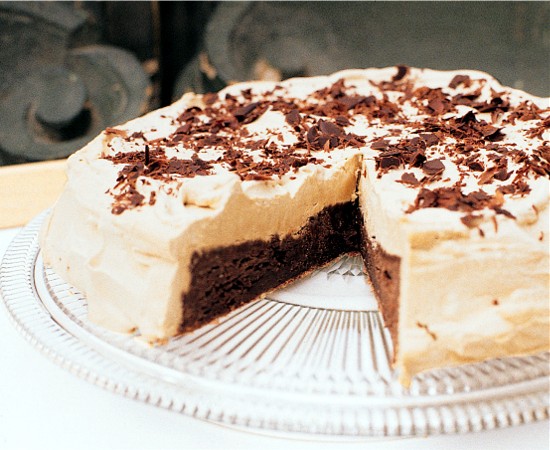
A Chocolate Torte with Cappuccino Cream in the freezer makes the time until strawberries just a bit sweeter.

Frozen Chocolate Torte with Cappuccino Cream

4          ounces unsweetened chocolate, chopped

1          cup all-purpose flour

1          teaspoon baking powder

Pinch of salt

2          sticks (1/2 cup each) unsalted butter, softened

1 3/4     cups sugar

4          large eggs

2          teaspoons vanilla extract

1          tablespoon instant espresso or regular instant coffee

1          cup whipping cream

2          tablespoons confectioners’ sugar

Bittersweet chocolate shavings for garnish

Preheat the oven to 350°F. Coat a 10-inch round springform pan with no-stick

spray.

Put the chocolate in a small microwaveable bowl. Microwave for 2 minutes. Stir. If lumps remain, microwave for about 20 seconds. Stir and set aside. On a sheet of waxed paper, combine the flour, baking powder, and salt. Stir to mix; set aside.

In the bowl of an electric mixer, beat the butter for about 2 minutes, or until fluffy. Gradually add the sugar, continuing to beat, and scraping the sides of the bowl as needed. Beat in the eggs, one at a time. Add the melted chocolate and the vanilla. Reduce the mixer speed to low. Add the reserved dry ingredients. Mix just to incorporate. Spoon into the prepared pan. Spread evenly.

Bake for about 45 minutes, or until a toothpick inserted into the center comes out clean. Remove the torte from the oven. Allow to sit for 5 minutes. Remove the outer ring of the pan. Place a freezerproof serving dish over the torte. Invert the torte onto the dish. Run the blade of a long thin knife between the top of the torte and the pan bottom to separate. Allow to cool.

In the mixing bowl of an electric mixer, stir instant espresso or regular instant coffee with 1 teaspoon cold water to dissolve. Add cream. Whip on high speed for 2 to 3 minutes or until soft peaks form. Add confectioners’ sugar. Whip for 1 to 2 minutes, or until peaks hold their shape. Spread, swirling into peaks, over the top and sides of the cooled torte.

Place in the freezer, uncovered, for 2 hours. For longer storage, cover tightly with plastic wrap and then with aluminum foil. Freeze for up to 1 week. To serve, unwrap and allow to sit at room temperature for 15 to 20 minutes. Bittersweet chocolate shavings may be scattered on top for decoration.

Makes 12 servings

©Cooking Up an Italian Life, PergolaWest, Inc.

Filed Under: Food, Recipes Tagged With: chocolate, Italian chocolate desserts, italian food, italian recipes

  • « Previous Page
  • 1
  • …
  • 7
  • 8
  • 9
  • 10
  • 11
  • Next Page »
Follow Simple Italy on FacebookFollow Simple Italy on RSS
Lasagne_19 Simple Italy's Greatest Hits at a click!
Lasagne alla Bolognese and more

Recent posts

  • The Hill Towns of Molise
  • Fior di Latte Cheese
  • In the Mood for Molise, Italy
  • Silk from the Sea in Sardinia
  • Driving a Ferrari Spider

Posts by Category

  • Abruzzo (12)
  • AirBnB (1)
  • Amalfi (8)
  • Archeology (3)
  • Architecture (21)
  • Art (19)
  • Artisans (4)
  • Automobiles (1)
  • Bakery (1)
  • Basilicata (3)
  • Bologna (4)
  • Books (21)
  • Calabria (4)
  • Campania (17)
  • Cooking Classes (5)
  • Cremona (2)
  • Culture (174)
  • dreamofitaly (1)
  • Driving in Italy (2)
  • Emilia Romagna (2)
  • Ferrari (1)
  • Ferrari Museum (1)
  • Film (22)
  • Florence (30)
  • Food (134)
  • Fred Plotkin (1)
  • Friuli-Venezia Giulia (2)
  • Gardening (25)
  • Genoa (2)
  • Golf in Italy (1)
  • Guides (1)
  • History (8)
  • Hotels (14)
  • Inner Italian Q & A (11)
  • Italian seafood (7)
  • Italy Artisans (3)
  • Italy restaurants (17)
  • Language (86)
  • Le Marche (4)
  • Lifestyle (113)
  • Liguria (2)
  • Lombardy cooking (5)
  • Lucca (3)
  • Mantua (1)
  • Markets (26)
  • Mediterranean diet (55)
  • Milan (1)
  • Miscellany (86)
  • Modena (1)
  • Molise (3)
  • Mt. Etna (1)
  • Music (9)
  • Naples (2)
  • New Orleans (2)
  • Opera (1)
  • Palermo (3)
  • People (3)
  • Photography (4)
  • Piedmont cooking (1)
  • Puglia (9)
  • Quotes (4)
  • Recipes (64)
  • Rome (8)
  • Salerno (3)
  • Sardinia (4)
  • Sicily (15)
  • Test Drive (1)
  • Testimonials (2)
  • Travel (110)
  • Trentino Alto-Adige (1)
  • Tuscan cooking (17)
  • Tuscany (30)
  • Venice (2)
  • Videos (2)
  • Wine (23)

Inside SimpleItaly

  • American Couple Marries Italian-Style
  • Appearances
  • Contact us
  • Cooking Up an Italian Life
  • Le Marche Tour with Luisa
  • Links
  • Palazzo Donati Sample Itinerary
  • Palazzo Donati Tours
  • Privacy and Site Policies
  • Publications and TV
  • Sharon’s Inner Italian
  • SimpleItaly Adventure in Tuscany Tour
  • Thank You
  • Walter’s Inner Italian

Tags

Abruzzo bucket list Florence Gardening gelato Genoa Inner Italian Italian cooking italian culture italian food Italian food stores italian language italian lifestyle italian markets Italian music Italian pasta recipe italian recipes Italian tourism italian travel italian wine Italy Italy travel Lago di Como Lake Como Malika Ayane Mediterranean diet mozzarella di bufala Naples tourism Paestum Paolo Conte porcini Puglia Rome Santa Croce Sardegna Sardinia Sicily Southern Italy Stile Mediterraneo Sulmona Tuscan cooking Tuscany Uffizi Gallery Villa Pipistrelli women and travel