Simple Italy

Celebrating Your Inner Italian

  • Home
  • Contact us
  • Links

Greens, Borlotti Beans, and Polenta

Posted January 19, 2011 by Sharon 10 Comments

(Clockwise from top) Collard greens, broccoli rabe, and curly kale.

“Do you have a rabbit?”

I was so intent on punching in the number codes for my produce items in the self-checkout that, at first, I didn’t realize the woman was speaking to me.

“Do you have a rabbit?” she repeated. “Or a juicer?”

My puzzled expression encouraged her to elaborate. “All these greens, I thought maybe you have a rabbit,” she said gesturing to the bags of broccoli rabe, curly kale and collards on the counter. “You don’t eat them, do you?”

I squelched my urge to laugh and assured her that these greens were incredibly tasty. “I stir sauté them in olive oil and garlic,”  I offered.  “My family loves them.” (I didn’t go so far as to disclose that one of my proudest achievements as a parent is that both my daughters adore these hearty, healthful vegetables.) As I bagged my leafy booty and left the market, she still didn’t look convinced.

I thought of her that evening when we feasted on pungent broccoli rabe, borlotti beans braised with pancetta, and creamy polenta. We are some lucky bunnies!

This rustic dinner of greens, borlotti beans and polenta is typical of central and northeastern Italian country food in the winter. Borlotti rival the Tuscan favorite cannellini as my pick for best Italian bean. The borlotti have tan skin with black-magenta streaks. When cooked the skin turns a warm cocoa brown and the cooking broth and beans create a savory gravy. They’re so satisfying especially with some pancetta in the pot.

My local supermarket doesn’t stock borlotti beans so chances are yours won’t either. I used the superb organic borlotti from www.ranchogordo.com in Napa, CA. Some other online beans sellers are www.purcellmountainfarms.com and www.bobsredmill.com for cranberry beans, a good stand-in for borlotti.

Stir-Sautéed Greens

Makes 4 to 6 servings

Extra-virgin olive oil

1          large clove garlic, minced

1          pound broccoli rabe, kale, chard, or collard greens

Salt and freshly-ground ground black pepper

Wash the greens in plenty of cold water. Remove and discard tough stems. Chop the greens. There’s no need to dry them; the water on the leaves will create steam in the pan to help tenderize them.

Film a large sauté pan or large pot generously with olive oil. Scatter in the garlic and make sure it is filmed with oil. Set over low heat. Cook for about 3 minutes, watching and stirring frequently, or until garlic is softened. Do not brown.

Increase heat to high. Add half the greens to the pan; toss with tongs. Cover for about 1 minute or until the greens start to wilt. Add the remaining greens. Toss and cover for 1 minute. Uncover and cook, tossing, for about 2 minutes or until greens are wilted, brightly colored and glossy. Season to taste with salt and pepper.

Vino sangiovese from the province of Romagna.

This recipe for borlotti is inspired by the beans I ate at Poggio Duca, a wonderful agriturismo on the border between Romagna province and the Marche. The large inviting dining room has a bank of windows overlooking the valley below the medieval mountaintop village of San Leo.

Braised Borlotti Beans with Pancetta

Makes 4 to 6 servings

Extra-virgin olive oil

2 ounces thick pancetta or good-quality slab bacon, finely chopped

1 onion, chopped

1 tablespoon minced fresh rosemary

1 cup canned crushed tomatoes or tomato puree

1 pound cooked borlotti beans with cooking liquid (see following cooking method)

Salt and black pepper

In a large heavy pot, combine about 1 tablespoon oil with the pancetta. Cook over medium-low heat for about 5 minutes, or until the pancetta fat is rendered and the meaty streaks start to brown. Add the onion. Cook, stirring, for about 5 minutes or until the onion is translucent. Add the rosemary and tomato. Bring to a simmer. Add the beans with their cooking liquid. Stir.

Partially cover the pot and cook at a gentle simmer for about 45 minutes until the beans thicken slightly and the flavors blend. Season to taste with salt and black pepper.

Basic Method for Cooking Dried Beans

Makes 6 to 7 cups

1          pound dried beans, sorted and washed

12        cups good-tasting water (approximately)

1          carrot, cut in 2-inch chunks

2          ribs celery heart, cut in 2-inch chunks

1          small onion, cut in half

1          bay leaf

Several parsley stems

Salt

In a large pot, soak the beans overnight in cold water to cover.

Drain the beans and return them to the pot. Cover with water about 2 inches above the beans. Add the carrot, celery, onion, bay leaf, and parsley. Cover and bring almost to a boil. Remove the cover and reduce the heat so the water liquid simmers. Skim any foam and discard.

Partially cover the pot. Adjust the heat so the water liquid simmers but does not boil. Cook for 1 hour. Test a bean for doneness. Add slightly more water if needed to keep beans covered. Stir gently. Cook for 1 to 2 more hours, adding more liquid as needed, or until beans are tender but hold their shape. Taste. Season to taste with salt.

Remove from the heat to cool.  Remove and discard the carrot, celery, onion, bay leaf, and parsley stems. Place the beans in a covered container and refrigerate for up to 2 weeks before using in a recipe. The beans may also be frozen if you plan to use them in a recipe like soup where firm texture is not crucial.

Creamy Polenta

Makes 4 to 6 servings

1          cup cornmeal, preferably stone-ground

4          cups chicken broth, water, or milk

1/4       teaspoon salt

Grated Pecorino Romano cheese

Whisk the cornmeal, milk, and salt in a saucepan. Cook, whisking constantly, over medium-high heat, for about 5 minutes, or until thickened. Reduce the heat to low. Simmer, stirring occasionally, for about 2 minutes. Remove from the heat.

Do you eat Italian rabbit food, too? How do you prepare your greens? What do you serve with them?

Filed Under: Culture, Food, Lifestyle, Markets, Mediterranean diet, Recipes Tagged With: borlotti beans, broccoli rabe, Italian greens, Italian winter meal, kale, polenta

Pomegranate

Posted December 11, 2010 by Sharon 6 Comments

Edible garnets bursting with sweet tart juice and a crunchy center.  These are pomegranate arils, the juice-filled sacs that encase the seeds of this delightful winter produce.

Pomegranates are an ancient fruit that were known by the Romans. Widely cultivated in the Mediterranean, the Italian name for them is melagrana.

I’m always excited when pomegranates show up in the market but the season is relatively short. Fresh pomegranates from California are available September through January. The Wonderful or Red Wonderful is the most common variety grown in this country.

For the best winter salad imaginable, in a bowl whisk two to three parts extra-virgin olive oil with one part lemon juice or red wine vinegar and a pinch of salt. Add mixed greens, cut-up clementine sections and a generous handful of pomegranate arils. Toss and serve garnished with coarsely ground black pepper.

To learn how to select and store pomegranates, as well as extract the arils without giving yourself a juice bath (word of warning: don’t wear white), visit the Pomegranate Council. They  offer recipes and of useful information such as the tip that pomegranate arils freeze just fine. I’m going to try that to extend the season for these edible garnets.

Filed Under: Culture, Food, Markets, Mediterranean diet, Recipes Tagged With: melagrana, pomegranate, winter salad with pomegranate and clementine

Tuscan Porcini Soup

Posted November 24, 2010 by Sharon 2 Comments

One taste of zuppa di porcini whisks me to rural Tuscany in autumn. My friend Anna Maria Gaggio showed me how to make this dish in the kitchen of her Tuscan farmhouse, using fresh porcini gathered by her husband Mario.

Because imported porcini are outrageously expensive, I recreate the soup using a mixture of fresh baby bella mushrooms and reconstituted dried porcini. The flavor is intense because the dried mushrooms concentrate the essence.

The portions in this recipe are adequate for a light meal with a salad. Half portions make a wonderful first course for a holiday meal. If you like, prepare the soup a few days ahead of time, refrigerate and reheat before serving.

Zuppa di Porcini

Serves 4 to 6

1          ounce dried porcini mushrooms

2                    cans fat-free reduced-sodium (14 1/2 ounces each) chicken broth, divided

1/3       cup olive oil

1 1/4    pounds baby bella mushrooms, sliced

4          cloves garlic, minced

1          tablespoon minced fresh rosemary leaves

1/4       teaspoon dried red-pepper flakes

3/4       teaspoon salt

1                    can (14 1/2 ounces) diced tomatoes, drained

4        cups water

4 to 6   slices (1-inch-thick) toasted rustic bread

2          ounces (1/2 cup) grated Parmesan cheese

Place the porcini and 1 cup of broth in a microwaveable glass measuring cup. Cover with plastic wrap, leaving a vent. Microwave for 3 minutes or until bubbling. Set aside for 10 minutes to soften.

Meanwhile, warm the oil in a large pot over high heat. Add the baby bella mushrooms, garlic, rosemary, red-pepper flakes, and salt. Cook, stirring, for about 5 minutes or until the mushrooms start to give off liquid. Turn off the heat.

Drain the porcini through a fine sieve lined with a coffee filter. Save the broth. Rinse the porcini and chop. Add the porcini, mushroom broth, chicken broth, water, and tomatoes to the pot. Cook over medium-low heat for 20 minutes for the flavors to blend.

Place a slice of toasted bread in the bottom of each soup bowl. Ladle the soup over the bread. Sprinkle with the Parmesan.

Note

Fresh rosemary is preferable to commercially dried leaves but if necessary, 2 teaspoons of dried rosemary may replace the fresh. Home-dried leaves, which crumble more readily than the commercially packaged rosemary, are also good to use. When you buy a bunch of fresh rosemary for a recipe, if you don’t use it all right away,  it makes sense to dry or freeze the remaining branches so they don’t go to waste.

Filed Under: Culture, Food, Language, Lifestyle, Mediterranean diet, Recipes, Tuscan cooking, Tuscany Tagged With: funghi porcini, Italian winter soups, porcini, porcini mushrooms, rosemary, zuppa di porcini

Mozzarella di Bufala

Posted November 10, 2010 by Sharon 9 Comments

An antipasto plate from Salerno province features fresh mozzarella di buffalo at 12 noon on the plate.

I think I know the reason that production of mozzarella di bufala increased by more than 11 percent in the first half of this year (according to the Mozzarella di Bufala Campana DOP consortium).

The bump in output coincided with my visit to Salerno Province—a major producer of mozzarella di bufala—where I savored the heavenly fresh cheese at every opportunity.

I learned that until you eat DOP (“protected designation of origin” zone) mozzarella on the day it is produced, you haven’t eaten true mozzarella. The milk of water buffalos is higher in fat (about 9 percent) than cow’s milk (about 4 percent) and fat = flavor + mouth feel. Tangy and supple mozzarella di bufala is simply divine.

Our group of travel professionals was invited to watch the artisans at the Fattoria del Casaro in Paestum making mozzarella. As we entered the spotless production room, we were cautioned to tread carefully. The tile floor was slick from dissolved milk fat splashing out of vats filled with steaming water and walnut-sized cheese curds.

Fresh curds of mozzarella form when water buffalo milk is mixed with naturally soured mozzarella whey and rennet.

The mozzarella men pulled the curds with a long stick to create skeins of cheese. Prior to the scalding stretch fest, the curds relaxed  in warm water for about four hours. The name mozzarella comes from the verb mozzare, meaning “to cut.” The stretched curds are pinched by hand  into varying sized balls or braids.

At Fattoria del Casaro in Paestum, artisans work the mozzarella curd.

In the U.S., fresh mozzarella di bufala is available in big city shops but is very expensive. A good alternative is cow’s milk mozzarella, called fior di latte “flower of milk.” Since freshness is its calling card, overcooking mozzarella is a big no-no. Melting it atop pizza is about as much cooking as it can take.

Fresh mozzarella shaped into una treccia, a braid.

In summer, a classic way to savor fresh mozzarella is in insalata caprese, named for the island of Capri. The dish is prepared by placing alternating slices of mozzarella and ripe tomatoes on a plate and drizzling with extra-virgin olive oil, fresh basil, salt and pepper.  New York-based cookbook author Arthur Schwartz, who teaches cooking classes in Paestum, writes in Naples at Table that vinegar is never used in a caprese. Also, he recommends cooks outside of Italy select ripe Big Boy tomatoes as a good stand in for the Caprese pomodori cuore di bue.

Here is a recipe from Naples at Table for a wonderful pasta dish made with fresh mozzarella.

Spaghetti con Melanzane e Mozzarella

(Spaghetti with Eggplant and Mozzarella)

1 pound eggplant, peeled or unpeeled, cut into 1/2-inch cubes

Salt

Oil for frying

2 large cloves garlic, lightly smashed

1/2 teaspoon hot red pepper flakes

1 pint (1 pound) cherry tomatoes, cut in halves or quarters

12 to 14 ounces spaghetti

2 tablespoons finely cut basil or parsley

8 ounces fresh or several-days-old mozzarella, cut into1/4-inch cubes

Grated Pecorino or ricotta salata

  1. Salt the eggplant and let it drain in a colander for 30 minutes or longer. Dry it well with paper towels, pressing the eggplant to remove moisture.
  2. In a skillet, heat about 1/2 inch of oil and fry the eggplant until it is soft and lightly browned. Remove the eggplant with a slotted spoon and drain on absorbent paper.
  3. Pour out (and discard) all but about 2 tablespoons of the frying oil. Add the garlic and the pepper flakes and place over low heat. Cook the garlic, pressing it into the oil a couple of times to release its flavor, until it barely begins to color on both sides. Remove the garlic.
  4. Add the tomatoes, immediately cover the pan, increase the heat to medium-high, and cook the tomatoes until they fall apart and become saucy, about 8 minutes.
  5. Meanwhile cook the spaghetti until al dente in plenty of salted boiling water.
  6. Just before the pasta id done, add the eggplant cubes to the tomato sauce, lower the heat, and cook gently, still covered, for another minute or so.
  7. Drain the spaghetti and turn it into a well-warmed serving bowl. Add the eggplant and tomato sauce, plus the finely cut herb. Toss well. Add the mozzarella and toss again.
  8. Serve immediately. Garnish with some grated Pecorino or ricotta salata if desired.

La Fattoria del Casaro packages mozzarella di bufala for airplane carry-on.  You can also purchase fresh mozzarella di bufala from Fattorie Garofalo which has a shop in Naples Capodichino Airport.

Filed Under: Campania, Food, Language, Lifestyle, Mediterranean diet, Recipes, Salerno, Travel Tagged With: Arthur Schwartz, genuine mozzarella, insalata caprese, mozzarella di bufala, Paestum, spaghetti with eggplant and mozzarella

Panzanella

Posted August 5, 2010 by Sharon 6 Comments


I crave panzanella in August. This home-spun jumble of stale bread, succulent tomatoes, aromatic basil, olive oil, wine vinegar, cucumber and onion is restorative. Each refreshing bite perks me up, makes me feel more  like a budding flower and less like a scorched weed.

I first tasted panzanella in the countryside outside of Florence. Friends told me that the dish evolved as thrifty country cooks combined stale bread with juicy seasonal produce to create a quick, inexpensive salad.

These days, the challenge to putting together a good panzanella is in obtaining ingredients that will give the dish a genuine flavor and the proper texture. The keys are the bread, the tomatoes, and the olive oil.

Bread

Panzanella requires a rustic whole-grain loaf–with no fat or sweeteners–that won’t dissolve into goo when moistened. (LaBrea Bakery whole grain loaf is one commercially-produced example. To find a store near you, go to La Brea Bakery.) Many so-called Italian breads are made from white flour and dough enhancers and are just too fluffy to hold their crumb. If you’re a baker, you can prepare the Italian Wheat Berry Bread for the panzanella. If you think your bread won’t hold up to the water bath, I recommend skipping that process. Instead, simple toast the bread lightly and then cut it into cubes before tossing with the vegetables and dressing.

Tomatoes

Choose very ripe fruit that’s grown in your area. I like heirloom varieties which are like tomato-juice machines.

Olive oil
The fruity taste of extra-virgin oil is essential. When it’s mixed with the vegetables and basil, it produces a seasonal elixir.

While I prefer the classic simplicity of the following recipe, you can add protein or other vegetables to a panzanella to make it a one-dish meal. Add-ins include lettuce, radishes, celery, fennel, prosciutto, canned tuna, Parmigiano Reggiano, Gruyère, capers, artichoke hearts, hard-cooked eggs and roasted red peppers.

Panzanella (Tuscan Bread and Tomato Salad)

Makes 6 to 8 servings

1 loaf (about 1 pound) rustic Italian Wheat Berry Bread, cut into 1/2-inch cubes, dried

1/3 cup extra-virgin olive oil

2 tablespoons red or white wine vinegar

Salt and pepper

1 1/2 pounds ripe locally-grown tomatoes, cut into chunks

1 medium cucumber, peeled, quartered lengthwise, sliced

1/2 medium red onion (about 4 ounces), halved and thinly sliced

1/2 cup slivered fresh basil

Place the bread in a large bowl. Cover with cold water. Allow to soak for 30 to 60 seconds until bread is saturated. Test by squashing a piece between thumb and finger. Drain. Scoop the bread in cupped handfuls, squeezing out excess water but taking care not to pulverize the bread. Transfer to a platter. Continue until all the bread is squeezed.

In a large bowl, whisk the oil, vinegar, and 1/4 teaspoon salt. Add the tomatoes, cucumber, onion, and basil. Toss. Add the bread and toss. Season to taste with pepper and more salt, if needed.

What’s your go-to Italian summer dish? Tell us about it.

Filed Under: Culture, Florence, Food, Mediterranean diet, Recipes, Tuscan cooking Tagged With: Italian summer salad, Tuscan bread and tomato salad, Tuscan cooking

Gratinata di Zucchini

Posted July 7, 2010 by Sharon 8 Comments

Sure, the happy yellow blooms look pretty now.

Oh, and look, some of the flowers have baby zucchini growing out of them. How cute!

Ah, but in a a span of days, those diminutive veggies will explode to gargantuan proportions.

Act now! Pick your zucchini when they are no more than 1-inch wide. You’ll thank me later.

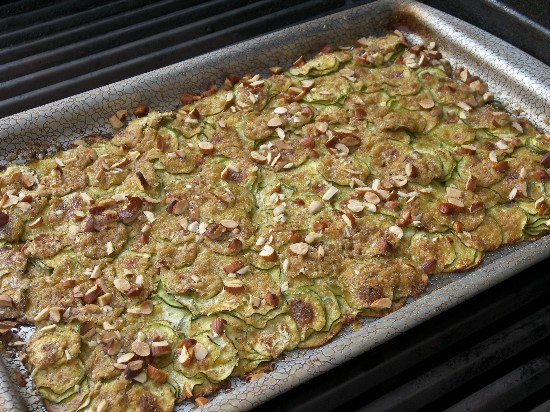
To prepare a gratinata, slice the zucchini very thin on the finest setting of a mandoline or with the slicing blade of a food processor.

This easy dish is always a hit because the cheese and olive oil not only add terrific flavor to the mild squash, they help to crisp up the texture. It’s equally delicious served warm or at room temperature.

Gratinata di Zucchini

Extra-virgin olive oil

3/4       cup grated Parmesan cheese

1/2       cup plain dry breadcrumbs

2          pounds small zucchini (1-inch diameter) very thinly sliced

Salt

1/4       cup coarsely chopped pine nuts or almonds

Preheat a grill to 375°F. On a sheet of waxed paper, combine the breadcrumbs and Parmesan.

Oil the bottom of a 13 x 10 x 1-inch baking sheet with sides. Coat with one-third of the Parmesan mixture. Place one third of the zucchini slices in an even layer in the pan. Season lightly with salt. Repeat layering twice. Drizzle lightly with oil. Sprinkle evenly with the pine nuts.

Bake in the covered grill over indirect heat for about 40 minutes or until browned and sizzling. Remove from the grill to cool for at least 15 minutes before serving. Serve warm or at room temperature.

What’s your favorite way to cope with zucchini bounty? Leave a comment below.

Filed Under: Food, Gardening, Mediterranean diet, Recipes Tagged With: Italian cooking, italian recipes, zucchini recipe

  • « Previous Page
  • 1
  • …
  • 5
  • 6
  • 7
  • 8
  • 9
  • …
  • 11
  • Next Page »
Follow Simple Italy on FacebookFollow Simple Italy on RSS
Lasagne_19 Simple Italy's Greatest Hits at a click!
Lasagne alla Bolognese and more

Recent posts

  • The Hill Towns of Molise
  • Fior di Latte Cheese
  • In the Mood for Molise, Italy
  • Silk from the Sea in Sardinia
  • Driving a Ferrari Spider

Posts by Category

  • Abruzzo (12)
  • AirBnB (1)
  • Amalfi (8)
  • Archeology (3)
  • Architecture (21)
  • Art (19)
  • Artisans (4)
  • Automobiles (1)
  • Bakery (1)
  • Basilicata (3)
  • Bologna (4)
  • Books (21)
  • Calabria (4)
  • Campania (17)
  • Cooking Classes (5)
  • Cremona (2)
  • Culture (174)
  • dreamofitaly (1)
  • Driving in Italy (2)
  • Emilia Romagna (2)
  • Ferrari (1)
  • Ferrari Museum (1)
  • Film (22)
  • Florence (30)
  • Food (134)
  • Fred Plotkin (1)
  • Friuli-Venezia Giulia (2)
  • Gardening (25)
  • Genoa (2)
  • Golf in Italy (1)
  • Guides (1)
  • History (8)
  • Hotels (14)
  • Inner Italian Q & A (11)
  • Italian seafood (7)
  • Italy Artisans (3)
  • Italy restaurants (17)
  • Language (86)
  • Le Marche (4)
  • Lifestyle (113)
  • Liguria (2)
  • Lombardy cooking (5)
  • Lucca (3)
  • Mantua (1)
  • Markets (26)
  • Mediterranean diet (55)
  • Milan (1)
  • Miscellany (86)
  • Modena (1)
  • Molise (3)
  • Mt. Etna (1)
  • Music (9)
  • Naples (2)
  • New Orleans (2)
  • Opera (1)
  • Palermo (3)
  • People (3)
  • Photography (4)
  • Piedmont cooking (1)
  • Puglia (9)
  • Quotes (4)
  • Recipes (64)
  • Rome (8)
  • Salerno (3)
  • Sardinia (4)
  • Sicily (15)
  • Test Drive (1)
  • Testimonials (2)
  • Travel (110)
  • Trentino Alto-Adige (1)
  • Tuscan cooking (17)
  • Tuscany (30)
  • Venice (2)
  • Videos (2)
  • Wine (23)

Inside SimpleItaly

  • American Couple Marries Italian-Style
  • Appearances
  • Contact us
  • Cooking Up an Italian Life
  • Le Marche Tour with Luisa
  • Links
  • Palazzo Donati Sample Itinerary
  • Palazzo Donati Tours
  • Privacy and Site Policies
  • Publications and TV
  • Sharon’s Inner Italian
  • SimpleItaly Adventure in Tuscany Tour
  • Thank You
  • Walter’s Inner Italian

Tags

Abruzzo bucket list Florence Gardening gelato Genoa Inner Italian Italian cooking italian culture italian food Italian food stores italian language italian lifestyle italian markets Italian music Italian pasta recipe italian recipes Italian tourism italian travel italian wine Italy Italy travel Lago di Como Lake Como Malika Ayane Mediterranean diet mozzarella di bufala Naples tourism Paestum Paolo Conte porcini Puglia Rome Santa Croce Sardegna Sardinia Sicily Southern Italy Stile Mediterraneo Sulmona Tuscan cooking Tuscany Uffizi Gallery Villa Pipistrelli women and travel