
Simple Italy

Celebrating Your Inner Italian

  • Home
  • Contact us
  • Links

Giotto Anew

Posted March 8, 2010 by Sharon Leave a Comment

A statue of the artist and architect Giotto stands outside the Uffizzi Gallery in Florence.

A statue of the artist and architect Giotto stands outside the Uffizzi Gallery in Florence.

Art restorers using ultra-violet rays are seeing rich original details of Giotto’s paintings in the Peruzzi Chapel in the Basilica di Santa Croce in Florence that have been hidden for centuries, according to an exclusive just-released story from Reuters news service.

The dry painted frescoes, said to have influenced Michelangelo, had been whitewashed and then badly repainted over the course of centuries.

Reporter Philip Pullella describes one panel of the Giotto viewed under ultra-violet light, “In the scene where God is accepting John the Evangelist into heaven, the wrinkles in John’s forehead, the threads of his beard, the whites of his eyes and God’s welcoming gaze appear like fleeting but powerful visions.”

Giotto di Bondone, known simply as Giotto, painted in the late 1200s and early 1300s throughout central Italy. His work was seminal in moving artists away from the stiff portrayls in Byzantine paintings to the more humanistic renderings of the Renaissance.

Filed Under: Culture Tagged With: art history, Basilica di Santa Croce, Giotto, Italian art, Peruzzi Chapel, Phillip Pullella, Reuters

Why Italians Love To Talk About Food

Posted January 20, 2010 by Sharon 3 Comments

Photograph of Elena Kostioukovitch by Massimo Pasquale

Photograph of Elena Kostioukovitch by Massimo Pasquale

Elena Kostioukovitch is not Italian. She was born in Kiev, Ukraine. But Kostioukovitch is deeply in touch with her Inner Italian. How do I know? I’ve been reading Why Italians Love to Talk About Food, the Farrar, Straus and Giroux publication of her book.

Kostioukovitch’s day job is to translate the literary works of Umberto Eco and other authors into the Russian language. Also an essayist and literary agent, she has lived in Milan for more than two decades. She explains in the preface to her 400-plus page tome, “This book was born specifically to assemble in a single volume stories about the symbolic foods of each Italian region and their ‘ideological’ meanings.”

She creates an intellectual journey from the north of the peninsula to the south, exploring culinary history, characteristic dishes, and cultural eccentricities of each region. Her research is rigorous — footnotes and bibliography cover more than 30 pages.

We learn, for instance, that the aperitivo Campari was created by Gaspare Campari at the Caffè Zucca in Milan in 1867.

We practically taste the brine on our lips as we discover that the remaining wilderness of Puglia fosters in the locals a preference for unadulterated foods. “The tendency to eat unprocessed food is especially evident in the consumption of raw fish. In fish markets, for example, it is customary to set out plates of raw shrimp, cuttlefish, and mussels for customers who are waiting, to be eaten on the spot with a squirt of lemon.”

And who knew that Nutella, the jarred gianduia paste created by the Ferrero brothers in Piedmont, makes a political statement? Kostioukovitch explains, “Nutella, loved by children (naturally) and adults, was also prized by nonconformists and leftists. As Italy’s answer to [American peanut butter], it is winning, uplifting, and youthful, a sign of democracy and leftist ideals.”

Essays interspersed between the regional food chapters are quirky and informative, covering topics as diverse as the “Jews,” “Early Gifts from the Americas,” “Totalitarianism,” and “Joy.” I particularly appreciated “Preparation Methods,” a roster of dozens of cooking techniques written in sort of a shorthand code. Not much is spelled out for the Italian home cook in printed recipes—presumably the cook learned these methods at an older cook’s elbow.

“Soak prickly pears.”

“Extract the ink from cuttlefish.”

“Shape polenta in a cloth.”

“Crogiolare (bask or laze comfortably): cook a food over a slow fire, with a little liquid, for a long time.”

One word of warning: Perusing this volume can be hazardous on an empty stomach. Hunger ensues. References to Roman coda all vaccinara (oxtail stew), Neopolitan sartù, (a rice mold with giblets, mushrooms, peas and mozzarella), Ferrara’s pumpkin filled tortelli, Calabrian jujume (sea anemone fritters), Sicilian granita with brioche, and more dishes too numerous to recount will surely make you long to be dining at an Italian table.

Kostioukovitch bottom line is this: “Examining the culture of food, we also come to understand its unique ability to inspire joy and create harmony. Whether at table with family, in a restaurant with friends, or at a scientific conference—food is talked about in a language that is accessible to all, exciting to everyone, democratic and positive.”

What conversations have you enjoyed around an Italian table?

Comment below.

Filed Under: Culture, Food, Italian seafood, Language, Lifestyle, Mediterranean diet, Travel Tagged With: Elena Kostioukovitch, Italian cooking, italian food, Italian regional cooking, Umberto Eco

Eat Food, Live Well

Posted January 10, 2010 by Sharon Leave a Comment

articleInlineThe wise Michael Pollan has done it again.

He’s preaching the Italian gospel of eating (although he doesn’t state it that way) — trying to save us from the foolish excess of ingesting manufactured stuff disguised as edibles.

For quick reference, he has distilled his mantra of “Eat food. Not too much. Mostly plants,” into a pocket book called Food Rules: An Eater’s Manual.

Read about it at the New York Time’s Well blog.

Filed Under: Culture, Food, Lifestyle, Mediterranean diet Tagged With: Healthy eating, Italian eating, Mediterranean diet, Michael Pollan

Savor the Day

Posted December 31, 2009 by Sharon 2 Comments

flowerboxPutting off little pleasures can lead to big regrets.

My wish to all in 2010, let’s take time to savor the joys that each day brings us, Italian-style.

Read John Tierney’s inspirational article in the New York Times

Filed Under: Culture, Lifestyle

Florence Awaits

Posted December 14, 2009 by Guest Author 7 Comments

Story and Photographs by Melinda Rizzo

The Palazzo Vecchio, the town hall of Florence.

The Palazzo Vecchio, the town hall of Florence.

Florentines are accustomed to waiting.

From Michelangelo to Botticelli, DaVinci to Galileo, Florentines have cultured their passions into pearls, like a single grain of sand nestled deep inside an oyster and emerging over time to become a gem of the sea.

This year was my 30th, or Pearl, wedding anniversary.

To celebrate this milestone, my husband and I opted to take a trip to Florence, the heart and breath of Italy’s Tuscany region.

In January, we made the decision to travel to Italy at the end of November. Planning and executing this trip—one in which we’d invited a cousin and were traveling with our 12-year-old son—took time and patience. Patience, you might say, of the Florentines.

I’ve never considered myself a patient person.

Cathedrals take time to build, often centuries, still Florentines seem content to wait knowing their labors are never in vain.

The Dome of Santa Maria del Fiore Cathedral, commonly know as The Duomo.

The Dome of Santa Maria del Fiore Cathedral, commonly know as The Duomo.

As Carl Jung, a 20th century Swiss psychiatrist would contend, any work with purpose regardless of its nature, ultimately provides satisfaction and even pleasure for the worker.

Prosciutto crudo (air dried and cured pork) from Parma and arguably the pride of its area, can take as long as two years from start to finish to be ready for consumption.

Two years for a ham and cheese sandwich, but what a sandwich it makes! Prosciutto for me, and my son, is porcine transcendence.

Does anyone ordering a prosciutto focaccia pressed and toasted, consider the amount of time it took to create the ham? A moment of mastication melts these buttery mouthfuls, and they are gone.

Florentines linger over osteria menus . . .  along alleyways . . . and outside the windows of leather shops.

performersStreet performers sing operatic arias. They pump life into an accordion’s complication.
They strum a guitar or play the love theme from Florentine Franco Zeffirelli’s 1968 film Romeo and Juliet in the Piazza Signoria, where I rented our apartment. They spend time and care honing their musicianship. For those who love music, they offer kinship without translation.

Street performers share their art in exchange for spare change dropped into a basket poised at their feet. Skilled musicians bear witness to patience and waiting.

Witnessing the patience of Florentines: to execute a 17-foot-tall statue of David in marble, paint the mythological birth of Venus over the ocean waves or slice tissue thin prosciutto from the seasoned hindquarters of a pig, taught me a thing or two about this most elusive of virtues.

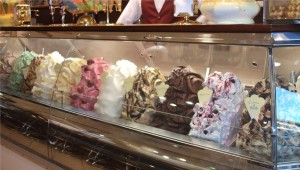
Consider the amount of time it takes for someone to carve mounds of
Nutella, vanilla or tutti fruitti gelato, into tempting, irresistible towering creations
decorated with fruit slices, nuts or plump, glistening blackberries and shiny
currants.gelateria

[Read more…]

Filed Under: Culture, Florence, Language, Lifestyle, Travel Tagged With: David, Duomo, Firenze, Florence, Ghiberti, italian travel, Melinda Rizzo, Michelangelo, Piazza Signoria, Uffizi Gallery

The Inner Italian Q & A: Melissa Muldoon

Posted December 3, 2009 by Sharon 16 Comments

One in an occasional series of Q & A profiles of  “wannabe” Italians


MelissaMuldoon
Melissa Muldoon is a freelance graphic designer living in the San Francisco Bay Area. Through her firm, Melissa Design, she creates graphics  for Web and print.  Raised in the Midwest, she studied studio art and history at Knox College. At the University of Illinois at Champaign, she worked as a teaching assistant and earned a Masters degree in Art History. Deciding she’d rather be “doing” art rather than “talking” about art, she pursued a career as a graphic designer. She is married to Patrick Muldoon and has three boys and a beagle. Her passion for art opened the door to Italy for her. During college she participated in a study abroad program in Florence and discovered a country full of history, culture and tradition, yet overflowing with contemporary style and quirky idiosyncrasies. Her love for art brought her “home” to Italy for the first time.

Q: Living “Italian”. . . Is it a great way to live or the greatest way to live?

A: Ma dai! Non c’e’ un modo migliore! Come on! There is no better way to live!  

Q: Why?

A: Let me just start off by saying I am a classic type A personality. I am impatient, competitive and a list maker. I don’t know what I like better, adding things to my “to do” list or checking them off.  I’m usually up late finishing a project or starting the next. I zoom from one appointment to the next and despise sitting in traffic or wasting time at stoplights. Now, while a type A lifestyle is great for getting things accomplished and moving ahead in life,  it may not be the sanest way to live.

Fortunately for me, I found Italy and discovered how to “live Italian.” Italy is my alter ego. It balances out my yin and yang. When I am in Italy, time slows down and I relax. I let go and go with the flow. My senses are reawakened and my creative side is nurtured and flourishes. I savor meals and notice things like the multi-colored marzipan pastries elegantly displayed in the panetterie and bars, or the wheels of cheese stacked up like oversized building blocks in the corner markets. I feel the cobblestones, worn and rounded by time, under my feet. I hear the clang of the church bells and the ronzare of the Vespa bikes. I meet the most interesting people, Italian locals and fellow travelers, and develop long lasting friendships.

Settimo Dalla Ricca escorts us through the Grana Padana Cheese factory in Mantova.

Settimo Dalla Ricca escorts us through the Grana Padana cheese factory in Mantova.

[Read more…]

Filed Under: Culture, Florence, Inner Italian Q & A, Language, Lifestyle, Travel Tagged With: Inner Italian, italian language, italian travel, Melissa Muldoon, www.melissadesign.com

  • « Previous Page
  • 1
  • …
  • 21
  • 22
  • 23
  • 24
  • 25
  • …
  • 29
  • Next Page »
Follow Simple Italy on FacebookFollow Simple Italy on RSS
Lasagne_19 Simple Italy's Greatest Hits at a click!
Lasagne alla Bolognese and more

Recent posts

  • The Hill Towns of Molise
  • Fior di Latte Cheese
  • In the Mood for Molise, Italy
  • Silk from the Sea in Sardinia
  • Driving a Ferrari Spider

Posts by Category

  • Abruzzo (12)
  • AirBnB (1)
  • Amalfi (8)
  • Archeology (3)
  • Architecture (21)
  • Art (19)
  • Artisans (4)
  • Automobiles (1)
  • Bakery (1)
  • Basilicata (3)
  • Bologna (4)
  • Books (21)
  • Calabria (4)
  • Campania (17)
  • Cooking Classes (5)
  • Cremona (2)
  • Culture (174)
  • dreamofitaly (1)
  • Driving in Italy (2)
  • Emilia Romagna (2)
  • Ferrari (1)
  • Ferrari Museum (1)
  • Film (22)
  • Florence (30)
  • Food (134)
  • Fred Plotkin (1)
  • Friuli-Venezia Giulia (2)
  • Gardening (25)
  • Genoa (2)
  • Golf in Italy (1)
  • Guides (1)
  • History (8)
  • Hotels (14)
  • Inner Italian Q & A (11)
  • Italian seafood (7)
  • Italy Artisans (3)
  • Italy restaurants (17)
  • Language (86)
  • Le Marche (4)
  • Lifestyle (113)
  • Liguria (2)
  • Lombardy cooking (5)
  • Lucca (3)
  • Mantua (1)
  • Markets (26)
  • Mediterranean diet (55)
  • Milan (1)
  • Miscellany (86)
  • Modena (1)
  • Molise (3)
  • Mt. Etna (1)
  • Music (9)
  • Naples (2)
  • New Orleans (2)
  • Opera (1)
  • Palermo (3)
  • People (3)
  • Photography (4)
  • Piedmont cooking (1)
  • Puglia (9)
  • Quotes (4)
  • Recipes (64)
  • Rome (8)
  • Salerno (3)
  • Sardinia (4)
  • Sicily (15)
  • Test Drive (1)
  • Testimonials (2)
  • Travel (110)
  • Trentino Alto-Adige (1)
  • Tuscan cooking (17)
  • Tuscany (30)
  • Venice (2)
  • Videos (2)
  • Wine (23)

Inside SimpleItaly

  • American Couple Marries Italian-Style
  • Appearances
  • Contact us
  • Cooking Up an Italian Life
  • Le Marche Tour with Luisa
  • Links
  • Palazzo Donati Sample Itinerary
  • Palazzo Donati Tours
  • Privacy and Site Policies
  • Publications and TV
  • Sharon’s Inner Italian
  • SimpleItaly Adventure in Tuscany Tour
  • Thank You
  • Walter’s Inner Italian

Tags

Abruzzo bucket list Florence Gardening gelato Genoa Inner Italian Italian cooking italian culture italian food Italian food stores italian language italian lifestyle italian markets Italian music Italian pasta recipe italian recipes Italian tourism italian travel italian wine Italy Italy travel Lago di Como Lake Como Malika Ayane Mediterranean diet mozzarella di bufala Naples tourism Paestum Paolo Conte porcini Puglia Rome Santa Croce Sardegna Sardinia Sicily Southern Italy Stile Mediterraneo Sulmona Tuscan cooking Tuscany Uffizi Gallery Villa Pipistrelli women and travel